







Argentina’s dramatic 2-1 win over England in the FIFA World Cup 2026 semifinal should have been remembered purely for the football. Instead, a post-match banner referencing the Falkland Islands has ignited a fresh diplomatic clash between Buenos Aires and London, dragging the decades-old sovereignty dispute back onto the world’s biggest sporting stage.
What Happened After the Argentina vs England World Cup Semifinal?
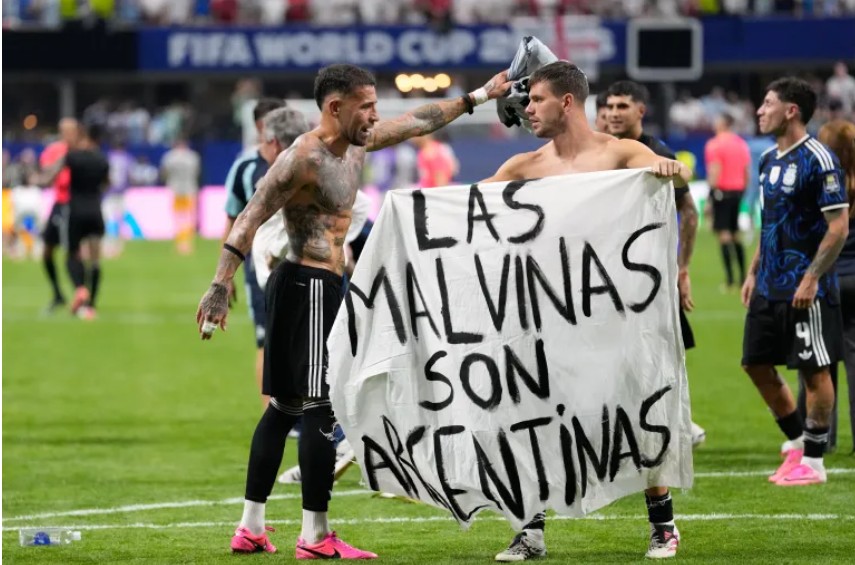
Following Argentina’s semifinal victory over England in Atlanta, several players celebrated on the pitch holding a banner reading “Las Malvinas son Argentinas” — Spanish for “The Falklands are Argentine.” Defender Lisandro Martínez and substitute Giovani Lo Celso were among those pictured with the banner, which was reportedly handed to them by fans before being laid out on the turf as the squad celebrated their place in the final.
The moment quickly went viral, reigniting one of football’s most politically sensitive rivalries just as the tournament reaches its climax.
Why Is the UK Government Angry About the Falklands Banner?
British Business Secretary Peter Kyle wasted no time reacting, calling the display an “egregious violation” of FIFA’s ban on political messaging at matches. He argued that keeping politics separate from football is one of the World Cup’s central principles, and urged FIFA’s disciplinary body to launch a full investigation into the incident.
A spokesperson for 10 Downing Street backed that call, delivering a pointed one-liner about the dispute: the World Cup trophy might not belong to England this year, but the Falkland Islands, they insisted, remain firmly British. The statement reaffirmed that self-determination for the islanders underpins the UK’s position, and that London’s commitment to the territory “will never waver.”
The Falklands War: A Quick History Lesson
To understand why a football banner triggered a diplomatic incident, it helps to revisit the 1982 Falklands War. Argentina’s military government invaded the British overseas territory in the South Atlantic that April, prompting Britain — then led by Prime Minister Margaret Thatcher — to send a naval task force to reclaim the islands. The 74-day conflict ended in June 1982 with Argentina’s surrender, but not before claiming the lives of 649 Argentine and 255 British service members, along with three Falkland Islanders.
Britain has administered the Falklands since the 19th century, while Argentina — which calls the archipelago “Las Islas Malvinas” — continues to claim historical sovereignty over the territory. A 2013 referendum saw the vast majority of islanders vote to remain a British overseas territory, a result Argentina has never recognised, insisting sovereignty should be settled through international negotiation rather than a local vote.
Has FIFA Responded to the Falklands Banner Incident?
As of this report, FIFA had not issued a public statement on the Atlanta incident, though the governing body’s disciplinary code explicitly prohibits political, ideological or offensive messaging at World Cup venues. This isn’t unprecedented territory for FIFA: Argentina’s federation was previously fined after players displayed a similar Falklands banner ahead of a warm-up friendly, and other national teams have faced sanctions for political gestures on the pitch, including a one-match ban handed to Spanish stars Rodri and Álvaro Morata in 2024 after they chanted about Gibraltar’s sovereignty. For the latest on the disciplinary process, FIFA’s official disciplinary updates can be tracked directly via FIFA.com.
Argentina’s Foreign Ministry Escalates the Row
The football controversy didn’t stay confined to the pitch. Argentina’s Foreign Minister lodged a formal diplomatic protest after reports emerged of a British warship, the HMS Medway, sailing near the Falklands around the same time. The minister condemned the patrol vessel’s presence as an “unconsulted and illegal” move, adding a naval dimension to a dispute that was already dominating headlines on both continents.
Why This Rivalry Runs Deeper Than Football
For Argentina, the “Las Malvinas son Argentinas” slogan is more than a protest chant — it’s tied closely to national identity and a decades-long grievance over lost territory. For Britain, the islanders’ right to self-determination remains the cornerstone of its position. Every time the two nations meet on a football pitch, especially at a tournament as high-profile as the World Cup, that unresolved history resurfaces.
The United Nations has repeatedly urged both countries to resolve the sovereignty question through dialogue, but nearly 44 years after the war ended, neither side has budged from its position — meaning incidents like this one are unlikely to be the last time football and geopolitics collide.
What Happens Next?
All eyes now turn to FIFA’s disciplinary committee to see whether Argentina’s federation or individual players face fines or bans ahead of the World Cup 2026 final. Given the precedent of prior Falklands-related sanctions, some form of disciplinary action looks likely — though a full ban for the final appears improbable given the scale of the tournament.

Economic Affair
- Budhigandaki Flood: 47 Rescued as Bridges Washed Away
- Nepal Supreme Court Handcuff Order: Police Barred From Routine Use
- 250+ Officials Deploy to Assess Rasuwa-Bhotekoshi Flood Damage
- Electricity VAT: Energy and Finance Ministers Strike Landmark Deal After Just 2 Months
- Nepal Inflation Shockingly Triples to 5.96% — Food and Transport Hit Hardest



Comments