




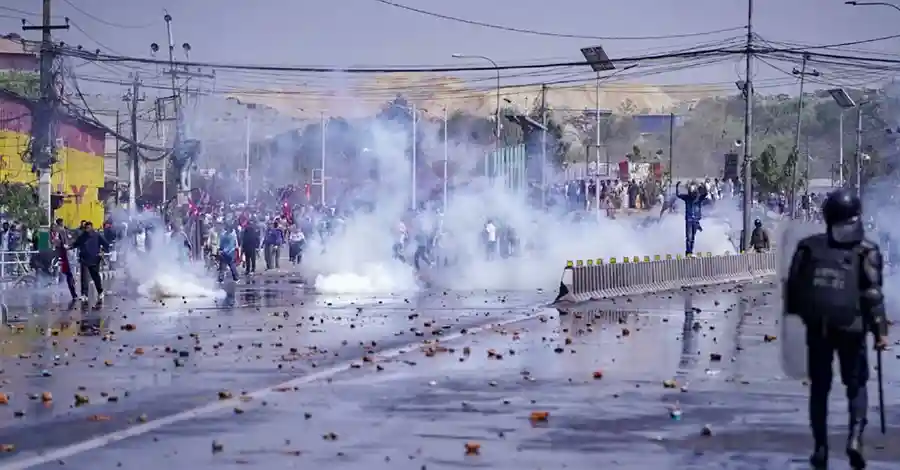
Human Rights Watch (HRW) released a damning investigation report revealing that Nepali security forces used disproportionate and lethal force against predominantly young protesters during the September 2025 Gen-Z demonstrations. The US-based advocacy organization found that police in Kathmandu indiscriminately opened fire on protesters multiple times over three hours on September 8, killing 17 people who had been demonstrating against political corruption and a sweeping social media ban.
The comprehensive investigation, based on interviews with 52 eyewitnesses, victims, journalists, health workers, politicians, and security officials, paints a troubling picture of security forces targeting peaceful demonstrators—some still wearing school uniforms—with military-grade weapons at close range without adequate warning or justification.
This marks one of the deadliest incidents of state violence against civilian protesters in Nepal’s recent history, raising urgent questions about accountability, police reform, and the government’s commitment to protecting fundamental rights.
Five Critical Failures: HRW’s Key Findings
1. Inadequate Crowd Assessment and Preparation
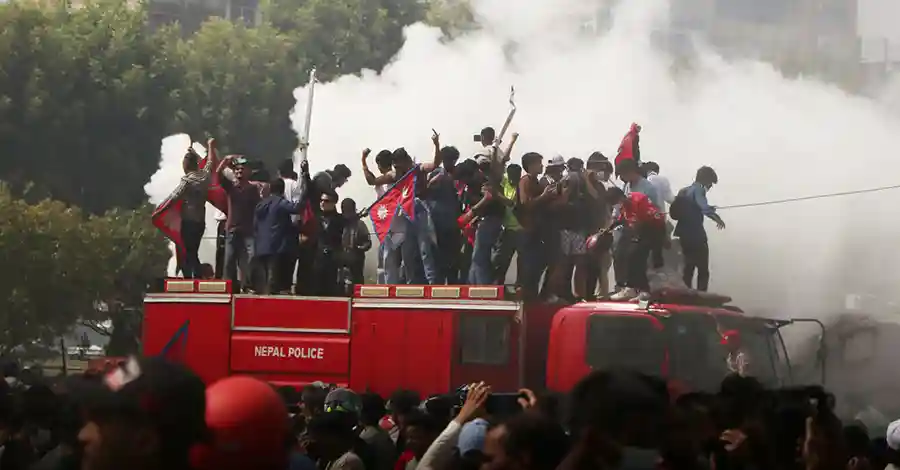
HRW’s investigation identified a fundamental failure in crowd management from the outset. Despite social media platforms—particularly Discord—mobilizing thousands of participants in the days leading up to September 8, security forces dramatically underestimated the protest size and failed to implement appropriate crowd control measures.
A retired police officer familiar with operations told researchers that authorities miscalculated the expected turnout and lacked advance intelligence. Only a single barricade was positioned on the main road leading to Parliament, allowing protesters to access the area through multiple alternative routes and side streets.
“That was a major mistake,” the officer stated, suggesting that with proper preparation, the demonstration could have been managed without resorting to lethal force. This intelligence failure represents the first link in a chain of events that ultimately resulted in preventable deaths.
2. Absence of Standard Crowd Control Protocols
The investigation found that police violated basic crowd management procedures outlined in both Nepali law and international standards. Most critically, security forces failed to provide adequate warnings before deploying lethal force.
The government declared a curfew at approximately 12:30 PM, but protesters and journalists received no notification. Remarkably, police began firing just five minutes after the curfew announcement—far too quickly for demonstrators to disperse even if they had been aware of the order.
According to UN standards, law enforcement may use lethal weapons only when facing imminent threats to life, and even then must issue clear warnings beforehand. Nepal’s domestic laws contain similar provisions, yet the investigation found systematic non-compliance with these requirements.
One eyewitness reported that “we heard no warning before they started shooting.” This pattern repeated throughout the three-hour period of intensive firing.
3. Lethal Force Without Imminent Threat
Perhaps most damning, HRW concluded that security personnel used deadly force even when their own lives were not in immediate danger. The report states: “The research does not show there was a serious and immediate crisis that would justify such lethal force.”
Video footage and eyewitness testimony reveal police fired from behind ambulances and barricades, suggesting they occupied protected positions rather than facing direct life-threatening attacks. In multiple instances, demonstrators were shot while fleeing, with bullets striking victims in the back—clear evidence they posed no immediate threat.
Pathologists at a Kathmandu morgue that received 47 bodies over two days determined that 35 deaths resulted from high-velocity gunshot wounds to the head, neck, chest, or abdomen—areas that maximize lethality and indicate officers aimed to kill rather than incapacitate.
The targeting of vital organs contradicts principles of proportionate force, which require security personnel to minimize harm even when force is justified.
4. Minimization of Harm Ignored
International policing standards require that even when force becomes necessary, officers must employ the minimum force needed to achieve legitimate objectives. HRW found Nepal’s security forces violated this principle systematically.
Police used military rifles at extremely close range—in some cases just three to seven meters from protesters—dramatically increasing the likelihood of fatal injuries. At such distances, high-velocity rounds cause catastrophic tissue damage far exceeding what’s necessary for crowd dispersal.
One 20-year-old victim described attempting to leave the area when two people died, only to be shot in the back while departing. “There was no strategy to reduce harm,” the victim stated. “They were shooting wildly at heads, shoulders, and chests.”
The case of 17-year-old Shreyam Chaulagain exemplifies this reckless disregard. Video analysis shows him walking toward Parliament in his school uniform, hands above his head, clapping peacefully. Suddenly, gunfire erupts; his head drops, and he collapses. Subsequent footage shows fellow protesters carrying his body while trying desperately to staunch blood flowing from his head. He did not survive.
5. Security Vacuum on Day Two Enabled Widespread Violence
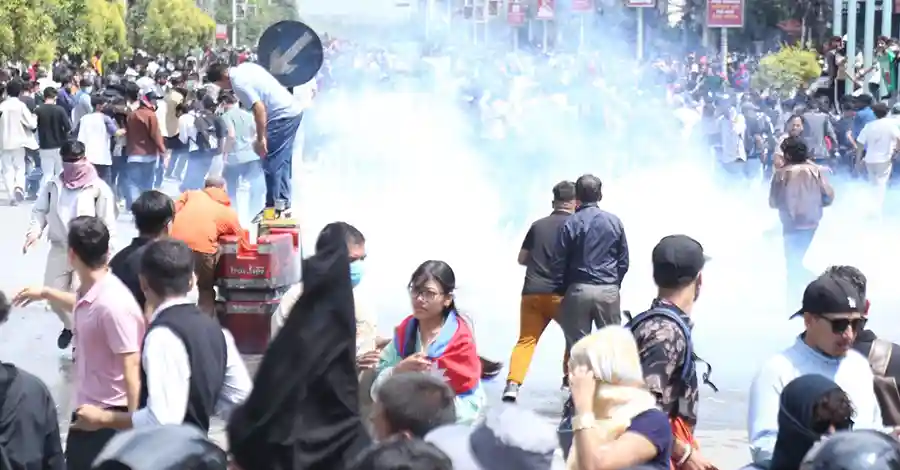
While HRW’s primary focus centers on police misconduct on September 8, the investigation also examined the chaos that engulfed Kathmandu on September 9. The rights body stated that unrest sparked a second day of violence, yet security forces appeared to fail to act when groups of people, some apparently not linked to the Gen-Z protest, set fire to prominent government buildings and assaulted politicians, journalists, and others.
This security failure resulted in attackers storming police stations, looting weapons, killing three officers, and setting fire to the Supreme Court, Parliament, Singha Durbar (the administrative headquarters), schools, media outlets, and private properties. Thousands of prisoners escaped from detention facilities. At least 76 people were killed over both days, including a 12-year-old child and at least 19 young students.
HRW concluded that while some September 9 violence represented spontaneous public anger, other attacks showed signs of planning and coordination by groups unaffiliated with the original Gen-Z movement. Witnesses reported seeing organized gangs carrying sticks, machetes, and kerosene arriving at specific targets, suggesting infiltration by criminal elements or political actors.
For comprehensive human rights monitoring, visit Human Rights Watch.
Medical Evidence: Hospitals Overwhelmed with Gunshot Victims
Casualty Statistics Paint Grim Picture
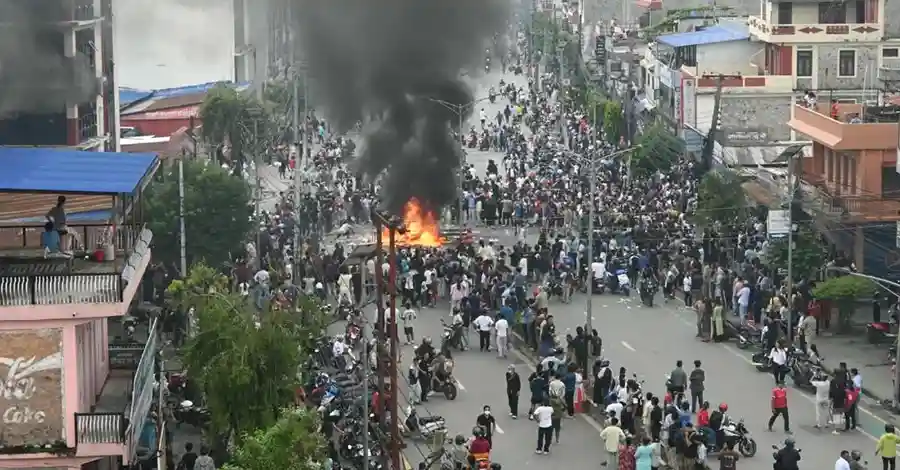
The medical response to September 8 revealed the scale of police violence. Civil Hospital in Kathmandu treated 221 injured individuals that day alone, three of whom died from their wounds despite emergency care. The Trauma Center received eight critical patients, several already deceased upon arrival.
An additional 73 injured protesters sought treatment at the Trauma Center, while Teaching Hospital, located further from the protest site, admitted 30 gunshot victims. Hundreds more received treatment at private facilities or never sought medical care due to fear of arrest.
The concentration of injuries to the head, neck, chest, and abdomen—areas where vital organs are located—provides forensic evidence that police aimed to inflict maximum damage rather than employing less-lethal alternatives.
Police Violence Extended to Medical Facilities
In a particularly egregious violation of medical neutrality, security forces deployed tear gas inside Civil Hospital where injured protesters were receiving treatment. This action not only endangered patients but violated international humanitarian principles protecting medical facilities and personnel during conflicts.
Such behavior suggests a deliberate strategy to deny protesters access to medical care—a tactic that transforms potentially survivable injuries into fatal ones and may constitute a separate category of human rights abuse.
The Protest Context: From Online Movement to Street Confrontation
Social Media Ban Sparked Mass Mobilization
The protests began following a nationwide ban on numerous social media platforms including YouTube, Facebook, and WhatsApp on September 4, 2025. The government justified the ban by claiming platforms failed to register with authorities for tax and regulatory purposes.
However, critics immediately recognized the ban as censorship aimed at silencing the “Nepo Baby” movement—a social media campaign exposing the lavish lifestyles of politicians’ children and relatives. Gen Z users tracked accounts of ultra-rich politicians’ children on Instagram, TikTok, and Facebook, sharing images of high-end European vacations, shopping for designer brands like Louis Vuitton and Prada, and stays in family properties worth billions.
For Nepal’s youth, where the unemployment rate for those aged 15-24 was 20.82% in 2024 and more than 1,500 adults leave the country every day searching for work, such displays of inherited wealth amid widespread poverty proved intolerable. The social media ban transformed online frustration into street mobilization.
Discord Became Organizational Hub
Thousands of young Nepalis coordinated through Discord servers, with the Hami Nepal organization’s server growing to over 100,000 members. The platform enabled real-time coordination, strategic planning, and democratic decision-making that traditional protest movements struggle to achieve.
Initially, organizers emphasized peaceful demonstration. Plans included presenting flowers to police and conducting orderly marches. However, the government’s heavy-handed response transformed what might have remained a peaceful expression of discontent into a violent confrontation.
Learn more about protest rights from the International Center for Not-for-Profit Law.
September 8: Hour-by-Hour Breakdown of Violence
Morning: Peaceful Gathering Grows
Around 9:00 AM, protesters began assembling at Maitighar, a traditional gathering point for demonstrations in Kathmandu. By 11:00 AM, journalist Sahana Vajracharya described seeing ‘a sea’ of protesters, many in school uniforms, marching toward Parliament.
The massive turnout exceeded anything security planners had anticipated. Young people, some as young as 12 years old, joined university students, recent graduates, and working-age adults frustrated by endemic corruption and lack of opportunity.
Initially, interactions between protesters and police remained relatively calm. Some demonstrators even attempted to engage officers in dialogue about their concerns. However, tensions escalated as the crowd pressed against the single barricade near Hotel Everest.
12:30 PM: Curfew Declared, Firing Begins Almost Immediately
The District Administration Office declared a curfew at 12:30 PM, but the announcement never reached protesters or journalists on the ground. Just five minutes later—far too quickly for peaceful dispersal—police opened fire with live ammunition.
“We were near Parliament when they fired metal bullets,” one injured protester recalled. “Some of our friends may have thrown stones, but they responded with gunfire.” The distance between police and protesters at that moment was approximately seven meters—close enough that protesters could clearly see officers taking aim.
1:00 PM – 4:00 PM: Three Hours of Sustained Firing
Over the next three hours, police fired repeatedly into crowds with military rifles. Video evidence analyzed by HRW shows officers positioned behind ambulances and barriers, systematically targeting demonstrators.
One particularly disturbing pattern emerged: protesters shot while fleeing had entry wounds in their backs, proving they posed no threat when killed. A teenage girl shot around 1:45 PM reported that the situation was calm when she was hit—no violence was occurring at that moment.
The firing intensified rather than de-escalated over time. What began as sporadic shots evolved into sustained barrages. Witnesses described bullets “whizzing past” continuously, forcing people to crawl behind obstacles or remain prone on pavement.
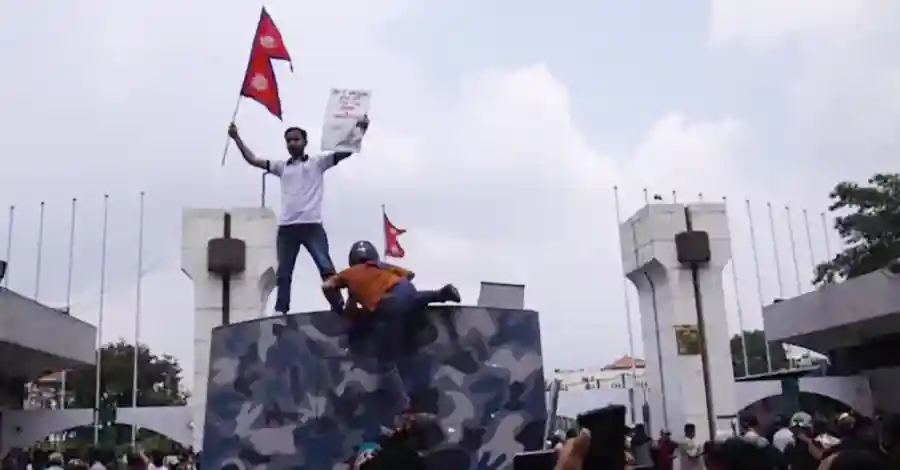
Around 3:00-3:30 PM, a protester attempted to rally the crowd to approach Parliament more directly. Shortly after, demonstrators climbed onto an army truck near the gate. In response, police unleashed a particularly intense volley of gunfire at point-blank range from approximately three meters away.
“They aimed directly at us and started shooting,” eyewitnesses reported. The deliberate aiming contradicts any suggestion of warning shots or crowd-dispersal tactics—this was direct engagement with intent to injure or kill.
The Case of Dipendra Basnet: Symbolic of Excessive Force
Dipendra Basnet scaled a police barricade during the protests. Video footage shows him being shot, collapsing with blood streaming from his head. Unlike many victims, Basnet survived, but his case illustrates police willingness to use potentially lethal force against unarmed individuals engaged in acts of civil disobedience that, while illegal, posed no immediate mortal threat to officers.
Second Day Catastrophe: Targeted Attacks and Security Collapse
From Protest to Chaos
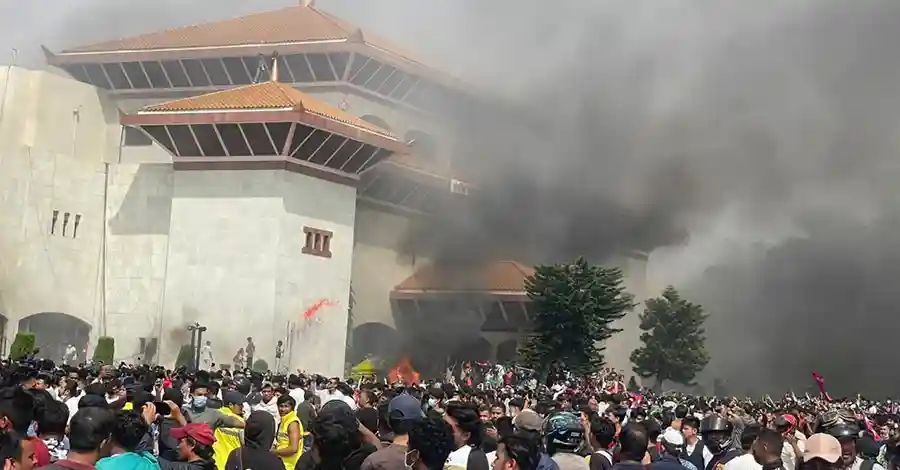
On September 9, protesters attacked police stations, looted weapons, and three police officers were killed in mob attacks. The violence represented both spontaneous reactions to the previous day’s killings and organized attacks by groups with specific targets.
HRW’s investigation concluded that the second day’s violence differed fundamentally from September 8’s demonstrations. While the initial protest was youth-led and focused on anti-corruption demands, September 9 saw participation by diverse actors with varying motivations.
Selective, Coordinated Attacks
The pattern of destruction reveals troubling sophistication. Attackers struck specific locations—the homes of politicians, certain media outlets, particular schools—while leaving adjacent properties untouched.
“The attacks were very targeted,” a businessman told HRW researchers, noting that neighboring businesses remained unscathed even as selected targets burned.
At 11:30 AM, assailants raided a housing complex at Hariside, disabled security cameras, and attacked a state minister’s residence. Later, organized groups carrying sticks, machetes, and kerosene converged on Kanti pur Television, Kantipur newspaper offices, and Annapurna Post.
Around noon to 1:00 PM, “extremely aggressive groups with crowds” began arriving at key government sites. Eyewitnesses reported seeing 10-15 armed individuals leading groups toward Singha Durbar.
By that time, prisoners had already escaped detention facilities and weapons had been looted from police stations. When the armed groups reached Singha Durbar, photographers were threatened not to take pictures.
HRW characterized these as “biker gangs” carrying machetes and iron rods who extracted fuel from motorcycles to create fire-bombs used to set the main building ablaze.
Security Forces Conspicuously Absent
Throughout September 9, security forces remained largely invisible despite widespread destruction. Several witnesses questioned why security forces did not intervene decisively as arson spread across the city, failing to protect individuals and properties under attack.
The Bhatbhateni supermarket fire, where six people burned alive and dozens more died, exemplifies this security vacuum. Had police or army units been positioned to protect critical infrastructure and civilian lives, many September 9 deaths could have been prevented.
HRW noted that whether the security absence resulted from tactical withdrawal, lack of coordination, or deliberate policy remains unclear. However, the consequence was unmistakable: civilian casualties and property destruction that might otherwise have been avoided.
Questions About Infiltration and Political Manipulation
Eyewitnesses and analysts quoted in the HRW report suggested various political groups and infiltrators participated in September 9 violence. The organized nature of certain attacks, the targeting of specific media outlets and political figures, and the sophistication of some operations point toward planning beyond spontaneous mob action.
“If there are credible allegations of criminal activity, they must be investigated,” HRW stated, calling for authorities to examine whether political actors orchestrated violence to discredit the Gen-Z movement or advance factional interests.
Accountability Gap: 423 Protesters Arrested, Zero Officers Charged
Selective Enforcement Raises Concerns
As of November 10, Nepal’s police had arrested 423 people allegedly involved in the violence on September 9, but had not taken action against officers who unlawfully opened fire on protesters on September 8.
This disparity in accountability strikes at the heart of rule-of-law principles. While civilian violence and property destruction certainly warrant investigation and prosecution, so too does excessive use of lethal force by state security personnel.
The failure to discipline or prosecute any officers involved in September 8 shootings sends a dangerous message: security forces operate above the law, immune from consequences regardless of how disproportionate or unlawful their actions.
The Impunity Problem in Nepal
HRW’s analysis connects current failures to Nepal’s long history of impunity for state violence. “The authorities should recognize that widespread impunity for human rights violations in the past helped enable the violence that occurred this time in Nepal,” stated Meenakshi Ganguly, HRW’s deputy Asia director.
Nepal’s decade-long armed conflict (1996-2006) left thousands dead, disappeared, or tortured. Yet prosecutions of security personnel or Maoist combatants for conflict-era crimes remain virtually non-existent. Truth and reconciliation mechanisms established after peace agreements have proven ineffective, with victims still waiting for justice nearly two decades later.
This pattern extends to other incidents of state violence against protesters. Past demonstrations that resulted in deaths or injuries rarely led to accountability, creating a precedent that security forces need not fear consequences for excessive force.
“It is crucial to reverse the decades-long tendency by successive governments in Nepal to bury investigations and stall prosecutions,” Ganguly emphasized.
Investigation Commission: Hopes and Skepticism
Interim Government Forms Inquiry Panel
Following the protests and Prime Minister K.P. Sharma Oli’s resignation, interim Prime Minister Sushila Karki’s government formed a high-level investigation committee to investigate the deaths of 76 people nationwide over two days of violence.
The commission’s success will determine whether Nepal breaks its cycle of impunity or reinforces it. HRW outlined clear requirements for credible investigation:
Independence: The commission must operate free from political interference or pressure from security establishments
Transparency: Proceedings, evidence, and findings should be accessible to the public
Comprehensiveness: Investigation must examine both police conduct on September 8 and violence on September 9, including potential infiltration by political actors
Time-bound: Delays serve only to diminish public confidence and allow evidence to deteriorate
Accountability: Findings must lead to appropriate discipline or prosecution regardless of suspects’ rank or political connections
International Pressure and UN Peacekeeping
Nepal is the largest contributor to UN peacekeeping operations, deploying thousands of police and military personnel to missions worldwide. HRW called on UN Peacekeeping to make clear that no officers or units implicated in abuses on September 8 will be eligible for future peacekeeping missions.
This leverage provides international partners with concrete means to encourage accountability. If Nepal wishes to maintain its lucrative peacekeeping role—which generates significant revenue and provides valuable experience for security forces—it must demonstrate commitment to human rights standards domestically.
“Unless the government takes serious action in response to the September 8 killings, UN Peacekeeping should start to reassess its relationship with Nepal,” Ganguly stated.
For more on international human rights standards, visit the Office of the UN High Commissioner for Human Rights.
Broader Context: Youth Frustration and Systemic Corruption
Economic Desperation Fuels Anger
The Gen-Z protests didn’t emerge from nowhere. They represent accumulated frustration over economic stagnation, political corruption, and lack of opportunity that characterize young Nepalis’ lived reality.
Nepal is ranked 143rd globally in the Human Development Index (2024), with youth unemployment at 20.82% and more than 1,500 adults leaving daily for work abroad. 33% of Nepal’s GDP comes from remittances, while the median age is just 25, meaning much of the population belongs to the age cohort most affected by economic dysfunction.
Young Nepalis watch their parents take dangerous, low-paying jobs abroad—with over 700 workers dying annually in foreign employment—while politicians’ children flaunt inherited wealth on social media. This stark inequality, combined with pervasive nepotism that blocks meritocratic advancement, created a powder keg requiring only a spark.
The social media ban provided that spark, transforming online frustration into street mobilization.
“Nepo Baby” Movement Exposed Elite Excess
Before September, the #NepoBaby and #NepoKids campaigns dominated Nepali social media. Young users systematically documented how politicians’ relatives enjoyed luxuries unimaginable to average citizens: designer shopping sprees in Europe, billion-rupee family properties, prestigious positions despite minimal qualifications.
These revelations made abstract corruption concrete and personal. They transformed statistics about embezzlement into visual evidence of how stolen public funds fund private excess.
When the government banned social media platforms ostensibly for tax compliance, few believed the official explanation. The timing—immediately following peak Nepo Baby momentum—suggested an attempt to silence embarrassing revelations and suppress growing demands for accountability.
Looking Forward: Can Nepal Break the Cycle?
Reform Requirements
For Nepal to move beyond this crisis, several fundamental reforms must occur:
Security Sector Reform: Police training must emphasize proportionate force, crowd management without lethal weapons, and accountability for misconduct
Anti-Corruption Action: Tangible prosecution of high-level corruption cases, asset recovery, and systemic reforms to reduce opportunities for graft
Economic Opportunity: Policies addressing youth unemployment, reducing forced migration, and creating domestic opportunities
Political Accountability: Electoral and governance reforms limiting nepotistic advantages and ensuring merit-based advancement
Judicial Independence: Strengthening courts’ ability to hold powerful actors accountable without political interference
Media Freedom: Protecting journalists’ ability to investigate and report on government conduct without censorship or retaliation
The Stakes for Nepal’s Democracy
“Nepal is at a crossroads,” HRW emphasized. The country can either build on its post-2006 democratic gains or slide backward into authoritarian patterns where state violence against dissent becomes normalized.
The investigation commission’s work will prove pivotal. A credible, thorough investigation leading to appropriate accountability would signal that rule of law applies equally to security forces and citizens. Conversely, another whitewash would confirm that impunity remains entrenched and that meaningful reform is impossible within existing structures.
Conclusion: Justice Delayed is Justice Denied
The Human Rights Watch investigation provides comprehensive documentation that Nepali security forces used excessive, unjustified lethal force against predominantly peaceful, young protesters on September 8, 2025. Seventeen people died during three hours of indiscriminate police firing, with hundreds more injured.
The following day’s chaos, while including violent elements requiring accountability, must be understood partly as reaction to the previous day’s killings and partly as opportunistic attacks by elements unconnected to the original Gen-Z movement.
“The recent violence in Nepal included serious human rights violations, and those responsible should be held accountable, whether they are security forces or political actors,” said Meenakshi Ganguly. “The government should ensure that investigations are independent, time-bound, and transparent, and that no one found responsible for breaking the law is unfairly protected from proper prosecution.”
For Nepal’s young generation—who organized, demonstrated, and died demanding integrity, transparency, and opportunity—justice requires more than symbolic gestures. It requires prosecutions where evidence warrants, disciplinary action against officers who violated protocols, systemic reforms preventing recurrence, and genuine efforts to address the corruption and economic dysfunction that sparked protests in the first place.
The world is watching whether Nepal can deliver that justice, or whether impunity will once again prevail.

Economic Affair
- Budhigandaki Flood: 47 Rescued as Bridges Washed Away
- Nepal Supreme Court Handcuff Order: Police Barred From Routine Use
- 250+ Officials Deploy to Assess Rasuwa-Bhotekoshi Flood Damage
- Electricity VAT: Energy and Finance Ministers Strike Landmark Deal After Just 2 Months
- Nepal Inflation Shockingly Triples to 5.96% — Food and Transport Hit Hardest



Comments