





How much sacrifice can one police officer make in pursuit of justice? How many years can someone dedicate to hunting down a single criminal gang? What personal losses must they endure? And after all that sacrifice, will their dedication even be recognized? These are the haunting questions at the heart of Theeran Adhigaaram Ondru (2017), a gripping Tamil action thriller that stands as one of Indian cinema’s most realistic and intense cop dramas.
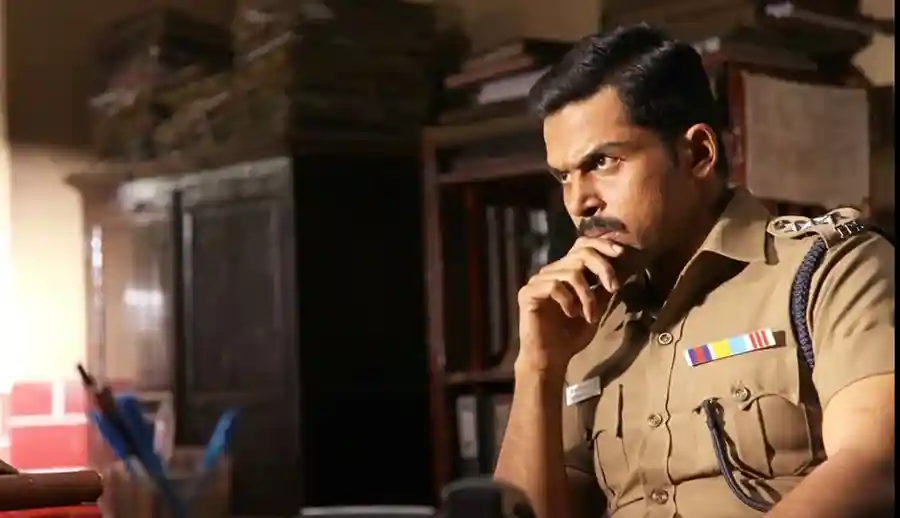
Directed by H. Vinoth and starring Karthi in a career-defining performance, this film is based on the real-life Operation Bawaria case that involved tracking down organized dacoit gangs terrorizing Tamil Nadu during the late 1990s and early 2000s. The movie follows DSP Theeran Thirumaran, a character modeled on Tamil Nadu Director General of Police S. R. Jangid, who led a special team to track down the main criminals involved in dacoity.
Unlike typical Bollywood or Kollywood masala cop films where the hero possesses superhuman abilities, Theeran presents a refreshingly realistic portrayal of police investigation work—methodical, frustrating, dangerous, and often thankless. The film earned an impressive 8.2/10 rating on IMDb and was ranked among the best Tamil films of 2017 by major publications including The Hindu, The Indian Express, and Firstpost.
This isn’t just another action movie—it’s a masterclass in procedural thriller filmmaking that will keep you on the edge of your seat for its entire 157-minute runtime.
The Opening: A Cold Case Resurfaces After Years
The File That Changes Everything
The film begins with a scene from a police station where police officer Sasi orders that documented criminal cases in the form of manuscripts be converted into digital format. During this process, he comes across a really spine-chilling dacoity murder case from several years ago. The shocking details of this case compel him to reach out to the officer who handled it—DSP Theeran Thirumaran.
This framing device immediately establishes the film’s documentary-like approach, grounding the narrative in reality rather than cinematic fantasy. When Sasi calls Theeran, now relegated to a desk job in the Traffic Vigilance Department, the story flashes back to 1995-1999, where Theeran’s extraordinary journey began.
The opening sets up a crucial theme: exceptional police work often goes unrecognized. Despite solving one of Tamil Nadu’s most horrific crime cases, Theeran ends his career behind a desk with a rickety chair that hasn’t been replaced in months—a bitter commentary on bureaucratic indifference to genuine heroism.
Plot Summary: The Hunt for Shadow Killers
From Police Academy to Personal Mission
The story shifts to 1999, where Theeran is in his police training college undergoing training to be posted as DSP from TNPSC (Tamil Nadu Public Service Commission) exams. He tops the training period. Unlike his colleagues who cite Tamil cinema as their investigative inspiration, Theeran emphasizes observation, analysis, and evidence-based policing.
After graduating, Theeran returns to his hometown of Thanjavur, falls in love with his neighbor Priya (Rakul Preet Singh), and marries her. Meanwhile, a horrifying pattern emerges across Tamil Nadu’s highways—families are being brutally murdered in their homes by shadow-like figures who appear at night, commit unspeakable atrocities, steal everything of value, and vanish without a trace.
These aren’t ordinary thieves. The dacoits kill indiscriminately—children, elderly, everyone—with a brutality that shocks even hardened police officers. Simultaneously in houses along the highway of Tamil Nadu, groups of dacoits wreck houses by barging in, killing all the people inside gruesomely, and taking the belongings.
The Impossible Investigation
Later Theeran becomes known in the police department for his ways of handling various cases and he is later moved to Ponneri after a dacoital attack. Along with Police Inspector Satya (Bose Venkat), Theeran begins investigating the dacoity cases but finds virtually no evidence—no witnesses survive, no fingerprints remain, and the perpetrators seem to evaporate into thin air.
What makes the investigation even more frustrating is the realization that these attacks aren’t isolated to Tamil Nadu. Similar patterns emerge across multiple Indian states, suggesting a vast, coordinated criminal network operating with impunity across state borders.
In 2003, Theeran, Sathya, and a group of other police officers go around India to see if they are able to identify the fingerprints of the dacoits. During this process, Theeran learns that these dacoits are actually tribe members of leftover cultural groups after Indian Independence. This revelation adds a complex sociological dimension—these aren’t random criminals but members of historically marginalized communities who have turned to organized crime spanning generations.
For insights into Indian cinema, visit IMDb’s Indian Film Section.
The Breakthrough: When Politicians Become Victims
Power Opens Doors That Justice Cannot
The case that had been languishing for years suddenly receives urgent priority when the dacoits make a fatal miscalculation. In 2003, the dacoits raid the house of the ruling party’s MLA and kill him. The government comes under heavy pressure from the public, and the Home Minister gives Theeran all powers and a full team to nab the dacoits.
This bitter reality—that cases only receive resources when powerful people are affected—adds a layer of social commentary to the thriller narrative. Dozens of ordinary families had been slaughtered without generating this level of response, but one politician’s death instantly transforms the investigation’s priority.
Armed with new authority and resources, Theeran assembles a specialized team and intensifies the hunt. The investigation takes them across India as they painstakingly piece together evidence that conventional policing had failed to gather.
The Personal Becomes Painfully Personal
A year later, they find one fingerprint match in Uttar Pradesh prison and go to a lorry station to capture the dacoit. Learning that the lorry has left and is heading to Ponneri, Theeran and the other officers rush to stop them. But they arrive too late.
In the film’s most devastating sequence, the dacoits raid Sathya’s house, killing his wife and eventually injuring Priya, putting her in a coma. This attack transforms the investigation from professional duty into personal vendetta. Theeran must now balance his commitment to justice with the anguish of his wife lying in critical condition.
The emotional stakes elevate dramatically as Theeran faces an impossible choice: abandon the case to be with his dying wife, or continue the hunt knowing she might not survive. This internal conflict humanizes the character beyond the typical tough cop archetype.
The Showdown: Into the Desert Badlands
Tracking Oma Singh to Rajasthan
Angered by this incident, Theeran, with the help of higher officials, puts together a team to capture the gang of dacoits led by Oma (Abhimanyu Singh). They camp in Rajasthan with the help of a local police officer.
The Rajasthan sequences provide the film’s most visually striking moments. In a seminal scene, DSP Theeran storms into a den of outlaws in the badlands of Rajasthan. He advises his team to stay inside the car as he walks on purposefully through the dusty hamlet—it’s the territory of Omah Singh, a much-feared highway dacoit.
This confrontation exemplifies the film’s approach to heroism—not as superhuman stunts but as calculated courage. Theeran walks into enemy territory not because he’s invincible but because investigation has left him no other choice. The sequence crackles with tension as dust motes ripple in the desert air and the entire village watches this outsider challenge their feared leader.
The Village Siege
They come to know that the gang members except Oma are in their village, so they visit the village only to be sent out by the villagers. This rejection by the community protecting the criminals underscores the complexity of the situation—these dacoits aren’t merely criminals but part of tribal networks with deep local roots.
While the case is ongoing, Theeran learns that Priya has gone into a critical state and an operation is required. This fuels Theeran’s anger, which makes him even more motivated to find Oma. The personal and professional crises converge, pushing Theeran to increasingly desperate measures.
The cat-and-mouse game between Theeran and Oma intensifies as both men prove equally determined and resourceful. Theeran captures the organizer of the gang and captures one of the gang members, putting them in police custody. Infuriated, Oma vows to kill Theeran and his team.
For Tamil cinema reviews, explore Film Companion South.
The Climax: Victory at What Cost?
The Train Chase and Village Massacre
Theeran gets information that Oma will be on a train which is infiltrated by the team, but Oma escapes to a nearby village. Theeran and his team walk to the village and reside there for the night. What follows is one of Indian cinema’s most harrowing action sequences.
Oma’s gang infiltrates the village, destroying it and killing Theeran’s teammates. The violence is brutal and unflinching, refusing to romanticize the cost of police work. Theeran watches his colleagues—men who had become brothers through years of investigation—fall one by one in the darkness.
This sequence distinguishes Theeran from typical action films. There’s no slow-motion heroics or triumphant background score—just chaos, terror, and devastating loss. The film forces viewers to confront the genuine sacrifices required in pursuing dangerous criminals.
Justice Served, Life Destroyed
Finally, Theeran captures Oma, brings him to Tamil Nadu, and gets him a death sentence. The victory, however, is pyrrhic. The professional success can’t compensate for personal tragedy.
Now in 2017, it is revealed that Theeran has a boring useless post in the Traffic Vigilance Department because he is straightforward and lives alone after the death of Priya. Despite solving one of Tamil Nadu’s most significant criminal cases, Theeran’s integrity made him inconvenient to bureaucratic machinery, resulting in his relegation to a meaningless position.
The ending refuses easy closure. Theeran succeeded professionally but lost everything personally—his wife, his friends, his career trajectory. When young officer Sasi visits to salute him, Theeran’s eyes still carry “that old glint of uprightness,” suggesting that despite everything, he would make the same choices again.
The movie ends with a note conveying “The film is dedicated to all the people in the police department who fought and arrested those dacoits, and we thank them for their bravery and courage”.
Performance Analysis: Karthi’s Career-Defining Role
Beyond the Typical Kollywood Hero
Karthi plays the titular character Theeran, modeled on Tamil Nadu Director General of Police S. R. Jangid, delivering what critics universally praise as his career-best performance. Unlike the larger-than-life heroes typical in Tamil cinema, Karthi portrays Theeran with restraint and authenticity.
Karthi described his character as “an upright cop who goes about his work in a tactful manner” rather than the bombastic types who “can reprimand anyone he wants”. This approach creates a believable protagonist whose intelligence and dedication, rather than superhuman abilities, drive the investigation forward.
Physical and Emotional Transformation
Karthi underwent significant physical preparation for the role, particularly for the grueling sequences shot in Rajasthan’s desert. The actor’s commitment shows in scenes requiring both physical action and emotional depth—from the anguish of his wife’s condition to the determination during investigation to the exhaustion of years-long pursuit.
In late 2019, Film Companion ranked Karthi’s performance in Theeran among the ‘100 Greatest Performances of the Decade’, testament to the role’s impact on Tamil cinema.
The Ensemble Strength
Abhimanyu Singh as Oma: Singh creates a genuinely terrifying antagonist without resorting to caricature. His Oma is intelligent, ruthless, and motivated by complex historical grievances rather than mere villainy.
Bose Venkat as Satya: Provides emotional grounding as Theeran’s partner and friend, whose personal tragedy mirrors the film’s central theme about the cost of duty.
Rakul Preet Singh as Priya: While critics note the romantic subplot as the film’s weakest element, Priya’s fate becomes the emotional anchor driving Theeran’s determination.
Learn about Tamil cinema history at Britannica’s Tamil Cinema Overview.
Direction and Technical Brilliance
H. Vinoth’s Meticulous Research
Director H. Vinoth spent years researching the Operation Bawaria case, meeting many police officers who handled similar cases before scripting the film. This extensive preparation shows in the film’s attention to investigative procedure and realistic portrayal of police work.
Vinoth’s approach emphasizes authenticity over spectacle. Rather than glorifying violence, he presents it as disturbing and consequential. The director’s previous work, Sathuranga Vettai (2014), demonstrated his skill with intricate plotting, and Theeran showcases his evolution as an action filmmaker without sacrificing narrative complexity.
Ghibran’s Haunting Score
Music director Ghibran’s background score deserves special mention for creating the film’s oppressive atmosphere. The score for dacoit sequences particularly stands out, accentuating their bestiality without becoming gratuitous.
Rather than traditional heroic themes, Ghibran employs dissonant, tension-building compositions that keep viewers on edge. The music doesn’t announce action scenes with bombast but instead amplifies dread and danger.
PS Vinod’s Cinematography
Cinematographer PS Vinod captures stark contrasts between Tamil Nadu’s verdant landscapes and Rajasthan’s harsh deserts, visually representing Theeran’s journey from comfortable normalcy to unforgiving pursuit. The camera work during action sequences favors grounded, handheld aesthetics over stylized choreography, maintaining the documentary-like realism.
Critical Reception and Cultural Impact
Award Recognition and Rankings
Theeran Adhigaaram Ondru dominated award season, winning:
- Ananda Vikatan Cinema Awards: Multiple categories
- Techofes Awards: Technical excellence recognition
- Two Edison Awards: Production and performance
- Two Vijay Awards: Popular and critical acclaim
- Filmfare Critics Best Actor – Tamil: Karthi’s only Filmfare win for the role
The Hindu, The Indian Express, The New Indian Express, and Firstpost ranked the film as one among the ‘Best Tamil Films of 2017′. Additionally, it was listed as the “Top 10 Indian Film” at IMDb along with Vikram Vedha and Baahubali 2: The Conclusion.
In late 2019, Film Companion ranked the film as one of the ’25 Greatest Tamil Films of the Decade’, cementing its status as a modern Tamil cinema classic.
Box Office Success
The film was a major commercial success, grossing ₹96 crore against its reported budget of ₹30-35 crore. The success proved that audiences would embrace realistic, procedural cop dramas over formulaic masala entertainers when executed with skill and authenticity.
Celebrity Endorsements
The film received praise from actors and directors from the Tamil film fraternity, including Karthi’s brother Suriya, who watched the film at a special screening in Chennai and praised the team for making “a bold film with an impactful and realistic approach”.
Director Shankar also praised the film, saying it as “a terrific cop film.” Vijay too appreciated Vinoth’s film-making style and authenticity after watching the film at a special screening in Chennai.
For Indian film industry news, visit Variety India Coverage.
What Works: The Film’s Greatest Strengths
Procedural Authenticity
Unlike most Indian cop films that treat police work as superheroics, Theeran presents investigation as painstaking, frustrating work requiring intelligence, persistence, and institutional support. The film shows dead ends, bureaucratic obstacles, and the slow accumulation of evidence—elements typically absent from masala cop dramas.
The fingerprint analysis, cross-state coordination, informant cultivation, and tactical planning all receive detailed attention, educating audiences about actual police methodology while maintaining thriller pacing.
Historical Context and Sociological Depth
The film provides fascinating historical background on dacoit communities, tracing their origins to tribal groups displaced during and after British colonial rule. This context doesn’t excuse the crimes but adds sociological complexity rarely seen in commercial cinema.
The animated sequence explaining dacoit gang history demonstrates creative exposition, making potentially dry background information engaging and visually memorable.
Unflinching Violence with Purpose
Theeran doesn’t shy from depicting the dacoits’ brutality, but the violence serves narrative purpose rather than exploitation. Every violent act has consequences—for victims, for investigators, for the audience’s emotional engagement. The film forces viewers to confront why these crimes demanded such determined pursuit.
The Cost of Duty Theme
The film’s greatest thematic strength lies in exploring what dedication to justice costs those who pursue it. Theeran loses his wife, his friends, and his career advancement—sacrifices that go largely unrecognized by the system he serves. This bittersweet reality distinguishes Theeran from feel-good cop dramas.
What Doesn’t Work: Valid Criticisms
The Romantic Subplot Problem
Nearly every critic identifies the first hour’s romantic subplot as the film’s weakest element. The conventional courtship between Theeran and Priya—including stalking played for laughs and formulaic family interactions—feels tonally inconsistent with the grim thriller that follows.
Rakul Preet Singh’s performance as Priya has been described as “cute but annoying beyond a point,” with the character serving primarily as a plot device rather than a fully realized person. The romance could have been condensed to a single montage, allowing the investigation to begin earlier.
Unnecessary Commercial Elements
The sensual item number featuring Scarlett Mellish Wilson serves no narrative purpose and disrupts the film’s realistic tone. This concession to commercial expectations undermines the authenticity Vinoth otherwise maintains.
Similarly, some heroic moments edge toward the superheroic style the film generally avoids, suggesting studio pressure to include crowd-pleasing but narratively unnecessary sequences.
Runtime and Pacing Issues
At 157 minutes (2 hours 37 minutes), Theeran tests patience during its first act. While the investigation sequences maintain brisk pacing, the extended romantic setup and some repetitive middle sections could have been trimmed without losing narrative coherence.
Several reviewers noted that reducing runtime to 90-120 minutes would have created a tighter, more consistently engaging thriller.
The Real-Life Inspiration: Operation Bawaria
The Historical Bawaria Gangs
The film is based on the Bawaria robberies, depicting the nefarious activity of organized dacoity committed in Tamil Nadu during the late 1990s and early 2000s. The Bawaria community, traditionally involved in hunting and gathering, turned to organized crime spanning generations across northern and southern India.
These criminal networks operated with sophistication that challenged police forces constrained by jurisdictional boundaries. The gangs moved seamlessly across state lines, committed crimes in one state while hiding in another, and leveraged tribal solidarity to resist investigation.
S. R. Jangid’s Leadership
The subsequent investigation and arrest of robbers was led by a special investigation team of the Tamil Nadu Police led by Director General of Police S. R. Jangid. Jangid’s methodical approach and willingness to coordinate across state lines proved crucial to breaking the case.
The real investigation involved painstaking forensic work, informant cultivation, and tactical operations across multiple states—elements faithfully represented in the film.
The Price of Justice
Like his fictional counterpart, the real officers involved in Operation Bawaria received limited public recognition despite solving one of Tamil Nadu’s most significant criminal cases. This lack of acknowledgment for genuine police work motivated Vinoth to tell their story, ensuring their sacrifices weren’t forgotten.
Read about Indian police operations at The Hindu’s National Section.
Comparing Theeran to Other Indian Cop Films
How It Stands Apart
Versus Singam Franchise: While Suriya’s Singam character operates through intimidation and superhuman strength, Theeran succeeds through intelligence and persistence. Karthi noted that unlike his brother Suriya’s character Durai Singam, who “has a command over things and can reprimand anyone he wants,” Theeran is “an upright cop who goes about his work in a tactful manner”.
Versus Kahaani (2012): Both are procedural thrillers emphasizing investigation over action, but Theeran operates at larger scale with multi-state coordination and decade-long timeline.
Versus Article 15 (2019): While Article 15 examines caste dynamics in contemporary crime, Theeran explores historical tribal marginalization as crime’s root cause, adding sociological depth to the police thriller format.
Versus Vikram Vedha (2017): Released the same year, both films elevated Tamil cop dramas, but while Vikram Vedha focuses on moral ambiguity, Theeran maintains clearer ethical lines despite acknowledging systemic failures.
International Comparisons
The film’s procedural approach and realistic tone invite comparisons to:
- Zodiac (2007): Shared obsessive pursuit across years
- Memories of Murder (2003): Similar frustration with unsolvable case
- Heat (1995): Parallel cat-and-mouse dynamic between cop and criminal
- No Country for Old Men (2007): Comparable desert confrontations and violence consequences
Sequel Announcement and Future
Theeran Adhigaaram Irandu in Development
A sequel to the film was announced in November 2023, though production details remain scarce. The announcement generated excitement among fans eager to see Karthi return to the role that defined his career.
Questions remain about the sequel’s direction: Will it continue Theeran’s story in present day? Flash back to another case from his career? Follow a protégé inspired by his methods? The “Adhigaaram Ondru” (Chapter One) title always suggested a larger narrative planned.
H. Vinoth’s Career Trajectory
Following Theeran’s success, Vinoth directed Nerkonda Paarvai (2019), starring Ajith Kumar, before moving to bigger-budget action films Valimai (2022) and Thunivu (2023). While these films achieved commercial success, critics argue they lack Theeran’s authenticity and narrative discipline, suggesting Vinoth’s best work came when balancing commercial and artistic imperatives.
Viewing Recommendations and Accessibility
Where to Watch
Theeran Adhigaaram Ondru is available on multiple streaming platforms:
- Amazon Prime Video: Available as “Khakee” in Hindi-dubbed version
- YouTube: Various language versions with subtitles
- Regional streaming platforms: Original Tamil version with English subtitles
The film’s accessibility across platforms and languages has introduced it to audiences beyond Tamil cinema’s traditional reach, building its reputation as one of India’s finest police thrillers.
Best Version to Watch
Purists recommend the original Tamil version with subtitles to appreciate Karthi’s performance nuances and Ghibran’s background score as intended. The Hindi-dubbed “Khakee” version provides broader accessibility but loses some dialogue sharpness and cultural specificity.
For optimal experience, watch with a quality sound system to appreciate Ghibran’s atmospheric score and the action sequences’ audio design.
Cultural Significance and Legacy
Elevating Tamil Cop Drama Standards
Theeran raised the bar for police procedurals in Tamil cinema, demonstrating that audiences would embrace realistic portrayals over formulaic heroics. The film’s success encouraged filmmakers to prioritize authenticity and narrative complexity in the cop genre.
Recognizing Unsung Heroes
Perhaps the film’s greatest contribution is honoring police officers whose exceptional work goes unrecognized. By telling their story, Vinoth ensured that the real investigators behind Operation Bawaria received overdue acknowledgment, even if the system they served never properly valued them.
Influencing Future Filmmakers
Young Tamil directors cite Theeran as inspiration for approaching commercial genres with artistic integrity. The film proved that thorough research, authentic performances, and complex themes could coexist with mass entertainment, creating a template for socially conscious blockbusters.
Final Verdict: A Modern Tamil Cinema Landmark
Rating: 8.5/10
Strengths:
- Karthi’s career-best performance
- Authentic police procedural approach
- Ghibran’s atmospheric score
- Unflinching examination of duty’s cost
- Sociological depth rare in commercial cinema
- Technical excellence in cinematography and editing
- Thrilling action sequences grounded in reality
Weaknesses:
- Overlong first act with weak romantic subplot
- Some unnecessary commercial concessions
- Rakul Preet Singh underutilized
- Occasional pacing issues in middle portions
Who Should Watch
Essential viewing for:
- Police procedural enthusiasts
- Fans of realistic action cinema
- Karthi’s filmography completists
- Students of Tamil cinema evolution
- Viewers interested in true crime adaptations
May not appeal to:
- Those seeking lighthearted entertainment
- Viewers uncomfortable with graphic violence
- Audiences preferring fast-paced action over investigation
- People sensitive to tragic endings
Conclusion: When Dedication Meets Destiny
Theeran Adhigaaram Ondru stands as a landmark achievement in Indian cop cinema—a film that honors the unglamorous reality of police work while delivering edge-of-your-seat thrills. H. Vinoth’s meticulous research and Karthi’s committed performance combine to create a protagonist whose intelligence and determination, rather than superhuman abilities, drive the narrative.
The film asks uncomfortable questions about sacrifice and recognition that linger long after credits roll. Theeran succeeds professionally but loses everything personally—a bittersweet reality reflecting actual police officers’ experiences. The system he serves with unwavering integrity ultimately relegates him to obscurity, raising pointed questions about how society values genuine heroism versus bureaucratic compliance.
More than entertainment, Theeran Adhigaaram Ondru serves as tribute to unsung heroes whose dedication protects society while costing them dearly. The film ensures that the real officers behind Operation Bawaria, and countless others like them, receive recognition their system denied them.
For those wondering how far one person can go in pursuit of justice, Theeran provides a sobering answer: as far as necessary, regardless of personal cost, because some people cannot turn away from duty even when doing so would spare them immense suffering.
That commitment—simultaneously inspiring and heartbreaking—makes Theeran Adhigaaram Ondru essential viewing and one of the finest police thrillers in Indian cinema history.

Economic Affair
- Budhigandaki Flood: 47 Rescued as Bridges Washed Away
- Nepal Supreme Court Handcuff Order: Police Barred From Routine Use
- 250+ Officials Deploy to Assess Rasuwa-Bhotekoshi Flood Damage
- Electricity VAT: Energy and Finance Ministers Strike Landmark Deal After Just 2 Months
- Nepal Inflation Shockingly Triples to 5.96% — Food and Transport Hit Hardest




Comments