



A shouting match inside a small parliamentary committee room rarely makes national headlines in Nepal. But this week, a tense confrontation between Inspector General of Police (IGP) Dan Bahadur Karki and Rastriya Swatantra Party (RSP) lawmaker Khagendra Sunar did exactly that — and in doing so, exposed a much bigger fault line running through Nepal’s democracy. At the center of the storm sits a serious corruption allegation involving nearly Rs 60 crore in police procurement, a public dispute over parliamentary conduct, and an uncomfortable question that neither politicians nor citizens can avoid: when does legitimate oversight of a public institution turn into public character assassination?
This report unpacks what actually happened in the Public Accounts Committee (PAC), why it matters for Nepal Police’s institutional morale, what the law and evidence actually show so far, and why the answer to this controversy will shape how Nepal’s Parliament holds security agencies accountable for years to come.
What Happened Inside the Public Accounts Committee?
On Wednesday, the House of Representatives’ Public Accounts Committee summoned senior police officials, including IGP Dan Bahadur Karki and Armed Police Force IGP Narayan Datta Paudel, to discuss complaints of financial irregularities in the procurement of uniforms, footwear, and other equipment for the Nepal Police, the Armed Police Force, and the Election Police. According to Nepali news outlet Arthakhabar,
lawmaker Khagendra Sunar alleged that the purchase of shoes, socks, uniforms, and batons for the police involved deliberate financial wrongdoing and demanded an impartial investigation. In the meeting, Sunar questioned Inspector General of Police Dan Bahadur Karki, claiming there were financial irregularities in the purchase of Nepal Police equipment.
The exchange did not stay confined to procurement records. As reported by Bajarko Chirfar English, Sunar went further, demanding the immediate removal of the then Home Minister, the Home Secretary, and the IGP himself, arguing that if the rule of law truly applied, dismissal should happen “today, right now.” Sunar demanded that if there is morality, they must leave office, saying that if this is a rule of law, there should be dismissal today, right now.
IGP Karki did not stay silent. Rather than simply defending the procurement process, he made a direct and public counter-move: he invited investigators to examine his personal finances. According to Ratopati’s English service, IGP Karki challenged the committee to check his and his family’s bank details and call detail records.
It is an unusually aggressive response for a sitting police chief, and it instantly reframed the story from “alleged procurement scam” to “police chief publicly stakes his reputation on a transparency dare.”
The Rs 3 Crore Theft Claim
The controversy deepened further when Sunar raised a separate and even more explosive claim — that a theft of roughly Rs 3 crore had occurred at IGP Karki’s official residence, an incident he alleged had never been made public. Reporting by myRepublica noted that the parliamentary committee later stepped in over this specific claim. Committee chairperson Samikchya Baskota issued a ruling after Sunar’s remarks concerning an alleged theft at Karki’s residence, with Sunar arguing that if the incident had actually occurred, it should be formally investigated by the committee.
Karki, for his part, pushed back hard, urging lawmakers to use dignified language and refrain from unproven bribery allegations. Karki urged lawmakers to respect Nepal Police and refrain from undignified language, and asked them not to make unsubstantiated allegations of corruption and bribery against police officials.
Why Is This More Than a Personal Feud?
It would be easy to reduce this story to a clash of two strong personalities — a hardened police chief versus an outspoken, anti-establishment lawmaker. But that framing misses what is actually at stake institutionally.
1. Two Powerful State Organs, One Public Stage
Nepal’s Parliament, through committees like the PAC, exists precisely to hold executive bodies — including the police — accountable for how they spend public money. That oversight function is a cornerstone of democratic governance.
On the other side stands Nepal Police, the institution responsible for day-to-day public safety, disaster response, and law enforcement across a country of over 29 million people. When the head of that 75,000-plus-strong force is publicly confronted in front of live media cameras, the confrontation is never really about one man. It ripples down through every district police office, every remote border checkpoint, and every traffic post in the country.
2. Allegation Is Not the Same as Proof
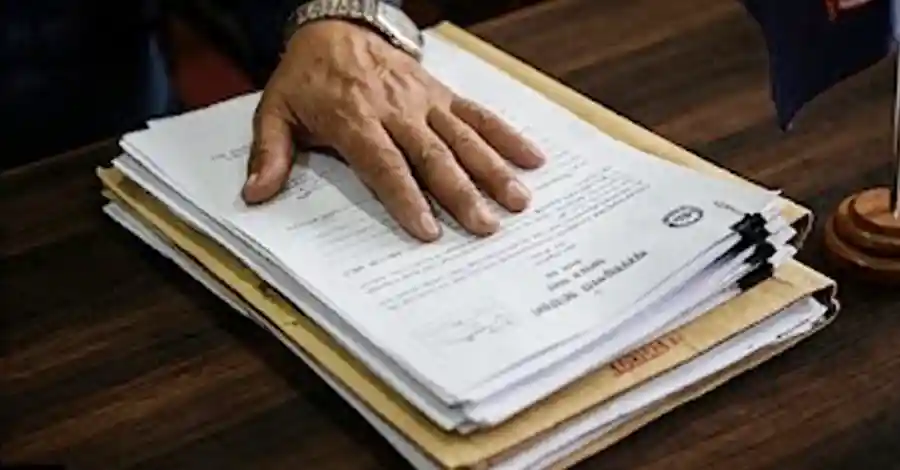
Nepal’s criminal justice framework, like most modern legal systems, is built on the presumption of innocence — the principle that an accusation, however serious, does not equal guilt until it is tested against evidence. In procurement cases specifically, established facts usually include tender records, comparative market pricing, vendor contracts, internal approval trails, and payment records.
None of these evidentiary building blocks were presented on the floor of the committee before Sunar’s public demand for dismissals. That gap between accusation and evidence is precisely why Home Minister Sudhan Gurung intervened days later.
3. A Home Minister Steps In
The controversy escalated enough that Nepal’s Home Minister felt compelled to publicly address it. Reporting from Nepal News noted that Home Minister Sudhan Gurung raised serious concerns over the conduct toward the IGP during the committee meeting and emphasized that unproven allegations should not be presented as established wrongdoing.
Bajarko Chirfar’s coverage adds a memorable line from the minister, framing the core of his objection: officials and lawmakers, in his words, cannot simply appoint themselves judges. Gurung said that employees and police leadership under the home administration are working according to the spirit of the government, pushing back against Sunar’s demand for immediate dismissals.
4. The Speaker Gets Involved
The episode escalated all the way to the Speaker of the House of Representatives. According to a detailed report by the Kathmandu Post, Speaker Dol Prasad Aryal and RSP chair Rabi Lamichhane sought details of the tense exchange between lawmaker Sunar and IGP Karki, with Aryal summoning Karki for a follow-up meeting to discuss the incident and the standards of conduct expected of both lawmakers and officials appearing before parliamentary committees.
That a Speaker of Parliament personally intervened underscores how seriously Nepal’s political leadership is treating the fallout — not just as a policy disagreement, but as a genuine crisis of parliamentary decorum.
Ratopati’s coverage of the aftermath adds that after formally briefing the Speaker, Aryal assured IGP Karki of institutional support after hearing his complaint about the treatment he received in the committee.
5. A Pattern, Not an Isolated Incident
This was not lawmaker Sunar’s only headline-grabbing moment in recent weeks. Nepali outlet Peoples’ Review noted that a fellow RSP parliamentarian, Raju Pandey, separately drove a bulldozer into the wall of a Nepal Army compound in Gokarna in an apparent protest against alleged military encroachment on public land — a second flashpoint that similarly forced the Home Minister and the Speaker to step in to defend institutional boundaries.
The outlet describes the Karki-Sunar row as having become as sensational and shocking to ordinary Nepalis as any major public controversy, especially once compounded by the bulldozer incident. Taken together, these episodes point to a broader tension between newer, disruptive political voices and the traditional institutional chain of command in Kathmandu.
Who Is IGP Dan Bahadur Karki?
Understanding the stakes of this controversy requires understanding who is actually in the hot seat. According to a detailed profile by OnlineKhabar, Karki was born on July 30, 1972, in Ghamir, Malika Rural Municipality, and holds bachelor’s degrees in humanities and social sciences, education, and law, along with a master’s degree in political science.
His career inside Nepal Police has spanned several high-profile postings. The same profile notes that he worked at the Central Bureau of Investigation and the District Police Office in Kapilvastu, later leading the Kathmandu Metropolitan Police Office during the high-profile Bhutanese refugee scam investigation, before rising through the ranks as Deputy Inspector General, central police spokesperson, and eventually Additional Inspector General.
He has also received international recognition, including a United Nations medal early in his career, reflecting his participation in UN peacekeeping-linked assignments — a point of pride for a police force that is, as one commentary noted, consistently in demand for international security deployments.
Karki formally took charge as Nepal’s Inspector General of Police in November 2025. Per Nepal’s official IGP framework documented on Wikipedia, the position reports to the Home Ministry, carries a four-year extendable term under the Police Act of 2012, and has existed since 1951, with Karki as its latest incumbent since 13 November Given the standard 30-year service ceiling for police officers in Nepal, industry reporting suggests his tenure atop the force will likely run for roughly two and a half years — a relatively short and high-pressure window in which to defend both his own record and the credibility of the institution he leads.
Who Is MP Khagendra Sunar, and Why Does His Voice Carry Weight?
Khagendra Sunar is not a fringe political figure. He represents the Rastriya Swatantra Party, a relatively new but influential force in Nepali politics that rode a wave of public frustration with traditional parties into Parliament. As a sitting member of the Public Accounts Committee, Sunar holds a formal legislative mandate to question public spending, demand documentation, and press officials — including police leadership — on allegations of financial irregularity.
That mandate is not symbolic. Nepal’s constitutional framework explicitly empowers parliamentary committees to scrutinize executive bodies, precisely so that taxpayer money is not spent without oversight.
At the same time, Sunar’s own public conduct has drawn scrutiny before. Arthakhabar’s report notes that this is not the first time Sunar’s public statements have stirred controversy, referencing an earlier controversy after a video showed him discussing being allowed to eat beef, which he later said was misinterpreted,
clarifying that he is vegetarian and respects Nepal’s national animal. That history matters for context, though it does not by itself settle whether his allegations against Karki are accurate or exaggerated — that question can only be answered through a documented, evidence-based investigation.
The Rs 60 Crore Question: What Do We Actually Know?
Strip away the shouting, and the underlying financial question is straightforward on paper, even if the politics around it are not: did Nepal Police, the Armed Police Force, and the Election Police overpay, mismanage, or corruptly award contracts worth close to Rs 60 crore for uniforms, footwear, and related equipment?
To answer that question properly — the way any credible anti-corruption investigation would — several categories of evidence typically need to be examined:
- Tender and bidding documents, showing whether the contract followed Nepal’s public procurement rules or was pushed through as a special/emergency exception.
- Comparative market pricing, to establish whether the price paid was inflated relative to prevailing rates for similar goods.
- Vendor and ownership records, to check for conflicts of interest between suppliers and decision-makers.
- Internal approval trails, identifying exactly which officials signed off on the purchase and at what stage.
- Payment and banking records, tracing where the money actually went after disbursement.
As of this reporting, none of these specific documents have been made public in full. IGP Karki has publicly stated there was no financial irregularity in the process and has invited scrutiny of his own accounts, while Sunar has pressed for a formal, independent probe. Both positions can be true simultaneously — a legitimate procurement complaint can exist that still requires proper evidentiary follow-through, rather than a verdict delivered mid-argument in a committee room.
The Deeper Democratic Dilemma: Oversight vs. Public Shaming
The original Nepali commentary that inspired much of this debate raised a pointed philosophical question: when the country’s top police officer is grilled in Parliament, does the public benefit from stronger institutional accountability — or does it lose something just as valuable, namely, public trust in the fairness of that very process?
There is a meaningful distinction between the two functions:
Legitimate Accountability Looks Like This
- Lawmakers requesting documented evidence before drawing conclusions.
- Investigations conducted through established bodies — the Commission for the Investigation of Abuse of Authority (CIAA), the Auditor General’s office, or dedicated police oversight mechanisms — rather than declared unilaterally from the dais.
- Officials being given a fair opportunity to respond with evidence, as Karki attempted to do by offering his financial records for review.
- Outcomes based on findings, whether that means disciplinary action, prosecution, or public exoneration.
Public Shaming Looks Like This
- Treating unverified claims as established fact in front of live television cameras.
- Demanding immediate resignation or dismissal before any formal inquiry has concluded.
- Allowing personal or political friction to overshadow the specific financial questions that triggered the meeting in the first place.
- Creating a chilling effect where honest officials fear reputational destruction regardless of whether they did anything wrong.
Nepal Police is a hierarchical, command-driven institution. When its most senior officer is publicly dressed down without documented proof, the psychological effect does not stop at the top. It filters down to the traffic officer standing in the monsoon heat, the constable posted at a remote border checkpoint, and the investigator working a sensitive case — all of whom may begin to internalize the idea that no amount of dedicated service offers real protection from unproven public accusations.
What Should Happen Next?
For this controversy to serve the public interest rather than simply generate viral outrage, several concrete steps would help restore both accountability and institutional dignity:
- A formal, documented investigation into the Rs 60 crore procurement claim, conducted by an independent body with access to tender files, vendor contracts, and payment records.
- A transparent review of IGP Karki’s personal financial disclosures, since he has already volunteered them for scrutiny — an offer that should be taken up rather than left symbolic.
- A clear, evidence-based examination of the alleged Rs 3 crore theft claim, following the Public Accounts Committee’s own ruling that it deserves proper investigation rather than remaining an unresolved rumor.
- Updated guidelines on parliamentary committee conduct, addressing how lawmakers question officials without prejudging outcomes, an issue the Law, Justice and Human Rights Committee has already begun discussing.
- Public communication of findings either way — because clearing an innocent official’s name matters just as much, from a justice standpoint, as punishing a guilty one.
The Bigger Picture: What This Means for Nepal Police’s Future
Nepal Police plays a role far larger than any single controversy involving its top officer. It is the institution first on the scene during floods and landslides, the body investigating crimes against women and children, the force deployed at every major protest and public gathering, and the agency Nepal depends on for internal security amid ongoing political transitions.
It is also, as multiple commentators have noted, an institution whose personnel are highly sought after for international security deployments, including United Nations peacekeeping missions — a reputation built over decades that a poorly handled domestic scandal could tarnish.
Whether this particular controversy ends in disciplinary action, prosecution, or a formal exoneration for Karki, the manner in which it is resolved will send a signal far beyond this one case. It will tell every officer in Nepal Police’s chain of command whether public service is met with fair, evidence-based accountability — or with reputational risk that no amount of dedication can fully protect against.
For now, the country waits to see whether Nepal’s Parliament, its Home Ministry, and its anti-corruption mechanisms can turn a viral, headline-grabbing shouting match into what it should have been from the start: a serious, document-driven investigation into how public money was spent, and a fair hearing for everyone involved.
Further Reading and External Sources
- Kathmandu Post: Lawmaker’s verbal clash with police chief raises questions over parliamentary conduct
- myRepublica: Parliamentary committee urges dignified language after MP Sunar’s remarks on IGP Karki
- Ratopati English: IGP’s challenge to check bank details and call details
- Nepal News Evening Briefing, August 14, 2026
- OnlineKhabar: Dan Bahadur Karki’s road to the top of Nepal Police

Economic Affair
- Budhigandaki Flood: 47 Rescued as Bridges Washed Away
- Nepal Supreme Court Handcuff Order: Police Barred From Routine Use
- 250+ Officials Deploy to Assess Rasuwa-Bhotekoshi Flood Damage
- Electricity VAT: Energy and Finance Ministers Strike Landmark Deal After Just 2 Months
- Nepal Inflation Shockingly Triples to 5.96% — Food and Transport Hit Hardest
Comments