





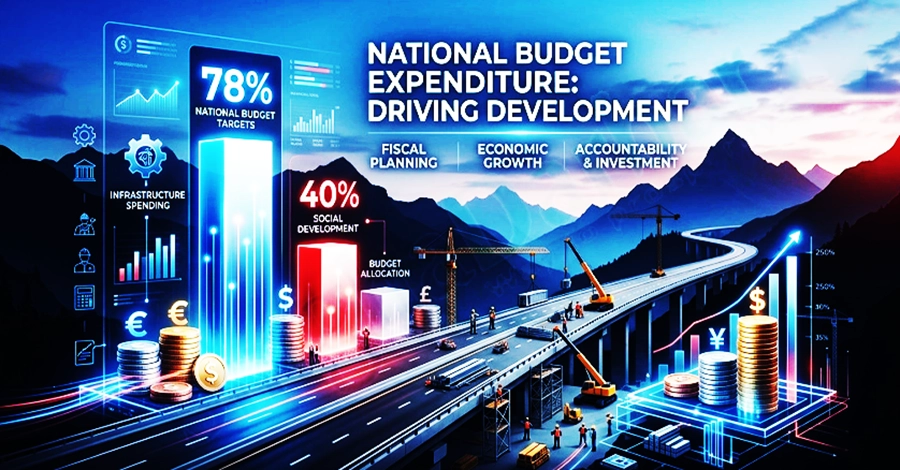
Nepal’s federal government has managed to spend just 78 percent of its total annual budget for the current fiscal year 2082/83, according to the latest figures from the Office of the Comptroller General. With only one day left in the fiscal calendar for regular expenditure, the shortfall highlights a familiar and persistent weakness in Nepal’s public financial management: the government’s chronic inability to fully utilize the funds it allocates for national development.
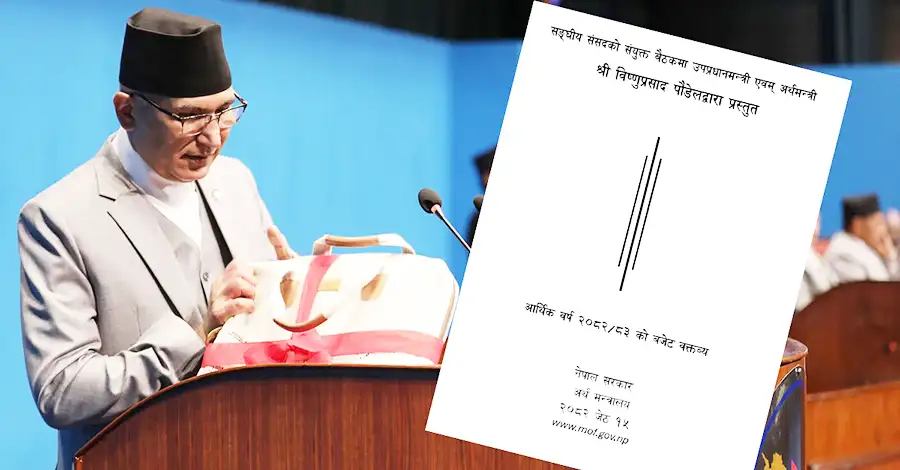
The Nepal budget expenditure 2082/83 data, updated through Wednesday, Asar 24 (the last working day before the fiscal year-end deadline), shows that out of the Rs 1.96411 trillion budget presented by then Finance Minister Bishnu Prasad Paudel, only around Rs 1.53197 trillion has actually been spent.
Capital Expenditure Nepal: Development Budget Stuck at 40%
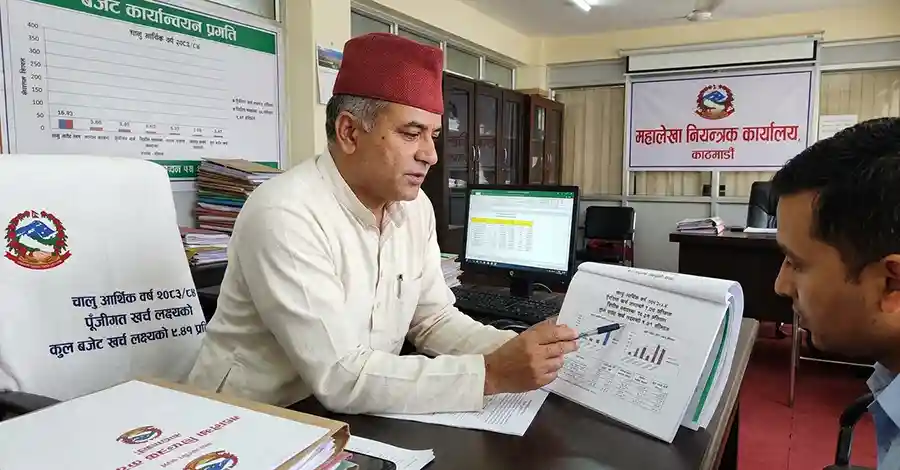
The most concerning figure in this year’s Nepal government budget spending report is capital expenditure — the portion of the budget earmarked for roads, hospitals, irrigation, bridges, and other physical infrastructure. Of the Rs 407.88 billion allocated for capital projects, the government has spent only Rs 163.17 billion, or roughly 40 percent.
Because capital expenditure directly funds construction and development projects, this low utilization rate is widely interpreted as a sign of slowed development activity across the country. Weak project readiness, delayed procurement, staff transfers, and slow disbursement to local and provincial governments are commonly cited reasons behind Nepal’s persistent capital spending gap — a problem that has featured in national budget reviews for over a decade.
Recurrent Expenditure Nearly Complete
Unlike capital spending, recurrent (regular) expenditure — which mainly covers civil servant salaries, allowances, and administrative operations — is far closer to target. Of the Rs 1,180.98 billion allocated under this heading, the government has already spent Rs 1,030.42 billion, or about 87.25 percent. Since recurrent spending is largely automatic and tied to fixed payroll obligations, this category is almost always executed close to its full target every year, regardless of how development spending performs.
Financial Management Spending Reaches 90%
Financial management expenditure — the funds used to repay government debt and manage the country’s borrowing obligations — has also seen relatively strong execution. Against an allocation of Rs 375.24 billion, the government has spent Rs 338.37 billion, or 90.17 percent. This category typically includes both domestic and external debt servicing, which are contractual obligations the government cannot easily postpone.
Three Finance Ministers, One Nepal Budget
An unusual feature of the current fiscal year is that the Rs 1.96 trillion budget was implemented under three different finance ministers in succession: Bishnu Prasad Paudel, who originally presented the budget; Rameshwar Khanal; and the current finance minister, Dr. Swarnim Wagle. Despite the change in leadership at the Ministry of Finance, the underlying execution problem — particularly in capital expenditure — remained largely unresolved through each transition.
Why Nepal’s Budget Execution Problem Matters
Nepal has struggled with low capital expenditure absorption for years, a trend widely documented by economists and international financial institutions monitoring the country’s public investment management. According to Nepal’s official budget documentation published by the Ministry of Finance, capital and recurrent expenditure targets are set annually as part of the national fiscal framework, yet actual disbursement routinely falls short, especially in infrastructure-heavy sectors. You can review the government’s own fiscal planning documents on the Ministry of Finance, Government of Nepal’s official budget portal for more context on how the Rs 1.96 trillion budget was originally structured.
Low capital spending has downstream effects beyond the current fiscal year. Unfinished roads, delayed hospital construction, and stalled irrigation schemes often get pushed into the next year’s budget, compounding delays and inflating project costs over time. Public financial management researchers, including those cited in the Institute of Chartered Accountants of Nepal’s federal budget review, have repeatedly flagged weak implementation capacity as one of the biggest structural challenges facing Nepal’s development ambitions.
Key Numbers at a Glance
- Total budget 2082/83: Rs 1,964.11 billion
- Total spent (as of Asar 24): Rs 1,531.97 billion (78%)
- Capital expenditure spent: Rs 163.17 billion of Rs 407.88 billion (40%)
- Recurrent expenditure spent: Rs 1,030.42 billion of Rs 1,180.98 billion (87.25%)
- Financial management spent: Rs 338.37 billion of Rs 375.24 billion (90.17%)
What Comes Next
With the fiscal year 2082/83 closing, attention now shifts to how the incoming budget for 2083/84 will address these recurring execution gaps. Whether the government can translate budget announcements into on-the-ground development will remain a key test of Nepal’s public financial management going forward.

Economic Affair
- Budhigandaki Flood: 47 Rescued as Bridges Washed Away
- Nepal Supreme Court Handcuff Order: Police Barred From Routine Use
- 250+ Officials Deploy to Assess Rasuwa-Bhotekoshi Flood Damage
- Electricity VAT: Energy and Finance Ministers Strike Landmark Deal After Just 2 Months
- Nepal Inflation Shockingly Triples to 5.96% — Food and Transport Hit Hardest




Comments