











At 37, Wang Zhuang had almost given up on ever getting married. Then an advertisement promising a fast track to a wife caught his eye — and pulled him straight into China’s booming, and increasingly notorious, flash marriage industry.
The pitch was simple: skip years of dating dead ends and meet a bride within days. Matchmaking agents told Wang that women from Guizhou province made frugal, hardworking wives who came from poor families and would move in with his household after the wedding. Chasing that promise, Wang traveled to Guiyang, the capital of southwestern China’s Guizhou province, hoping to finally find a partner.
Within days, he was introduced to a woman who seemed to match everything he was looking for. They met only a handful of times before marrying. The relationship collapsed almost as fast as it began — and Wang later discovered that most of what she had told him about herself was untrue.
What Is ‘Flash Marriage’ and Why Is It Spreading in China?
Flash marriage — a matchmaking model built around meeting and marrying a stranger within an extremely short window, sometimes just days — has turned into a fast-growing business in parts of China, particularly for men in their late 30s and 40s from smaller cities and rural areas who feel they have run out of time and options.
Agencies marketing flash marriage services claim they can deliver a spouse without the years of failed dating many older bachelors have already gone through. For men like Wang, the promise of a quick, guaranteed outcome outweighs the obvious risk of marrying someone they barely know.
Wang’s marriage broker had assured him every match would be background-checked, and that he would be compensated if he were defrauded. Trusting that promise, he paid the agency’s fees and began meeting candidates.
Behind the Scenes: A Broker-Controlled Courtship
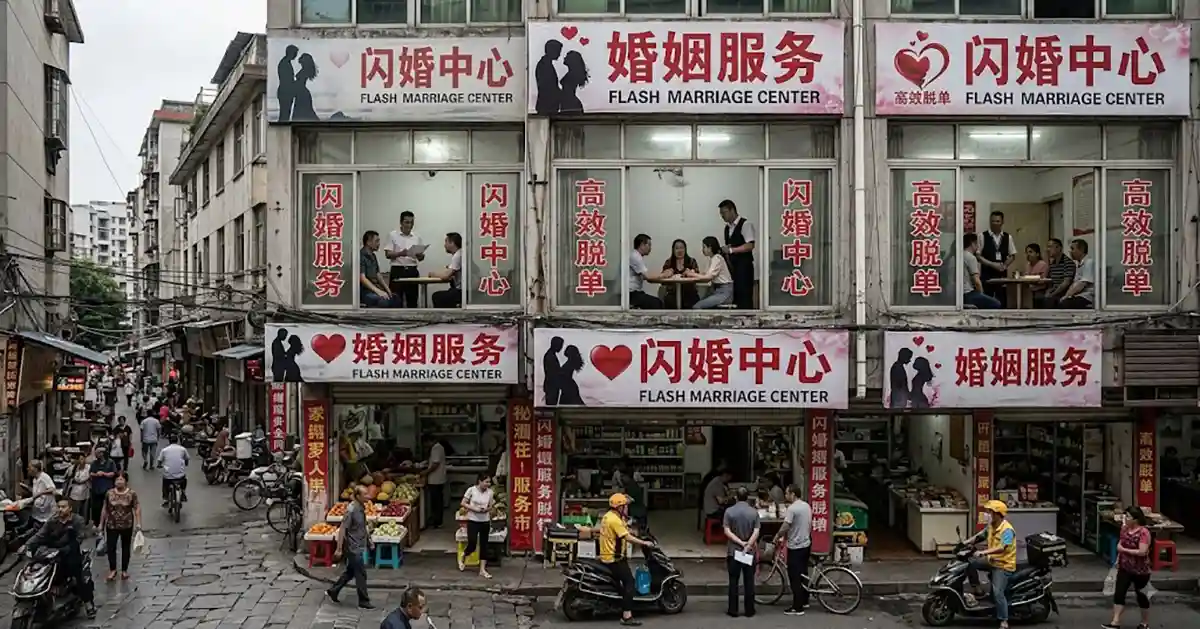
Over the following days, Wang met seven different women, one at a time, in small “first meeting” rooms inside the agency’s office. Staff supervised every meeting closely, asking each woman scripted questions about her hometown, marital history, and whether she had children — details the agency had apparently not verified in advance.
It was the eighth woman who caught his attention. She was introduced as never having been married, without children, and slightly younger than him. Wang recalls her as soft-spoken, modestly dressed, and — as far as he could tell at the time — sincere.
The couple met four or five times, each meeting lasting no more than eight to ten minutes. Under the agency’s rules, couples were strictly barred from exchanging phone numbers or any private contact information before the deal was finalized; breaking that rule carried a financial penalty.
Within two or three days, Wang decided she was the one. He agreed to pay a hefty bride price to her family — a traditional Chinese custom in which the groom’s side pays a sum of money to the bride’s family before marriage.
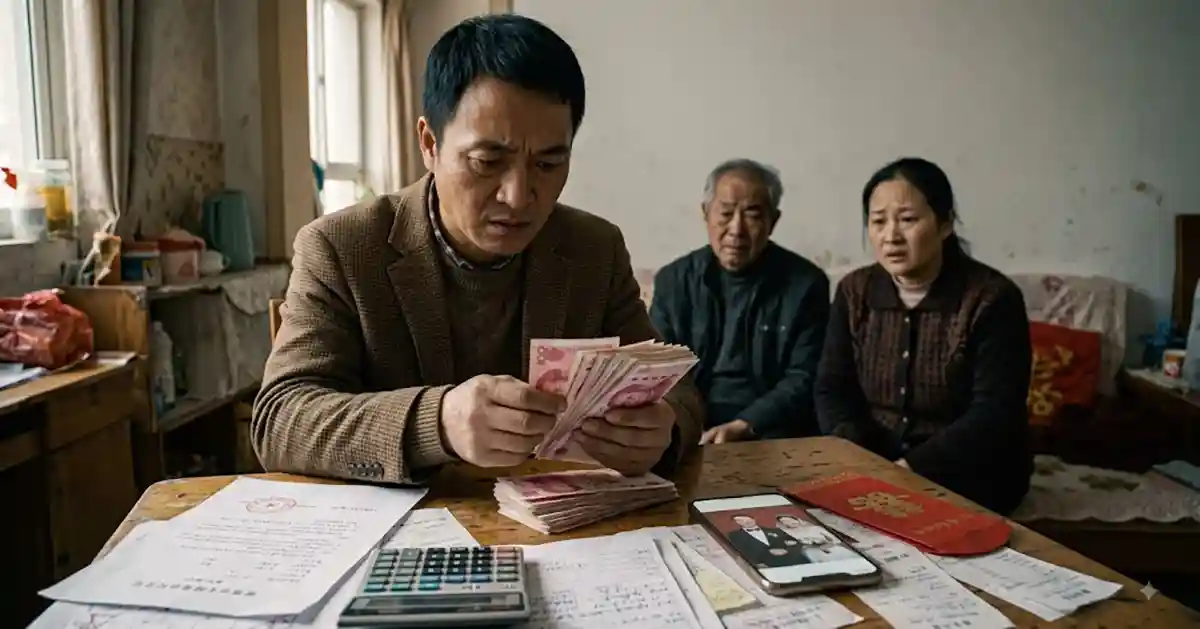
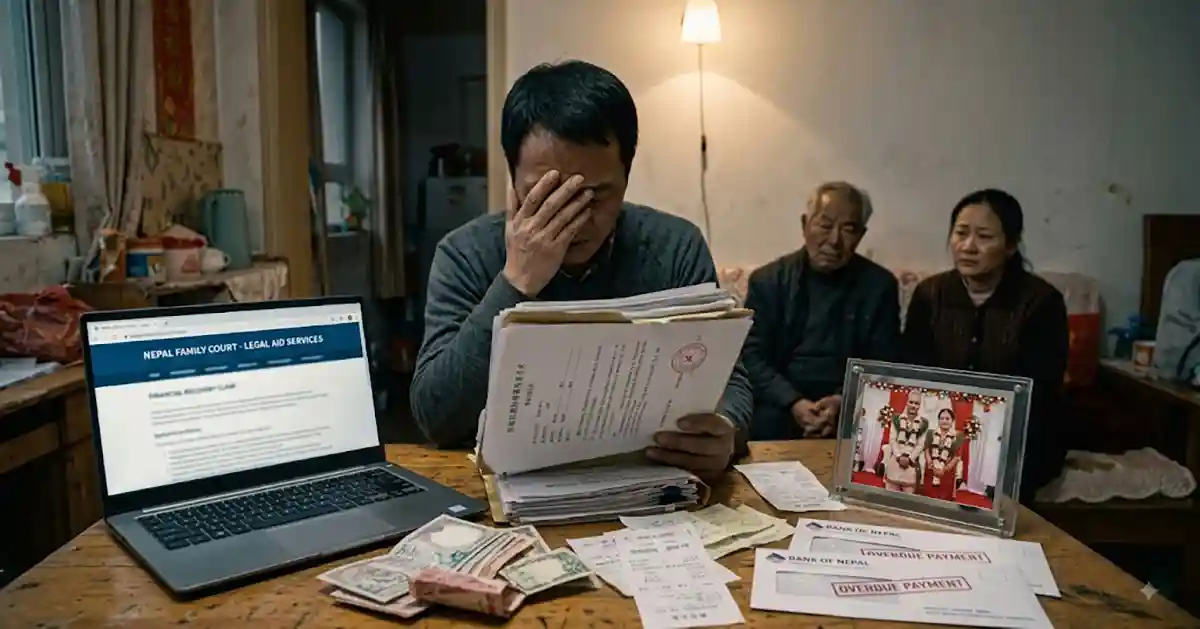
“I spent more than 300,000 yuan [roughly $42,000],” Wang says, holding a stack of legal paperwork he now keeps as evidence for his case. Counting the wedding banquet and other expenses, his total spending reached an estimated 400,000–500,000 yuan. The agency documented the entire courtship in a glossy set of photographs, later reused to advertise its matchmaking services on Chinese social media — including a video of the couple smiling and holding hands on a red carpet to the sound of romantic background music.
The Truth Wang Only Learned Later
After the wedding, cracks appeared almost immediately, and Wang’s new life fell apart nearly as quickly as it had been built. More than a year later, he is still trying to put his life back together.
He eventually learned that his wife had previously worked at a karaoke bar, had been married three times before, and already had three children — none of which matched what he had been told. She was also dealing with a serious sexually transmitted infection and was buried in debt. Even her age, he later found, had been misrepresented.
Wang is now fighting a legal battle for divorce. He says he cannot move forward with his life until he recovers at least part of the life savings he lost — and claims he handed over a large sum to the marriage agency within hours of being introduced to some of the candidates.
“My parents blame me. I have anxiety. I can’t concentrate on work,” Wang says.
Why So Many Chinese Men Are Turning to Flash Marriage Brokers
Wang’s ordeal is a stark example of a demographic imbalance decades in the making. For years, China’s one-child policy limited most couples to a single child, and a deep-rooted cultural preference for sons led many families to choose male children over female ones wherever possible. Although the policy was formally scrapped in January 2016, its demographic damage was already locked in.
China now has roughly 30 million more men than women, according to widely cited government population data — and the imbalance is most acute for men in their late 30s and older living in small towns or remote rural regions, exactly the demographic flash marriage agencies target. Researchers who study China’s marriage market note that the shortage of women gives them significantly more bargaining power in choosing partners, particularly in rural and lower-income regions, according to peer-reviewed research on the one-child policy’s effect on China’s marriage market.
Wang describes the pressure this creates for men in his position bluntly: in his hometown, a prospective groom is expected to own a car and a home outright, and it helps considerably if his family runs a business.
Many families also demand a steep bride price before agreeing to a marriage — a long-standing custom in which the groom’s family pays the bride’s family a negotiated sum. In regions with a severe shortage of women, this payment has become a heavy financial burden, and it is precisely this pressure that has fueled demand for “instant solution” marriage brokers in places like Guizhou.
China’s declining birth rate adds another layer to the crisis. Births fell sharply to 7.92 million in 2025, down from 9.54 million a year earlier and far below official projections made when the one-child policy ended, according to analysis published in The Japan Times. A shrinking pool of women of childbearing age, combined with the existing gender gap, is intensifying competition for brides even further.
A Booming — and Increasingly Scrutinized — Industry
Matchmaking agencies are nothing new in China. But a growing number now appear to specifically target older, more vulnerable men who have struggled to marry through conventional means — precisely the profile flash marriage brokers court most aggressively.
The scale of the problem has become significant enough that Chinese state media has begun reporting on it directly, describing “explosive growth” in the flash marriage sector alongside a rise in “illegal activity and disorder” linked to it.
It’s difficult to measure exactly how widespread this type of fraud has become, but it has drawn serious attention from Chinese authorities. Between January 2024 and March 2025, state prosecutors took action against 1,546 individuals in cases connected to the matchmaking industry. This month, five separate government bodies jointly launched a nationwide crackdown targeting the marriage brokerage sector.
In one documented case, a matchmaking agency used women working at karaoke bars as bait, defrauding 128 victims of more than 2.5 million yuan — roughly $371,000 in total.
Fan Binghe, a lawyer with the Nanjing office of the Beijing-based Jingshi Law Firm, believes regulators may eventually need to draft dedicated rules specifically to curb fraud carried out under the flash marriage model.
Guiyang: The Unlikely Capital of China’s Flash Marriage Trade
Despite becoming closely associated with the rapidly expanding flash marriage trade, Guiyang doesn’t look or feel like a hub built around love and romance. The city’s matchmaking agencies operate out of cramped, disorganized offices stacked above a commercial building — hardly the setting one would expect for life-altering financial decisions.
Downstairs, vendors sell local fruit, while office workers line up for rice noodles in sour soup during their lunch break. It is an ordinary, unremarkable commercial strip — not the polished bridal district the marketing might suggest.
Yet it was in exactly this setting that Wang placed his trust, handed over his savings, and walked away with a marriage that took only days to arrange and more than a year to unravel — a pattern researchers say is becoming disturbingly common wherever China’s gender imbalance collides with financial desperation and the promise of a fast fix.
The Bigger Picture
Wang’s story is not an isolated incident — it’s a symptom of deep structural pressures reshaping marriage across China: a historic gender gap, a shrinking population, rising bride-price expectations, and a demographic squeeze on men in smaller cities and rural regions. Until China’s underlying gender imbalance eases, demand for fast, high-risk matchmaking services like flash marriage brokers is likely to keep growing — and with it, the risk of fraud for men desperate enough to pay first and ask questions later.
For readers seeking more background on the demographic forces behind China’s marriage crisis, see additional reporting and academic analysis from The Japan Times and peer-reviewed research published in Nature Humanities and Social Sciences Communications.

Economic Affair
- Budhigandaki Flood: 47 Rescued as Bridges Washed Away
- Nepal Supreme Court Handcuff Order: Police Barred From Routine Use
- 250+ Officials Deploy to Assess Rasuwa-Bhotekoshi Flood Damage
- Electricity VAT: Energy and Finance Ministers Strike Landmark Deal After Just 2 Months
- Nepal Inflation Shockingly Triples to 5.96% — Food and Transport Hit Hardest




Comments