
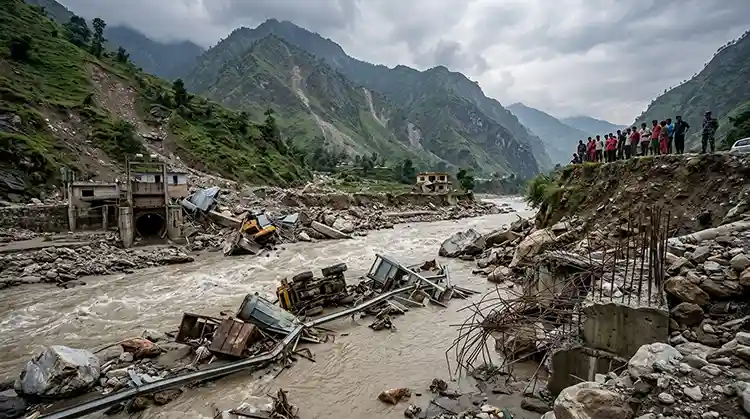






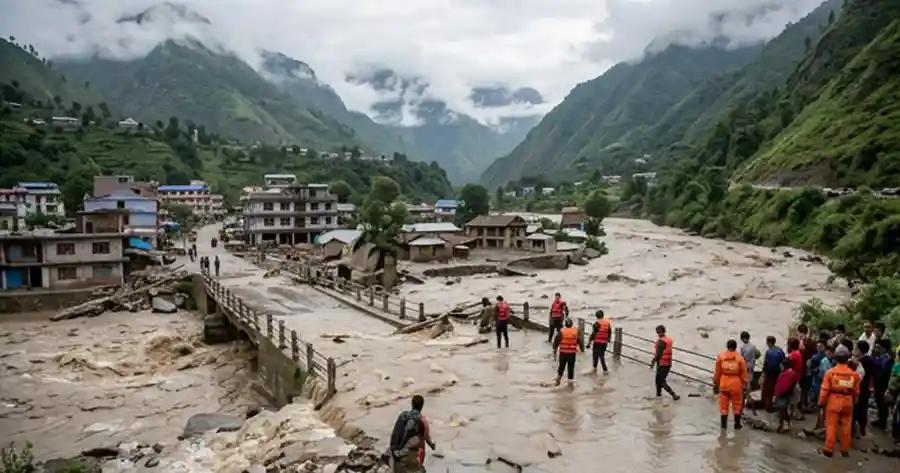
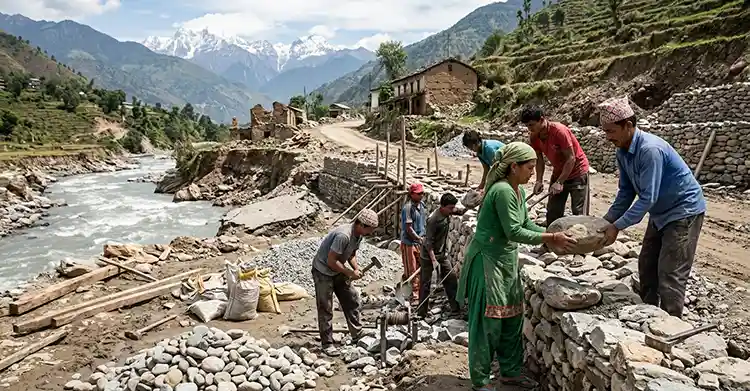
Kathmandu — A sudden and powerful Rasuwa flood tore through the Syabrubesi and Timure areas of northern Nepal on Wednesday morning, damaging markets, hydropower infrastructure, and police posts after a massive surge of water rushed into the Bhote Koshi River from the Tibetan side of the border. The Nepal government has since launched an urgent rescue, search, and relief operation, with Prime Minister Balendra Shah personally directing security forces and ordering the evacuation of residents from low-lying riverside areas.
The flood, which struck at around 9 am local time, has raised alarm not only in Rasuwa but along the entire downstream course of the Trishuli River, with authorities extending high-alert warnings as far as Nuwakot and Muglin. Officials say the scale of destruction is still being assessed, but early reports point to extensive damage in the Timure market area, the Timure Customs Office, and Ward No. 5 of Syabrubesi.
What Happened in Rasuwa on Wednesday Morning
According to the Rasuwa District Police Office, a large volume of water suddenly surged into Nepal from the Tibetan side shortly before 9 am, rapidly swelling the Bhote Koshi River. Rasuwa Chief District Officer Narendra Pariyar said the exact scale of the damage was not yet known and that the underlying cause of the sudden flooding remained unclear at the time of reporting. Local police said they were still gathering detailed information on the extent of destruction as the situation continued to unfold.
The Flood Forecasting Division of Nepal’s Department of Hydrology and Meteorology confirmed it was notified around 9:00 am that a major flood had entered the river system from Tibet. One official described the flood as unprecedented in scale, noting significant damage in Gosaikunda Rural Municipality-2, Timure, and Ward No. 5 of Syabrubesi.
A Possible Glacial Lake Outburst Flood (GLOF)
Hydrological experts cited in early coverage suspect the sudden deluge may have been triggered by a Glacial Lake Outburst Flood (GLOF) originating in Tibet rather than by localized rainfall in Rasuwa itself. Nepal’s Department of Hydrology and Meteorology is reportedly coordinating with Chinese authorities and reviewing satellite imagery to help pinpoint the exact origin and cause of the surge, though a formal confirmation has not yet been issued.
Scale of the Damage: Markets, Police Posts, and Hydropower Hit
Initial damage assessments indicate the flood has affected a wide range of infrastructure in the Timure and Syabrubesi areas.
Police Infrastructure Damaged
Nepal Police Headquarters confirmed that three police offices in Rasuwa district alone sustained major damage from the flood: the Timure Area Police Office, the Syabrubesi Police Post, and the Rasuwagadhi Police Post. Headquarters said detailed information about the condition of these offices and the safety of personnel stationed there was still being compiled as rescue teams reached the affected sites.
Hydropower Projects and Local Markets Affected
The flash flood has also damaged hydropower installations and local market areas in Timure and Syabrubesi, according to early reporting. The Rasuwa District Administration Office said it had received reports of the sudden surge in the Bhote Koshi River — which flows into Nepal from Tibet — and warned that rising water levels could increase flood risk further downstream along the Trishuli River.
Cross-Border Trade Point Once Again at Risk
The Timure Customs Office, located near the Nepal-China border, sits in one of the areas hit hardest by Wednesday’s flood. This is a matter of particular concern given the area’s fragile recent history: on July 8, 2025, a devastating flash flood originating from Tibet’s Lhende river surged into the Bhote Koshi and killed at least eight to nine people, left roughly 19 others missing.
swept away the Miteri Friendship Bridge linking Nepal and China, and severely damaged the Rasuwagadhi dry port along with the Syabrubesi–Rasuwagadhi road. That earlier disaster caused an estimated 60 percent of the under-construction dry port’s structures to collapse or wash away, despite the facility being roughly 81 percent complete at the time. (Read the Kathmandu Post’s report)
Wednesday’s flood raises fresh questions about whether reconstruction work at these critical border facilities can withstand another cycle of extreme glacial and monsoon-driven flooding from across the border.
Government Response: PM Balendra Shah Orders Immediate Action
Prime Minister Balendra Shah moved quickly after news of the flood broke, directing government agencies to mobilize their full emergency response machinery.
Evacuation Orders for Low-Lying Areas
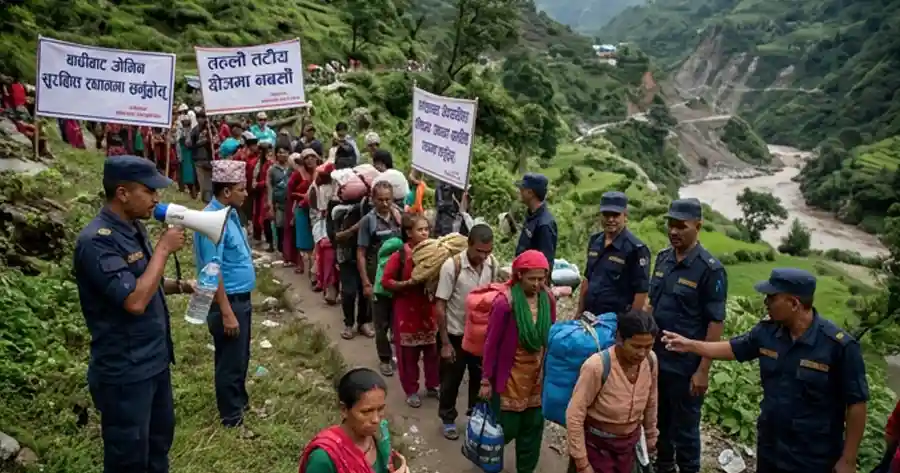
The Prime Minister has instructed Chief District Officers (CDOs) in the affected and downstream districts to immediately relocate residents living in low-lying riverside areas to safer locations. Authorities have been directed to continue issuing warnings to other communities who may be affected as the flood’s downstream impact develops. The Prime Minister’s Office also confirmed that residents in affected areas have been alerted through SMS and phone notifications, urging them to move to safe locations without delay.
Nepal Army Helicopters Deployed
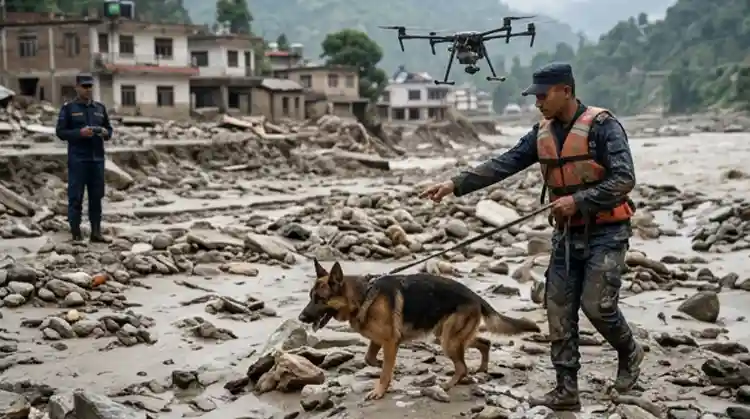
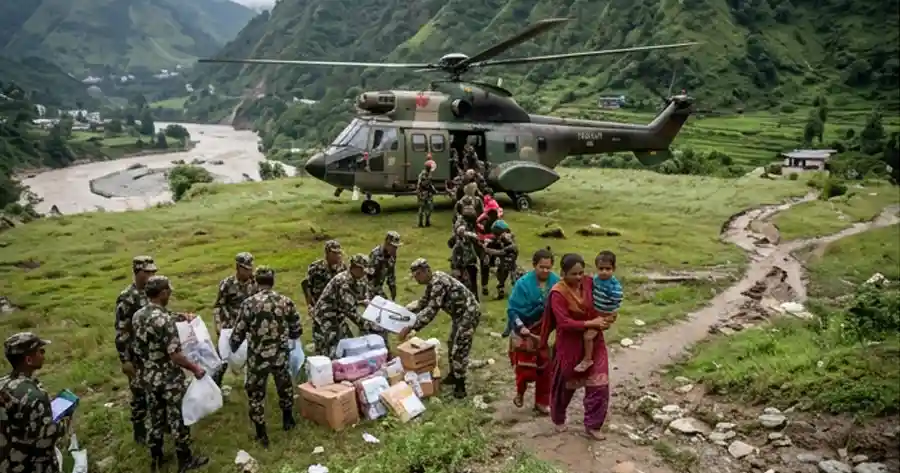
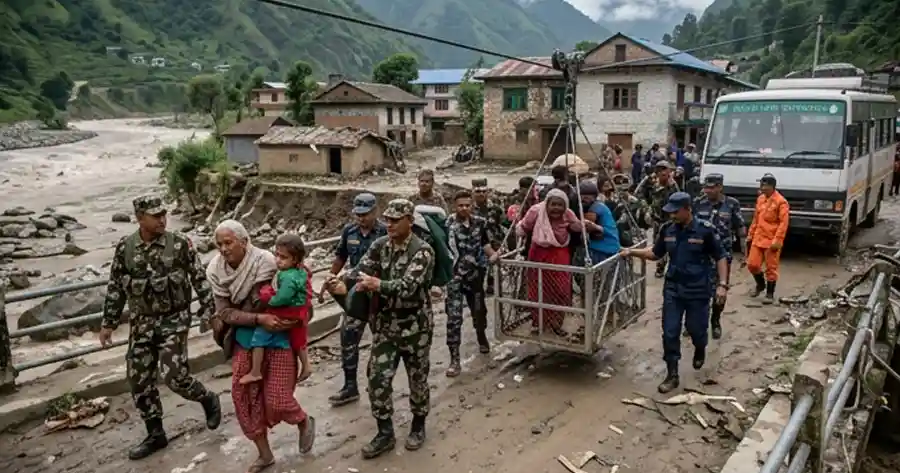
On the Prime Minister’s instructions, two Nepal Army helicopters carrying medical teams have already been dispatched to the affected region for potential rescue and relief operations. Additionally, private helicopter companies have been placed on standby readiness to support search-and-rescue efforts if needed.
Security Forces Mobilized on the Ground
Nepal Police, the Armed Police Force Nepal, and district administration offices have intensified rescue and search operations in the flood-hit areas. The Nepali Army has likewise advanced its own search and rescue mobilization in coordination with other emergency responders.
Emergency Meetings Convened at the Highest Level
The scale of the disaster prompted an immediate institutional response from Nepal’s disaster management apparatus.
Home Ministry-Led National Disaster Authority Meeting
A meeting of the National Disaster Risk Reduction and Management Authority was convened at the Home Ministry in Singha Durbar, chaired by Home Minister Sudhan Gurung, to coordinate the government’s immediate response to the flood.
Prime Minister Calls National Council Meeting
Separately, Prime Minister Shah called a meeting of the National Council for Disaster Risk Reduction and Management at the Office of the Prime Minister and Council of Ministers, convened shortly after the disaster authority’s meeting began. Reports also indicate an emergency meeting of the Monsoon Response Command Post was held to coordinate the broader relief effort as new information from the field continued to come in.
Travel Advisory: Roads to Avoid
With the flood having damaged key transport corridors in the region, authorities have urged the public to avoid travel on several major routes until further notice:
- Prithvi Highway
- Galchhi–Nuwakot–Rasuwa Syabrubesi Road
- Muglin–Narayanghat Road
Officials have asked travelers not to attempt journeys along these stretches while assessment and clearance work is underway, citing the ongoing risk of further landslides, road damage, or flash flooding.
Downstream Risk: Trishuli River Communities on High Alert
Because the Bhote Koshi feeds directly into the Trishuli River, the flood’s impact is not confined to Rasuwa. The Flood Forecasting Division has urged residents living along the Trishuli — stretching from Rasuwa through Nuwakot and as far as Muglin — to remain on high alert due to the sudden rise in water levels. Authorities have specifically asked people fishing or working directly in the Trishuli River to move away from the water immediately, and have urged residents, as well as hydropower projects and other infrastructure operators situated near the river, to take precautionary measures.
Local reporting indicates that at least five districts have been placed on alert as the flood’s downstream effects continue to be monitored, underscoring how a single glacial or monsoon-triggered surge in a remote Himalayan valley can cascade into a much wider regional emergency within hours.
A Recurring Threat: Why Rasuwa Keeps Flooding
Wednesday’s disaster is the second major flood to strike the Timure–Syabrubesi corridor in just over a year, reviving concerns about the vulnerability of this high-mountain border region to glacial lake outburst floods and extreme monsoon events.
The July 2025 Rasuwagadhi Flood
Nepal experienced a similarly devastating flood on July 8, 2025, when a flash flood — attributed to monsoon rainfall combined with a likely glacial lake outburst in Tibet — swept away the Sino-Nepal Friendship Bridge over the Trishuli River at Rasuwagadhi. That disaster left at least eight people dead and dozens missing, including both Nepali and Chinese workers, destroyed hundreds of parked trucks and electric vehicles awaiting cross-border transit, and brought cross-border commerce to a halt for an extended period.
Rescue teams from the Nepal Army and other agencies managed to save around 55 people during that operation, while then-Prime Minister Khadga Prasad Oli visited the disaster site as relief efforts intensified. The 2025 flood was later confirmed to have originated from the outburst of a supraglacial lake in Tibet. (Read more on Wikipedia: 2025 Nepal floods)
Climate Change and Glacial Instability in the Himalayas
Scientists have repeatedly warned that the Himalayan region — including the mountains straddling the Nepal-Tibet border — is becoming increasingly prone to glacial lake outburst floods as rising temperatures accelerate glacial melt and destabilize high-altitude lakes. Rasuwa’s location directly downstream from glacial systems on the Tibetan Plateau makes it especially exposed to these fast-moving, difficult-to-predict disasters, which can strike with little or no warning even during periods without heavy local rainfall.
The repeated damage to the Rasuwagadhi dry port and the Timure customs area — a key node in Nepal-China land trade — also highlights the broader economic vulnerability created by locating major cross-border infrastructure directly along a flood-prone Himalayan river corridor.
What Residents and Travelers Should Do Now
Given the fast-moving nature of the situation, authorities are urging the public to take the following precautions:
- Avoid travel on the Prithvi Highway, the Galchhi–Nuwakot–Rasuwa Syabrubesi road, and the Muglin–Narayanghat road until conditions are confirmed safe.
- Residents along the Trishuli River, from Rasuwa through Nuwakot to Muglin, should move away from the riverbank and avoid entering the water.
- Anyone in Rasuwa’s low-lying riverside areas should follow evacuation instructions from local Chief District Officers without delay.
- Families in the region should monitor official SMS alerts and instructions from the Nepal Police and district administration for updates on evolving risk levels.
- Hydropower operators and infrastructure managers near the Trishuli River should activate their own emergency preparedness protocols as advised by the Flood Forecasting Division.
Timeline of Wednesday’s Rasuwa Flood Response
Around 9:00 AM — A large volume of water suddenly surges into Nepal from the Tibetan side of the border, rapidly raising levels in the Bhote Koshi River near Timure.
Shortly after 9:00 AM — The Flood Forecasting Division is notified of the surge and begins issuing downstream alerts along the Trishuli River. Rasuwa District Police begin gathering initial damage reports from Timure and Syabrubesi.
Mid-morning — Reports confirm damage to the Timure Area Police Office, Syabrubesi Police Post, and Rasuwagadhi Police Post, along with local markets and hydropower infrastructure. The Rasuwa District Administration Office issues a formal warning urging people to stay away from the Trishuli River.
Late morning — Prime Minister Balendra Shah directs Chief District Officers to evacuate residents from low-lying riverside areas and orders the deployment of two Nepal Army helicopters carrying medical teams to the affected region. Private helicopter operators are placed on standby.
Late morning to midday — The Home Ministry convenes an emergency meeting of the National Disaster Risk Reduction and Management Authority under Home Minister Sudhan Gurung. The Prime Minister separately calls a meeting of the National Council for Disaster Risk Reduction and Management at his own office, alongside a Monsoon Response Command Post meeting to coordinate the wider relief operation.
Ongoing — Nepal Police, the Armed Police Force, district administration offices, and the Nepali Army continue rescue and search operations on the ground, while the Department of Hydrology and Meteorology works to determine the cause of the flood in coordination with satellite data and, reportedly, Chinese counterparts.
Why This Flood Is Being Watched Closely Beyond Nepal
The Timure-Syabrubesi corridor is not just a remote mountain settlement — it is a strategically important trade and transit route connecting Nepal directly with Tibet, China. The Rasuwagadhi border point and its associated dry port represent one of Nepal’s most significant investments in overland trade infrastructure with its northern neighbor, built at a cost of nearly three billion Nepali rupees. Repeated flood damage to this corridor therefore carries implications well beyond the immediate human toll, touching on cross-border trade continuity, regional supply chains, and Nepal’s broader infrastructure resilience strategy in a rapidly warming Himalayan environment.
International disaster researchers have flagged the Nepal-Tibet border region as one of the more closely watched GLOF hotspots in the Himalayas, given the concentration of glacial lakes upstream of populated valleys and infrastructure corridors.
Repeated events in the same river system within roughly thirteen months — the July 2025 Rasuwagadhi flood and Wednesday’s Syabrubesi-Timure flood — are likely to intensify calls from disaster-risk experts and local officials for stronger early-warning systems along the Bhote Koshi and Trishuli rivers, as well as more flood-resilient design standards for any rebuilt customs, dry port, and hydropower infrastructure in the area.
What Happens Next
With rescue and search operations still underway, the coming hours and days will be critical in determining the true human and economic toll of the Rasuwa flood. Key questions authorities are racing to answer include the exact cause of the surge — whether it was a glacial lake outburst, a sudden ice-dam failure, or another trigger originating in Tibet — the full extent of casualties, if any, and how much of the Timure customs and dry port infrastructure, still recovering from the 2025 disaster, has been damaged this time.
The Nepal government’s swift mobilization of army helicopters, medical teams, and multiple layers of emergency coordination — from the district-level Disaster Risk Reduction Authority to the Home Ministry and the Prime Minister’s own national council meeting — reflects lessons learned from last year’s flood, when criticism arose over the pace of the initial response. Whether that improved coordination translates into a faster, more effective recovery for the communities of Syabrubesi and Timure will likely shape public assessment of the government’s disaster management capacity in the weeks ahead.
Frequently Asked Questions
What caused the Rasuwa flood? The exact cause has not been officially confirmed. Hydrological experts suspect a possible Glacial Lake Outburst Flood (GLOF) originating in Tibet, though local authorities say the precise trigger is still under investigation.
Which areas in Nepal have been affected by the Rasuwa flood? The flood has caused significant damage in Syabrubesi and Timure in Rasuwa district, with downstream risk warnings extended along the Trishuli River through Nuwakot and as far as Muglin.
Has Prime Minister Balendra Shah responded to the Rasuwa flood? Yes. Prime Minister Shah has directed the evacuation of residents from low-lying riverside areas, deployed two Nepal Army helicopters with medical teams, and convened a meeting of the National Council for Disaster Risk Reduction and Management.
Are any roads closed because of the Rasuwa flood? Authorities have urged the public to avoid the Prithvi Highway, the Galchhi–Nuwakot–Rasuwa Syabrubesi road, and the Muglin–Narayanghat road until further notice.
Is this related to last year’s Rasuwagadhi flood? Wednesday’s flood struck a similar stretch of the Bhote Koshi and Trishuli river system to the devastating July 8, 2025 flood, which killed at least eight people and destroyed the Nepal-China Friendship Bridge, though officials have not yet confirmed whether the two events share a common cause.
This report is based on official statements from Nepal’s disaster response agencies along with additional English-language reporting from the Kathmandu Post, OnlineKhabar, The Himalayan Times, Ratopati, Nepalnews, Setopati, and Wikipedia, cited above. This is a developing story, and details regarding casualties and the full extent of damage may be updated as more information becomes available from Rasuwa district authorities.

Economic Affair
- Budhigandaki Flood: 47 Rescued as Bridges Washed Away
- Nepal Supreme Court Handcuff Order: Police Barred From Routine Use
- 250+ Officials Deploy to Assess Rasuwa-Bhotekoshi Flood Damage
- Electricity VAT: Energy and Finance Ministers Strike Landmark Deal After Just 2 Months
- Nepal Inflation Shockingly Triples to 5.96% — Food and Transport Hit Hardest

Comments