







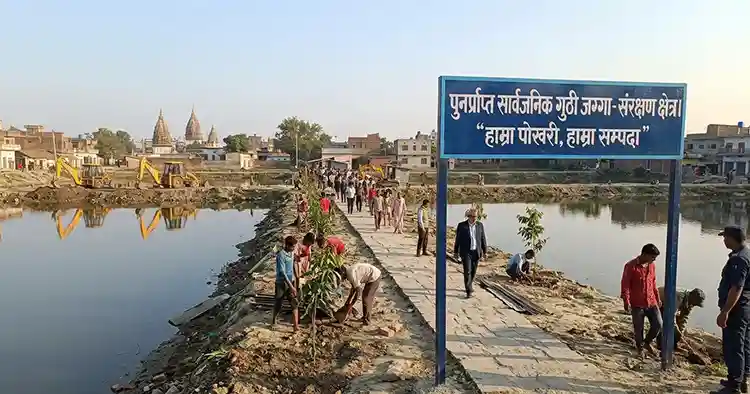
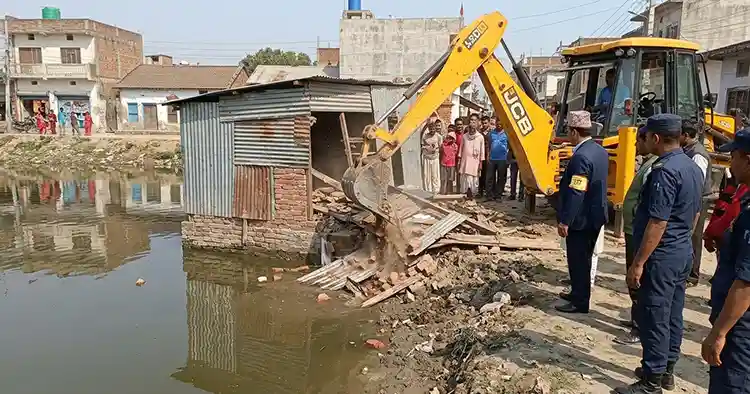
Janakpurdham is bracing for a dramatic transformation. Starting tomorrow, bulldozers will roll into the ancient temple town to tear down illegal structures built on encroached Guthi land, marking one of the most decisive Janakpur Guthi land encroachment clearance operations the Mithila region has witnessed in decades. Authorities say the first target is the shrinking, garbage-choked banks of the city’s centuries-old ponds — sacred water bodies that have slowly disappeared under decades of illegal construction, land grabbing and administrative neglect.
The operation, coordinated by the Guthi Land Protection and Encroachment Removal Implementation Committee, will begin with the Goardhoi Pokhari pond bank and gradually expand to cover roughly fifty ponds already identified as encroached across Janakpurdham. For a city whose religious and cultural identity is inseparable from its network of holy ponds, temples and pilgrimage routes, this bulldozer drive is being watched closely across Madhesh Province and beyond.
Why the Bulldozer Drive Is Happening Now
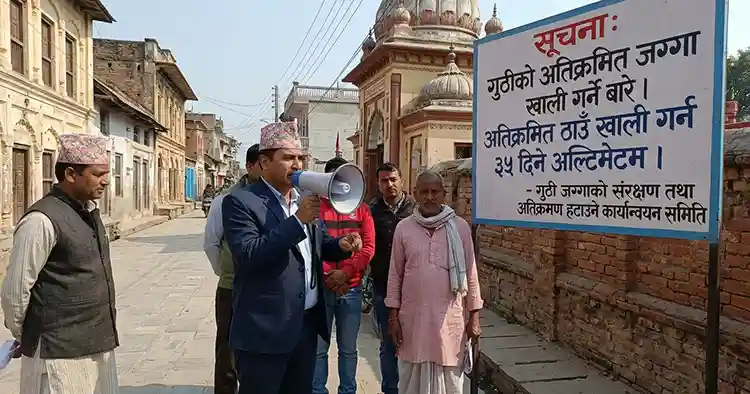
Janak Pokharel, Member Secretary of the Guthi Land Protection and Encroachment Removal Implementation Committee, confirmed that the machines will move in starting tomorrow, beginning the practical, on-the-ground phase of a campaign that has been building momentum for weeks. According to Pokharel, the committee formally issued a public notice on the first day of the Nepali month of Saun, instructing individuals and institutions occupying encroached Guthi land to vacate voluntarily.
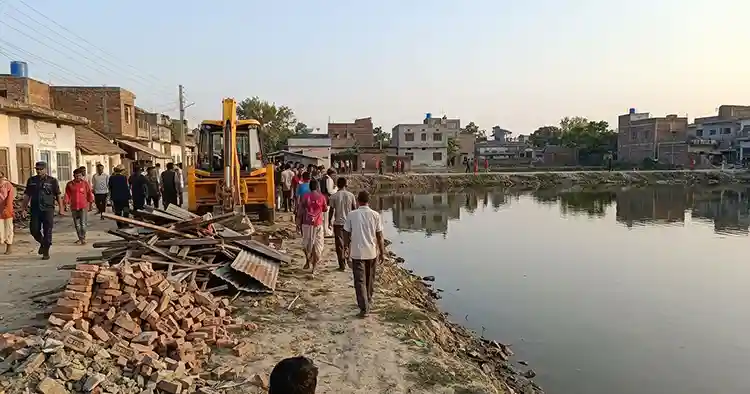
Field teams have spent the days since then verifying the ground reality, marking boundaries and, most recently, using loudspeaker announcements — locally known as miking — to alert residents and business owners in the affected pond areas that demolition equipment is on its way. This public-address campaign is designed to give encroachers one last opportunity to remove their own belongings and structures before bulldozers arrive, reducing the risk of confrontation once machinery starts operating.
The urgency behind the operation reflects a broader pattern playing out nationwide. Nepal’s federal government has been pushing provincial and local authorities to accelerate the recovery of public and Guthi land as part of its wider governance commitments, and according to reporting by OnlineKhabar English News, the government’s policy commitment document specifically calls for digitising records of public land, tightening monitoring systems and launching special campaigns to clear existing illegal occupation nationwide. Janakpur has effectively become one of the highest-profile test cases for that policy.
First Phase Target: Fifty Encroached Ponds in Janakpurdham
According to Pokharel, the first phase of the campaign will focus exclusively on ponds that have already been identified and verified as encroached. Roughly fifty such water bodies across Janakpurdham have made it onto the committee’s initial list, and officials say each one will be freed from illegal occupation in a phased, site-by-site manner rather than all at once.
Janakpur is often called the “City of Ponds” because dozens of religiously significant water bodies are woven into its urban and spiritual fabric. Names such as Ganga Sagar, Dhanush Sagar, Ratna Sagar and dozens of smaller pokharis have historically served as sites for ritual bathing, Chhath festival celebrations, daily worship and community gathering. Over the years, however, unregulated construction — homes, shops, sheds and even semi-permanent business structures — crept steadily onto pond banks that were traditionally left open for public and religious use.
A detailed report on the government notice names several of the specific water bodies covered under the wider protection drive, including Bishahara Pokhari, Dasharath Talau, Argaja Sar, Ratnasagar Pokhari, Murali Sar, Dirghika Sar and Goddhoi Pokhari — several of which overlap directly with the sites now facing bulldozer action. The same notice made clear that both the ponds themselves and the surrounding banks and adjoining plots fall under the scope of the eviction order, since encroachment has affected not just the water bodies but the open public space around them.
Goardhoi Pond: Ground Zero for Tomorrow’s Demolition
Of all the ponds on the list, Goardhoi Pokhari has been chosen as the starting point. Officials confirmed that bulldozers will begin operating on the encroached portions of the Goardhoi Pond bank tomorrow, making it the symbolic and practical launchpad for the entire fifty-pond clearance campaign. Local residents in the vicinity have reportedly already begun relocating movable structures ahead of the demolition, following the miking announcements carried out earlier today.
Choosing a single, well-defined site for the opening operation allows the implementation committee to test logistics, security coordination and public response before scaling the drive up to dozens of additional locations across the city in the coming weeks and months.
A Three-Phase Action Plan for Reclaiming Guthi Land
Officials say the entire anti-encroachment campaign in Janakpur has been carefully classified into three sequential phases, each targeting a different category of encroached property. This structured, phase-wise approach is meant to prevent the operation from becoming chaotic or legally contested, while still sending a clear message that encroachment across all categories of Guthi land will eventually be addressed.
Phase One: Ponds and Pond Banks
The current operation — the one beginning tomorrow — falls under phase one, which is dedicated entirely to freeing ponds and their surrounding banks from illegal occupation. This phase is considered the most urgent because encroached pond banks have the most visible and immediate impact on public access, drainage, flood risk and the religious use of the water bodies during major festivals such as Chhath.
Phase Two: Temple Premises
Once the pond-clearing operation is substantially complete, the committee plans to move into phase two, which targets encroachment within temple premises. Janakpur is home to numerous historic temples, including the globally recognised Janaki Mandir, and encroachment on land legally belonging to temple trusts has long been a sensitive and complicated issue, often involving religious custodians, tenants and local power structures.
Phase Three: Remaining Guthi Land
The third and final phase will address all other categories of encroached Guthi land across Janakpurdham that do not fall under ponds or temple premises — including agricultural plots, commercial land and residential encroachments built on land historically donated to Guthi trusts. This is expected to be the most extensive and legally complex phase, since much of this land has been occupied for decades and, in some cases, informally bought and sold multiple times despite never being legally transferable.
The Legal Foundation: Bhojraj Ghimire’s 2062 BS Task Force Report
The entire operation is not happening in a legal vacuum. According to Pokharel, the committee’s actions are grounded in the findings of a high-level task force formed in 2062 BS (around 2005–2006 AD) under the leadership of Bhojraj Ghimire. That task force was specifically constituted to identify and document encroached Guthi land across Janakpurdham, and its report has since become the reference document guiding successive governments’ attempts to reclaim the property.
This is significant because Guthi land disputes in Nepal are notoriously difficult to resolve through ad-hoc administrative action alone — encroachers frequently challenge eviction notices in court, arguing lack of proper identification or procedural fairness. By anchoring the current drive in a formally documented, decades-old task force report, the implementation committee is attempting to build a stronger legal foundation that can withstand such challenges.
Separately, a 2076 BS Commission of Inquiry on the Protection of Government, Public and Guthi Land also examined similar encroachment issues nationwide, and its recommendations, alongside those of the Ghimire task force, form the basis of a nine-member committee the Ministry of Land Management, Cooperatives and Poverty Alleviation formed earlier this year specifically to protect Guthi assets in the Greater Janakpur area. According to Bajarko Chirfar English, that nine-member body is led by Dhruva Ghimire, the Guthi Administrator at the Guthi Sansthan Head Office, and includes senior district officials such as the Assistant Chief District Officer of Dhanusha, the District Coordination Officer, and the Chief Survey Officer of Dhanusha, reflecting the multi-agency coordination this task requires.
Understanding the Guthi System: Why This Land Matters
To understand why this bulldozer drive carries such weight, it helps to understand what “Guthi” land actually is. The Guthi system is a centuries-old Nepali institution under which land was historically donated by kings, nobles and wealthy individuals to religious and cultural trusts, with the income generated from that land used to fund temple rituals, festivals, priest salaries and the maintenance of religious sites. Guthi Sansthan, the government body responsible for managing this land, was established in 2021 BS to formalise and centralise administration of these trusts nationwide.
Over the decades, however, Guthi Sansthan has struggled badly to protect its holdings. According to a Khabarhub investigation, the institution once held roughly 1.45 million ropanis of land across 69 districts, but has repeatedly admitted its own difficulty in tracking and safeguarding that property, citing outdated record-keeping systems and a lack of digital infrastructure as key obstacles. The Kathmandu Post has separately documented cases of Guthi land being transferred to private and religious organisations without the Sansthan’s own knowledge, only coming to light years later through investigations by Nepal’s National Vigilance Centre, as reported in this Kathmandu Post investigation.
Janakpur’s Guthi land has been particularly vulnerable to this pattern. A widely cited myRepublica investigation found that land brokers, allegedly working in collusion with a local temple’s head priest, had encroached upon around 15 bighas — roughly 300 katthas — of Guthi land registered to the Shree Ram Janaki Dulaha Bhagwan Mandir Guthi, land originally donated by King Rajendra Bir Bikram Shah in 1889 BS. That single case illustrates how encroachment in Janakpur has often involved not just individual squatters but organised, long-running arrangements between religious custodians and private land interests, making enforcement politically and socially delicate.
Ponds as Living Cultural Heritage, Not Just Water Bodies
It would be a mistake to view Janakpur’s ponds simply as neglected government-owned land parcels. As noted in reporting on the government’s earlier seven-day eviction notice, these ponds sit at the centre of religious rituals, local festivals and daily community practices that have continued for generations, and the physical condition of the ponds directly shapes how residents and pilgrims experience the city’s cultural landscape. As banks have narrowed under illegal construction, public movement around several ponds has become genuinely difficult, particularly during high-footfall periods such as the Chhath festival, when thousands gather at pond edges for ritual worship of the sun god.
This cultural dimension is precisely why authorities have chosen to begin the broader anti-encroachment campaign with ponds rather than temples or general Guthi land. Ponds are highly visible, universally recognised as sacred community space, and their restoration is likely to generate strong public sympathy — making them a strategically sound starting point for a campaign that will only get more legally and politically complicated in its later phases.
A Precedent Already Set: The Ganga Sagar Clearance
Janakpur has already seen a preview of what large-scale bulldozer operations against pond encroachment look like. Earlier this year, authorities carried out a similar clearance drive around the historic and religiously significant Ganga Sagar Pond, one of the city’s most prominent water bodies. According to Ratopati English, that operation was led by Madhesh Province’s Home, Communication and Law Minister Fakira Mahato, and saw bulldozers deployed early one Sunday morning to demolish illegal structures surrounding the pond, in coordination with Janakpurdham Metropolitan City and the local Chamber of Commerce and Industry.
Separate reporting from MakaluKhabar English confirmed that the Ganga Sagar operation involved a heavy mobilisation of local administration, district police and municipal police, and noted brief moments of tension as structures were pulled down. Minister Mahato was quoted as saying the conservation of Ganga Sagar mattered not only for religious faith but also for Janakpur’s historical identity and tourism potential — an argument officials are likely to repeat as the new fifty-pond campaign gets underway.
That earlier operation effectively served as a dry run, demonstrating both the feasibility of pond-clearing drives in Janakpur and the kind of localized tensions that can arise when demolition crews confront residents and shopkeepers who have occupied land for years, in some cases for entire generations.
Growing National Debate Over Bulldozer Justice
Janakpur’s campaign is unfolding against the backdrop of a much larger, more contentious national conversation about the use of bulldozers to clear encroachment across Nepal. As documented by OnlineKhabar English News, similar bulldozer operations have intensified nationwide this year, including one case where seven bulldozers were deployed simultaneously along a canal-side settlement built on encroached Guthi land, backed by a heavy security presence.
While officials frame these operations as long-overdue enforcement of existing law and past commission recommendations, critics quoted in that same reporting argue the campaigns are frequently rushed, with inadequate attention paid to due process, resettlement support and basic humanitarian considerations for families who may have lived on the land for years without any other housing option. This tension between the state’s interest in reclaiming public and religious land and the practical, human cost of eviction is likely to shape public reaction to Janakpur’s fifty-pond campaign as it expands beyond its first target site at Goardhoi Pokhari.
Local governance analysts note that the difference between a well-executed encroachment removal drive and a controversial one often comes down to process: whether adequate notice was given, whether alternatives were offered to genuinely vulnerable occupants, and whether the demolition targeted verified encroachment rather than sweeping indiscriminately through an area. Janakpur’s committee appears to be attempting to address at least the notice requirement, having issued its public notice roughly seven weeks before bulldozers were scheduled to move in, followed by direct loudspeaker warnings on the eve of the operation.
What Happens Next in Janakpur
With tomorrow’s operation at Goardhoi Pokhari marking the formal start of phase one, attention will now turn to how quickly the remaining forty-plus identified ponds are cleared, and how smoothly the process unfolds without major legal challenges or public unrest. If phase one proceeds without significant disruption, officials are expected to move relatively quickly into phase two, targeting encroachment within temple premises — a category likely to prove more sensitive given the involvement of religious custodians and long-standing tenancy arrangements.
Phase three, covering all remaining categories of encroached Guthi land across Janakpurdham, is likely to be the longest and most legally contested stage of the campaign, given the scale of land involved and the number of private parties, some holding decades-old informal claims, who stand to be affected.
For now, though, all eyes in Janakpurdham are on the banks of Goardhoi Pond, where bulldozers are set to begin dismantling illegal structures tomorrow — the opening move in what officials describe as the most systematic attempt in years to restore the city’s sacred ponds and reclaim land that, on paper, has belonged to Guthi trusts for generations.
Frequently Asked Questions
What is Guthi land in Nepal? Guthi land refers to property historically donated to religious and cultural trusts, with income from the land traditionally used to fund temple worship, festivals and the upkeep of heritage sites. It is managed nationally by Guthi Sansthan.
Which pond in Janakpur will be cleared first? Goardhoi Pokhari has been selected as the starting point of the bulldozer operation, with clearance work scheduled to begin there before expanding to the remaining identified ponds.
How many ponds are targeted in the first phase? Officials have identified approximately fifty encroached ponds in Janakpurdham for removal of illegal structures during the first phase of the campaign.
What report is guiding the current demolition drive? The operation is based on the findings of a high-level task force formed in 2062 BS under Bhojraj Ghimire, which documented encroached Guthi land across Janakpurdham, along with a later 2076 BS commission of inquiry into public and Guthi land protection.
Has Janakpur seen similar bulldozer drives before? Yes. Authorities previously carried out a comparable clearance operation around Ganga Sagar Pond earlier this year, removing illegal structures from its banks under the leadership of Madhesh Province’s Home Minister.

Economic Affair
- Budhigandaki Flood: 47 Rescued as Bridges Washed Away
- Nepal Supreme Court Handcuff Order: Police Barred From Routine Use
- 250+ Officials Deploy to Assess Rasuwa-Bhotekoshi Flood Damage
- Electricity VAT: Energy and Finance Ministers Strike Landmark Deal After Just 2 Months
- Nepal Inflation Shockingly Triples to 5.96% — Food and Transport Hit Hardest



Comments