





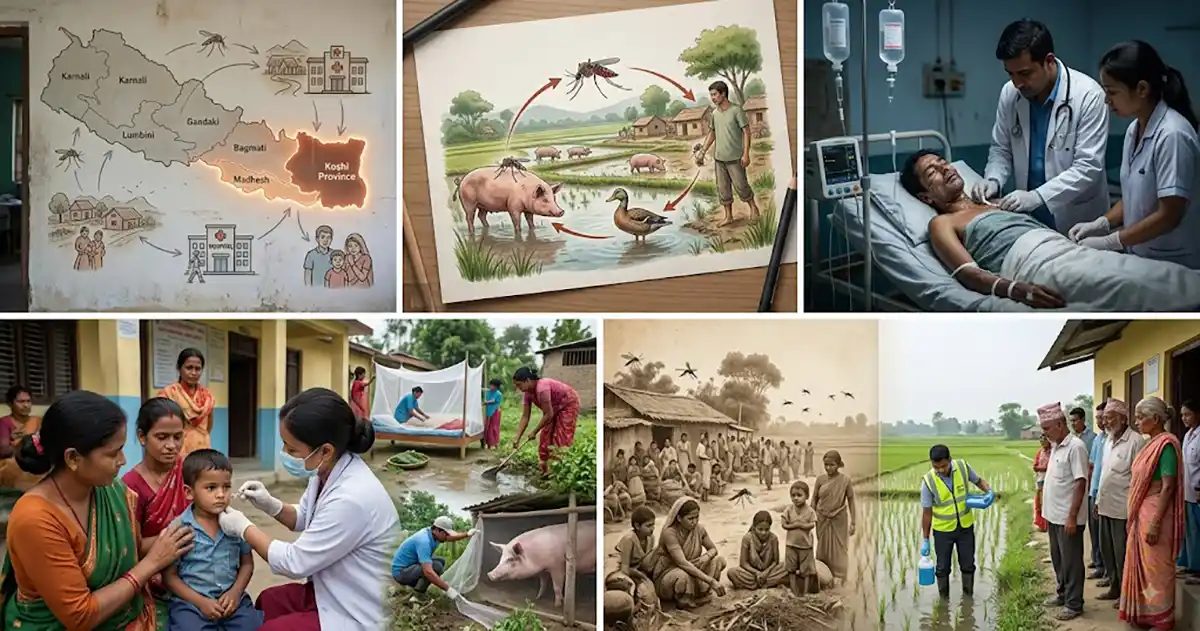
Kathmandu — Nepal is facing an alarming Japanese encephalitis (JE) outbreak with a fatality rate health officials are calling unprecedented. Since the month of Poush (mid-December), the country has confirmed 54 cases of Japanese encephalitis, and 13 of those patients have died — a devastating 24 percent death rate. In simple terms, one out of every four people infected with the mosquito-borne virus this season did not survive. The outbreak has now spread across 21 districts, raising urgent questions about Nepal’s mosquito-control and vaccination programs.
What Is Driving Nepal’s Japanese Encephalitis Crisis?
According to Dr. Abhiyan Gautam, chief of the Immunization Section under the Family Welfare Division, Japanese encephalitis has re-emerged aggressively over the past three years. Last year alone, JE claimed 41 lives nationwide. Health authorities say stronger disease surveillance — not necessarily a bigger outbreak — is partly responsible for the rising numbers, since better testing means more cases are being caught that once went unreported.
Japanese encephalitis is caused by a flavivirus, the same viral family that includes dengue, Zika, yellow fever and West Nile virus. It spreads through the bite of infected Culex mosquitoes, which are most active at dawn and dusk. According to the World Health Organization, JE is estimated to cause around 100,000 clinical cases worldwide every year, with a case-fatality rate of up to 30 percent among those who develop severe brain infection.
Koshi Province Hit Hardest by the Outbreak
Health ministry data shows Koshi Province has recorded the highest number of infections, with 20 confirmed cases and 6 deaths. The breakdown by district:
- Jhapa: 8 infections, 5 deaths
- Morang: 5 infections, 1 death
- Sunsari: 5 infections, 1 death
- Ilam: 2 infections, 1 death
Madhesh Province follows with 11 cases and 3 deaths, spread across Dhanusha, Mahottari, Parsa, Rautahat, Saptari and Bara. Bagmati Province, which includes Kathmandu, reported 7 infections, including cases in Chitwan, Kathmandu, Kavrepalanchok and Makwanpur, with one death in Kavrepalanchok. Lumbini Province recorded 5 cases (4 in Dang, 1 in Kapilvastu), while Gandaki and Karnali provinces reported smaller clusters in Nawalparasi East and Surkhet. Of all confirmed patients, 28 are male and 26 are female.
How Japanese Encephalitis Spreads: Pigs, Ducks and Mosquitoes
Japanese encephalitis does not spread directly from person to person. Instead, infected Culex mosquitoes bite animals — most commonly pigs and ducks — which act as amplifying hosts for the virus. When the same mosquito later bites a human, the infection is transmitted. Dr. Gautam explained that pigs and ducks can multiply the virus “a thousand-fold” once bitten, making them a critical link in the transmission chain. He recommends keeping pigs in netted, enclosed shelters away from homes rather than allowing them to roam freely.
Rice paddy fields, warm temperatures and standing water create ideal breeding conditions for these mosquitoes, which is why Nepal’s flat, agricultural Terai region faces disproportionately higher risk compared to hilly and mountainous areas — although the virus is increasingly being detected in hill districts too. For broader context on mosquito-borne disease prevention, the U.S. CDC’s Japanese encephalitis resource outlines at-risk regions across Asia and the Pacific.
Older Adults Now at Greater Risk Than Children
Traditionally, children under 15 were considered the group most vulnerable to Japanese encephalitis. But Nepal’s current data tells a different story: more than 80 percent of confirmed infections are now in people older than 15, and most deaths are occurring in adults over 50. Dr. Gautam attributes this shift to vaccination gaps — many older adults never received the JE vaccine because immunization programs did not exist or reach them when they were children.
“Most of those who died had not been vaccinated,” Dr. Gautam said. “The vaccination system simply wasn’t available to them earlier, and that’s why we are now seeing infections concentrated in age groups that missed out.”
Symptoms and Long-Term Risks of Japanese Encephalitis
Symptoms typically appear 4 to 14 days after a mosquito bite and include high fever, severe headache, neck stiffness, confusion, muscle rigidity and, in severe cases, unconsciousness. Without prompt treatment, the disease can be fatal. There is currently no specific antiviral drug for JE — treatment focuses on managing symptoms and complications.
Even among survivors, the outlook can be grim: up to 50 percent of severe cases result in long-term neurological damage, including paralysis, memory loss, hearing or vision impairment, and speech difficulties, according to health officials. Roughly 20–30 percent of patients recover fully. These figures align with global estimates from the World Health Organization, which reports that permanent neurological, cognitive or behavioral after-effects occur in 30–50% of severe encephalitis cases worldwide.
Nepal’s Vaccination History and the 2005 Tragedy
Japanese encephalitis is not a new threat for Nepal. In 2005 alone, roughly 2,000 people died from JE, most of them children in the Terai. That catastrophic toll led the government to launch a targeted childhood vaccination campaign starting in 2006, later expanded nationwide with support from international health partners. By 2015, Nepal’s National Immunization Advisory Committee recommended extending the JE vaccine to all children up to age 15 in the remaining 44 districts, and the shot was formally added to the national routine immunization schedule.
Despite this progress, experts like vaccine specialist Dr. Shyam Raj Uprety warn that populations who missed earlier vaccination drives remain dangerously exposed. He is calling for a renewed, targeted immunization campaign to close these gaps before the disease claims more lives.
How to Protect Yourself From Japanese Encephalitis
Health officials recommend the following precautions, especially during dusk, night and early morning hours when Culex mosquitoes are most active:
- Wear long-sleeved clothing that covers the body, even in hot weather
- Use mosquito coils, repellents or other approved protective measures
- Sleep under mosquito nets
- Keep livestock such as pigs in netted, enclosed shelters away from living areas
- Eliminate standing water around homes to reduce mosquito breeding sites
- Get vaccinated against JE if you or your children have not already done so
Dr. Gautam stressed that community-level awareness must go hand-in-hand with health-system surveillance: “This isn’t just about when mosquitoes bite — people need to change their everyday behavior to avoid them.”
This report is based on Nepal’s Ministry of Health and Population data as of Poush 2082 (mid-December 2025 onward). For general health information on Japanese encephalitis prevention and vaccination, consult the WHO fact sheet or your local health authority.

Economic Affair
- Budhigandaki Flood: 47 Rescued as Bridges Washed Away
- Nepal Supreme Court Handcuff Order: Police Barred From Routine Use
- 250+ Officials Deploy to Assess Rasuwa-Bhotekoshi Flood Damage
- Electricity VAT: Energy and Finance Ministers Strike Landmark Deal After Just 2 Months
- Nepal Inflation Shockingly Triples to 5.96% — Food and Transport Hit Hardest



Comments