
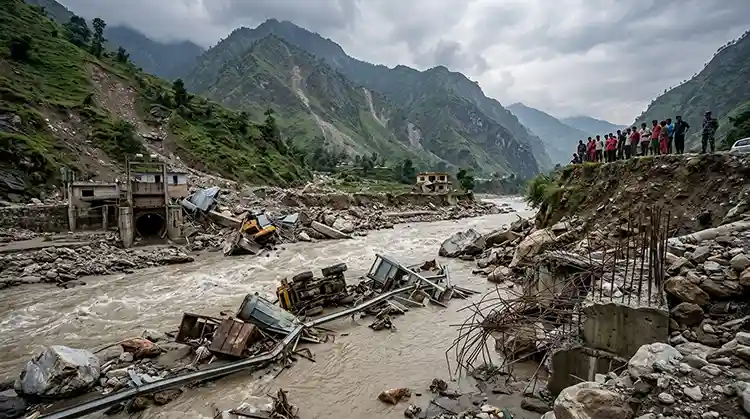
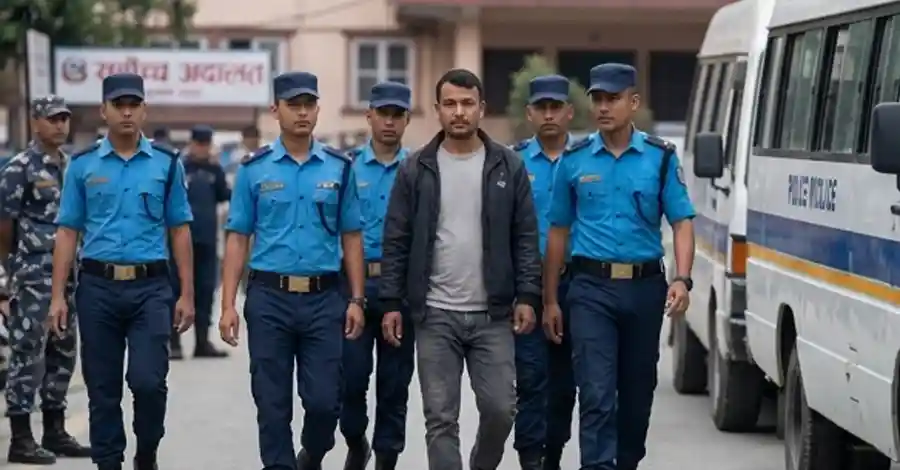
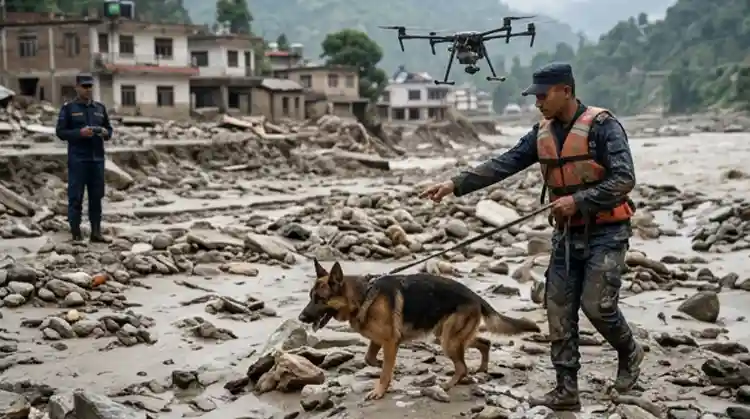





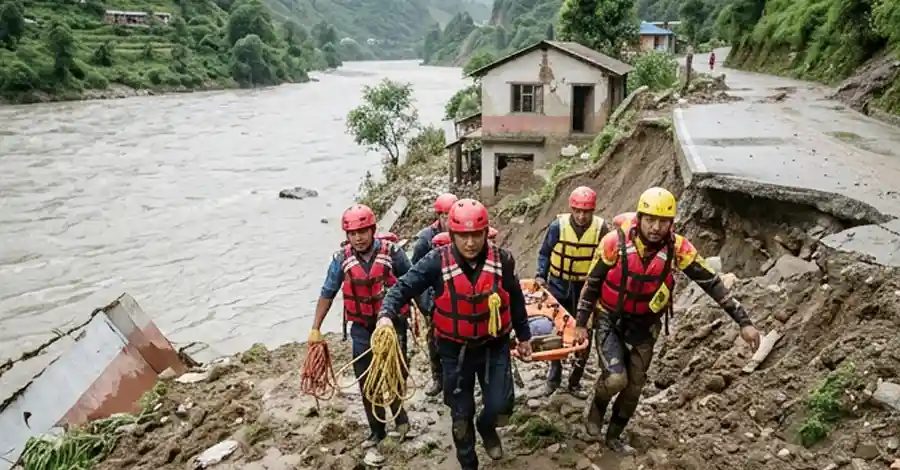
Kathmandu. Nine days after a catastrophic flood tore through Nepal’s Rasuwa district, the Rasuwa flood Nepal disaster has left a staggering trail of loss: 12,038 people rescued, 5,384 treated for injuries, and 1,259 bodies recovered, according to the National Disaster Risk Reduction and Management Authority (NDRRMA). Another 5,083 people remain unaccounted for as of Thursday evening, while more than 21,402 security personnel continue to comb the disaster zone.
What began as a wall of water crashing down the Bhotekoshi River on the morning of August 26, 2026, has grown into one of the deadliest natural disasters in Nepal’s modern history — a tragedy that has tested the country’s emergency response systems, exposed critical gaps in early-warning infrastructure, and drawn international rescue teams from China, India and South Korea into the Himalayan foothills.
This report traces, day by day, how the disaster unfolded, how the government of Prime Minister Balendra Shah responded, and what experts say Nepal must learn before the next flood strikes.
How the Rasuwa Flood Nepal Disaster Began
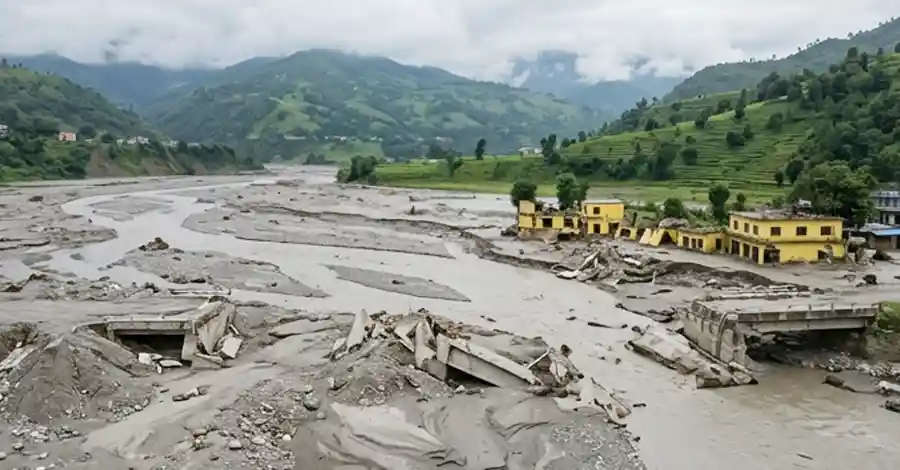
At around 8:37 a.m. on August 26 (10 Bhadau in the Nepali calendar), a massive surge of water, ice and debris roared down from the Nepal-Tibet border into Timure village in Rasuwa district. Within minutes, footage of the flood surfaced online, but its true scale was not immediately understood by the public.
According to geographer Dr. Narendra Raj Khanal, the disaster originated when a rock and ice mass collapsed into the Lhende River, temporarily damming it before the blockage gave way and unleashed a wall of water downstream. Rasuwagadhi lies roughly 14 kilometers from the collapse site, followed by Timure (17 km), Syaphru (28 km), Betrawati (58 km), Trishuli (66 km), Devighat (75 km) and Narayangadh (192 km).
That the flood traveled such a long distance and still caused devastating loss of life, Dr. Khanal notes, is proof that Nepal’s early-warning systems for glacial and river disasters remain dangerously inadequate — a gap flood-prone Himalayan nations continue to struggle with even after Nepal’s 2015 Gorkha earthquake exposed similar preparedness failures.
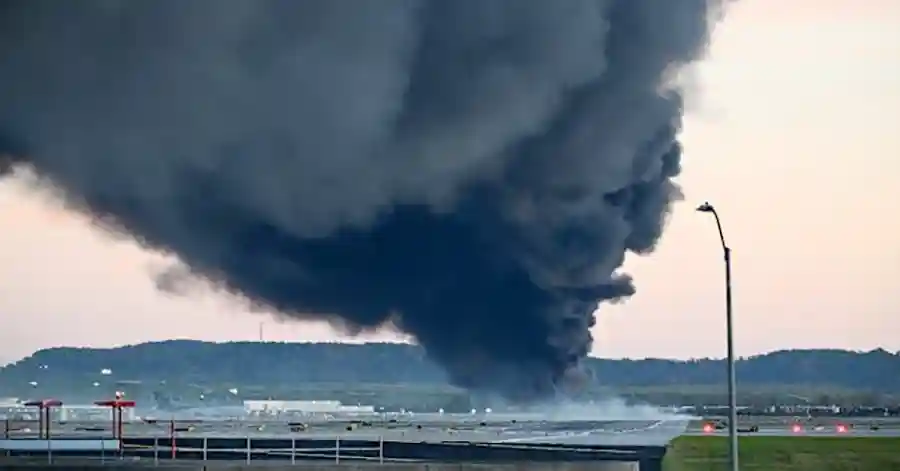
International outlets have since confirmed the scientific picture. According to the United States Geological Survey and independent flood assessments, the seismic tremor recorded that morning was a consequence of the glacial collapse and debris flow — not the trigger of it. Water levels on the Trishuli River reportedly rose by as much as 9 meters (about 27 feet) in just 30 minutes, giving downstream communities almost no time to flee.
A Nation Distracted While Disaster Struck
In a striking irony that has since drawn public criticism, a scheduled discussion program organized by an Indian television channel in Kathmandu went ahead as planned even as the flood raged in Rasuwagadhi, Timure, Syaphrubesi, Betrawati and Trishuli. Senior Nepal government ministers and prominent public figures reportedly attended the event while injured survivors in the flood zone were pleading for rescue.
The contrast became a symbol of the disconnect between the capital and the disaster zone in the disaster’s early hours — a gap the government would spend the following days trying to close through emergency mobilization.
On September 17 (17 Bhadau), addressing Nepal’s federal parliament, Prime Minister Balendra Shah acknowledged the scale of the national tragedy, saying the grief was not confined to Rasuwa, Nuwakot or Dhading alone but had struck at the heart of the entire nation.
Timeline of Nepal’s Emergency Response to the Rasuwa Flood
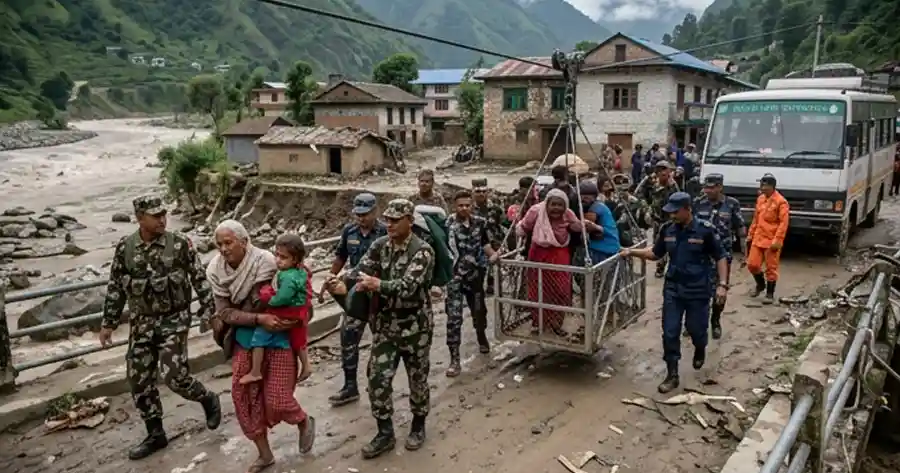
Day 1 (August 26): Emergency Mobilization Begins
- 8:37 a.m. — The flood strikes Timure, causing major destruction.
- 9:15 a.m. — The National Disaster Risk Reduction and Management Committee holds an emergency meeting and orders immediate rescue operations.
- 9:45 a.m. — A Nepal Army Mi-17 helicopter carrying a medical team departs for Rasuwa. Prime Minister Shah later told parliament that private helicopters were also placed on standby.
- Mid-morning — Home Minister Sudan Gurung orders traffic halted on the Prithvi Highway, the Galchhi-Nuwakot-Rasuwa road, and the Muglin-Narayangadh road, and announces a toll-free emergency contact number, 1234.
- 10:00 a.m. — Traffic police block vehicles from entering Rasuwa, Nuwakot, Chitwan and Dhading.
- Late morning — Police confirm security checkposts in Rasuwagadhi, Timure and Syaphrubesi have been swept away; nine armed police personnel stationed at a border outpost go missing.
- 11:00 a.m. — The National Council for Disaster Risk Reduction and Management meets and directs security chiefs to prioritize search, rescue and treatment operations in affected areas.
- 12:30 p.m. — An emergency Cabinet meeting authorizes the home minister to mobilize all available rescue resources, including helicopters.
- By the time the Cabinet meeting concluded, the Nepal Army had already rescued 12 people.
- Before 2:00 p.m. — Of 24 injured people brought to Rasuwa Hospital in Dhunche, one dies during treatment.
- Evening — The Ministry of Health activates its emergency health response system, coordinating with hospitals in Trishuli and Dhunche and preparing Kathmandu’s Bir Hospital, Trauma Centre and Tribhuvan University Teaching Hospital to receive critically injured patients.
- President Ram Chandra Poudel directs all concerned authorities to intensify rescue and relief work.
- Foreign Minister Shishir Khanal briefs parliament, and all political parties pledge unified support for rescue, treatment and relief.
- Indian Prime Minister Narendra Modi calls Prime Minister Shah, offering all possible humanitarian assistance.
- By 7:00 p.m., 72 bodies had been recovered, and more than 400 people — including locals, security personnel and hydropower project staff — were reported missing.
- By 10:00 p.m., the death toll reaches 100.
- That night, Nepal Army trucks carrying mosquito nets, dignity kits, sleeping bags, blankets, plastic sheets, tarpaulins, solar lights and generators are dispatched to the affected areas.
Day 2 (August 27): International Support Begins
Rescue operations resume at dawn. United Nations Secretary-General António Guterres expresses condolences over the human and material losses and pledges support.
An all-party meeting at Singha Durbar results in political leaders issuing a 10-point commitment to jointly confront the disaster. World leaders — including US President Donald Trump, Chinese President Xi Jinping, and Britain’s King Charles III — express solidarity and pledge assistance.
Day 3 (August 28): Death Toll Nears 470
By the morning of August 28, the confirmed death toll reached 469, according to figures corroborated by Al Jazeera’s reporting on the disaster. China’s embassy in Kathmandu warns that the risk from the glacial collapse along the Nepal-China border remains active. Hospital morgues across the country, with a combined capacity of only around 600 bodies, begin overflowing, forcing bodies to be kept in hospital corridors.
Aid organizations, including CARE International, report that at least 700 of the missing were later identified as foreign nationals, with 466 additional people injured, and that an entire settlement of roughly 250 households — many of them families displaced by the 2015 earthquake who had resettled along the Trishuli River — was wiped out.
Day 4-6 (August 29-31): Tunnel Rescue Crisis
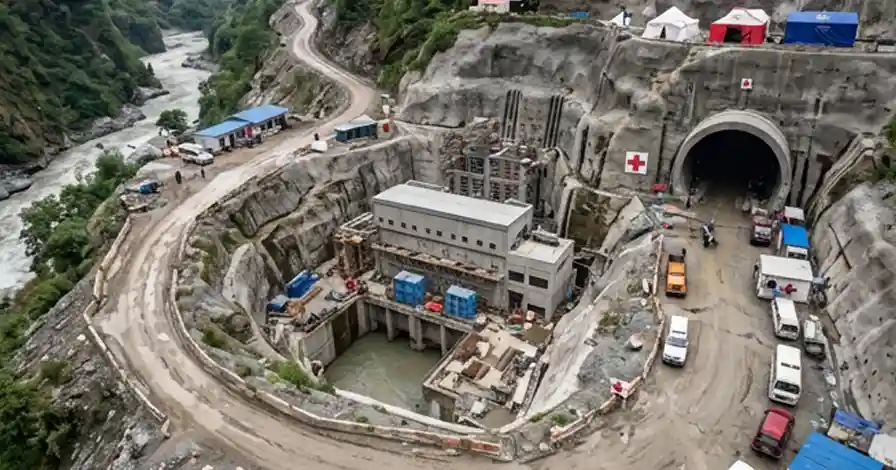
More than 35 people are believed trapped inside the tunnel of the Upper Trishuli-3A Hydropower Project. Desperate families demand action from the prime minister and turn to social media to search for missing relatives.
By August 30, sufficient relief supplies have been collected nationally, but complaints emerge that aid is not reaching victims in remote areas. As body management becomes increasingly difficult, the government prepares to bury unidentified bodies in Chitwan, later extending similar measures to Kathmandu and Kaski.
Criticism intensifies as more than 600 people remain trapped in hydropower tunnels for four days without rescue. On August 29 (13 Bhadau), Chinese and Indian rescue teams arrive in Nepal to assist.
Day 7-8 (September 1-2): Specialist Teams Deployed
A second Chinese tunnel-rescue specialist team arrives on September 1. The same day, a joint Nepal Army and Indian tunnel-rescue team retrieves two bodies from the Chilime Hydropower Project tunnel. Prime Minister Shah confirms via social media that rescue teams from China, India and South Korea are actively assisting Nepali security forces.
By the morning of September 2, the death toll rises to 903, while police confirm that 10,451 people have been rescued in total. Around this time, a major landslide damages the road at Krishnabhir under the Nagdhunga-Muglin section, cutting off the Prithvi Highway.
Prime Minister Shah separately briefs the chiefs of the Nepal Army, Nepal Police and Armed Police Force on the disaster response. Citing climate change as the underlying cause of the flood, Nepal formally writes to the United Nations’ Loss and Damage Fund requesting compensation.
Day 9 (September 3-4): Death Toll Crosses 1,259
Search efforts continue at the Upper Trishuli-3A tunnel, with rescuers breaking through concrete walls to reach those trapped. On September 3, the government releases its first official situation report, confirming that 1.6 million people have been affected by the disaster nationwide.
A temporary cable crossing (tuin) is installed at Battar in Nuwakot after nearly three dozen bridges collapse, cutting off road access across Rasuwa, Nuwakot, Dhading and Chitwan.
International and joint rescue teams reportedly penetrate roughly 50 meters into the Chilime Hydro tunnel, 150 meters into the Langtang Hydro tunnel, and 200 meters into the Upper Trishuli-1 tunnel in continued search operations. Home Minister Gurung clarifies that a single-window coordination system has been implemented to prevent duplication and mismanagement of rescue efforts.
On September 4 (17 Bhadau), Prime Minister Shah formally briefs the House of Representatives, calling Rasuwa’s tragedy a shared blow to the entire nation. Speaker Dev Raj Ghimire draws the government’s attention to ensuring the safety of flood-affected women and children. By Thursday evening, the confirmed death toll stands at 1,259.
On September 5 (18 Bhadau), two more bodies are recovered from the tunnel of the Langtang Khola Hydropower Project in Rasuwa.
Did Nepal’s Government Respond Well to the Rasuwa Flood?
What Went Right
Former NDRRMA chief executive Anil Pokharel credits the government with two major achievements. According to Pokharel, state machinery mobilized in the field almost immediately, a marked improvement over past disasters where response typically took much longer. He also points to the scale of personnel deployment — helicopters and large numbers of security forces were mobilized without major resource shortages.
Where the Government Fell Short
Pokharel is far more critical of the tunnel rescue effort, arguing that Nepal simply lacked the technical knowledge and equipment needed to extract people trapped deep inside hydropower tunnels — a gap he says must urgently be addressed.
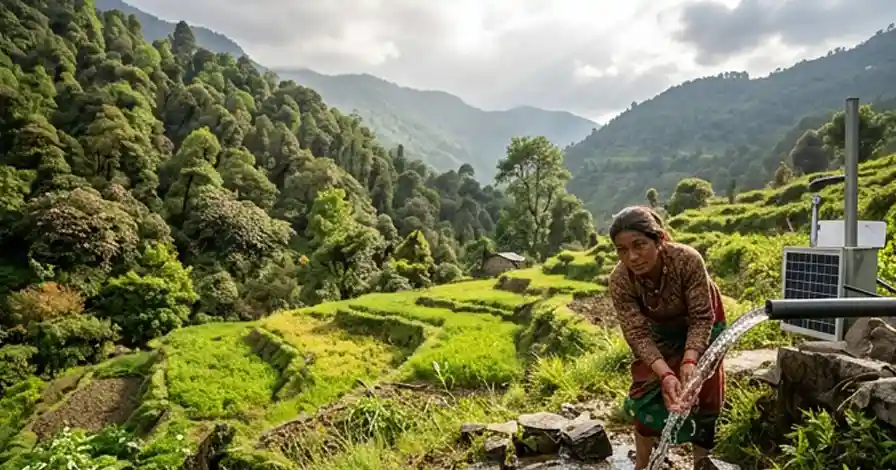
Pokharel is equally blunt about Nepal’s early-warning systems, stating that the country effectively had no functioning glacial lake or flood early-warning system in place, and that whatever limited infrastructure existed failed to provide meaningful warning of the risk.
He also notes that rural municipalities and ward offices lacked basic disaster stockpiles and equipment, arguing that Nepal failed to strengthen local government disaster preparedness even after the lessons of the 2015 Gorkha earthquake.
Field reports also point to a shortage of trained volunteers, even as some controversial groups, such as the “Green Army,” appeared active on the ground. Prabha Bogati, deputy mayor of the flood-affected Bidur Municipality, described a severe shortage of volunteers able to reach areas inaccessible by helicopter or road — even locations just five minutes away — and said responders were often unable to act even when bodies were seen floating down the river.
Former CEO of the National Reconstruction Authority (formed after the 2015 earthquake), Yuvraj Bhusal, argues the government’s tunnel rescue response fell short, suggesting that international rescue assistance for those trapped underground should have been mobilized more quickly, even acknowledging that procedural delays likely played a role. Still, Bhusal concludes that overall, the government’s broader response was commendable given the scale of the catastrophe.
Scale of the Disaster in Numbers
- 12,038 — people rescued as of the ninth day
- 5,384 — people treated for injuries
- 1,259 — confirmed deaths as of Thursday evening
- 5,083 — people still unaccounted for
- 21,402 — security personnel mobilized nationwide
- 1.6 million — people affected nationwide, per the government’s first situation report
- 600+ — bridges and hydropower tunnels affected; roughly 30 bridges destroyed
- 600 — combined body storage capacity of hospitals nationwide, which proved insufficient
International figures reported separately by the Associated Press and other outlets in the days following the disaster placed the toll above 360 dead with more than 1,400 missing in the earliest phase, a number that has climbed steadily as search operations have continued and communications have been restored to isolated settlements.
What Triggered the Bhotekoshi Flood?
Scientific consensus, according to geological assessments cited by international media, points to a glacial or rock-ice collapse in the high mountains near the Nepal-Tibet border, which formed a temporary natural dam across a tributary river. When that natural dam failed, it unleashed an enormous surge of water and debris downstream through the Lhende, Bhotekoshi and Trishuli river systems, devastating everything in its path across four districts — Rasuwa, Nuwakot, Dhading and Chitwan.
Nepali authorities have formally attributed the disaster to climate change, pointing to accelerating glacial melt and unstable high-altitude terrain in the Himalayas as contributing long-term factors, and have sought compensation through the United Nations’ international loss and damage mechanism.
Lessons for Nepal’s Disaster Preparedness
Experts broadly agree on three urgent priorities emerging from the Rasuwa flood disaster:
- Early-warning systems. Nepal needs functioning glacial lake outburst flood (GLOF) and river-level monitoring systems capable of giving downstream communities life-saving advance notice, even when the source of danger lies dozens of kilometers away or across an international border.
- Technical rescue capacity. The prolonged struggle to reach people trapped inside hydropower tunnels exposed a critical lack of specialized underground rescue equipment and trained personnel — capacity gaps that had to be filled by international teams from China, India and South Korea.
- Local government preparedness. Ward and municipal offices in disaster-prone regions need dedicated equipment, emergency stockpiles and trained volunteer networks so that response does not depend solely on national-level mobilization.
Frequently Asked Questions
How many people died in the Rasuwa flood in Nepal? As of the ninth day after the disaster, Nepal’s disaster authority confirmed 1,259 deaths, with 5,083 people still missing.
What caused the Bhotekoshi flood in Rasuwa? Geological experts believe a glacial or rock-ice collapse near the Nepal-Tibet border formed a natural dam, which later burst and sent a massive surge of water and debris down the Lhende, Bhotekoshi and Trishuli rivers.
Which countries helped in the rescue operation? Rescue teams from China, India and South Korea joined Nepal’s Army, Police and Armed Police Force in search and rescue operations, particularly in the technically difficult hydropower tunnel rescues.
Which districts were most affected by the flood? Rasuwa, Nuwakot, Dhading and Chitwan districts bore the brunt of the destruction, with entire settlements and dozens of bridges destroyed.

Economic Affair
- Budhigandaki Flood: 47 Rescued as Bridges Washed Away
- Nepal Supreme Court Handcuff Order: Police Barred From Routine Use
- 250+ Officials Deploy to Assess Rasuwa-Bhotekoshi Flood Damage
- Electricity VAT: Energy and Finance Ministers Strike Landmark Deal After Just 2 Months
- Nepal Inflation Shockingly Triples to 5.96% — Food and Transport Hit Hardest


Comments