










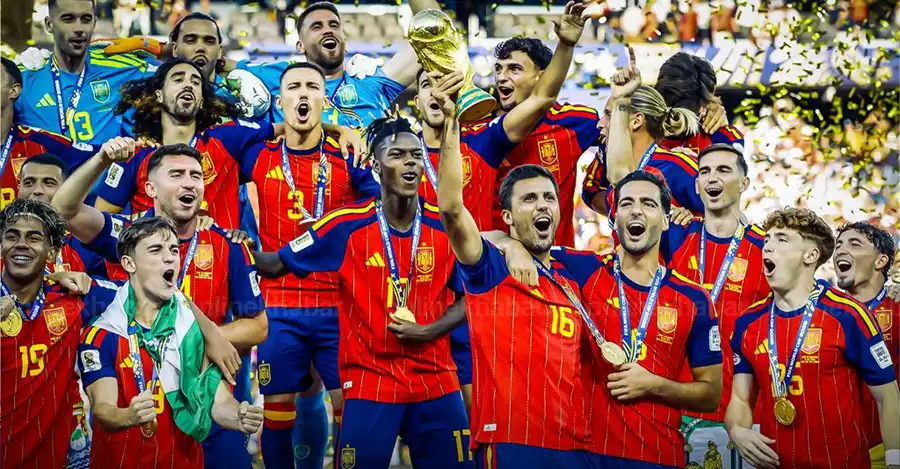
Spain didn’t merely lift the FIFA World Cup 2026 trophy — they demolished record after record along the way. Luis de la Fuente’s side produced one of the most statistically dominant campaigns in tournament history, breaking marks for passing, clean sheets, dribbling, and an unbeaten run that stretches back years. Here’s a breakdown of every milestone La Roja set during their triumphant World Cup 2026 run.
Rodri Breaks His Own World Cup Passing Record
Spain captain Rodri completed an extraordinary 790 passes across the tournament, shattering his own World Cup record for a single edition. He had previously set the mark with 638 successful passes at Qatar 2022, which itself broke a benchmark set by Xavi at the 2010 World Cup. His closest challengers this time were teammates Pau Cubarsi with 668 and Aymeric Laporte with 618, underlining just how far ahead of the pack Spain’s midfield engine operated.
Cucurella and Cubarsi Log the Most Minutes on the Pitch
Defenders Marc Cucurella and Pau Cubarsi were fixtures of the Spanish backline, each playing 750 minutes — the joint-most among outfield players alongside Argentina’s Alexis Mac Allister. Their near ever-present role reflected the defensive consistency that underpinned Spain’s title run.
Oyarzabal’s Relentless Work Rate Off the Ball
It wasn’t just Spain’s attacking numbers that stood out. Mikel Oyarzabal forced 58 turnovers, more than any other player at the tournament, while teammate Pedri and Morocco’s Neil El Aynaoui followed with 51 apiece. Dani Olmo, meanwhile, applied the most defensive pressures of any player, with 305 — evidence of a squad that pressed and hunted the ball as relentlessly as it kept possession.
Spain’s Unbeaten Streak Reaches 38 Games
Spain’s World Cup final victory extended their unbeaten international run to 38 matches, a new world record. The streak began after a defeat to Colombia in March 2024, since which Spain have won 29 games and drawn 9, eclipsing the previous 37-match record held by Italy.
Lamine Yamal’s Dribbling Masterclass
At just 19, Lamine Yamal was Spain’s most electric dribbler, completing 35 successful take-ons — the most of any player at the tournament. Kylian Mbappe (28), Lionel Messi (25), Vinicius Junior (23) and Jeremy Doku (21) rounded out the top five, but none could match Yamal’s directness on the ball.
Yamal Joins an Elite Club of Teenage World Champions
At 19 years and 6 days old, Yamal became one of the four youngest players ever to win a World Cup, a group that otherwise includes only Brazilian greats Pele and Ronaldo, plus Italy’s Giuseppe Bergomi. His teammate Pau Cubarsi, also 19, ranked seventh on that all-time list — meaning Spain’s own defenders and attackers occupy multiple spots among football’s youngest world champions.
Spain’s Most Prolific World Cup Goal Tally
Spain found the net 14 times across the tournament — their highest World Cup goal tally in history, surpassing the 12 goals scored in 1986 and well clear of the 8 goals managed during their 2010 title-winning campaign.
Seven Straight Wins to the Title
After drawing their opening group match, Spain reeled off seven consecutive victories to lift the trophy — the second-best winning streak to close out a World Cup, behind only Brazil’s 11-match run between 2002 and 2006.
Unai Simon’s Historic Clean Sheet Record
Goalkeeper Unai Simon kept seven clean sheets in eight matches, the most ever recorded in a single World Cup edition, surpassing the previous best of five, a mark shared by six different goalkeepers across tournament history including Italy’s Gianluigi Buffon and Spain’s own Iker Casillas. Simon also went 650 minutes without conceding a goal, breaking Italian great Walter Zenga’s long-standing record of 517 minutes from the 1990 World Cup.
Oyarzabal Matches Spain’s All-Time World Cup Scoring Record
Mikel Oyarzabal finished the tournament with five goals, matching the Spanish record for goals scored by a player in a single World Cup, a mark previously shared by Emilio Butragueno in 1986 and David Villa during the victorious 2010 campaign.
Ferran Torres’ Super-Sub Final Winner
Coming off the bench in the final, Ferran Torres scored the decisive goal to become only the second substitute in World Cup final history to score a match-winning goal — following in the footsteps of Germany’s Mario Gotze, who achieved the same feat in the 2014 final against Argentina.
The Meanest Defense of Any World Cup-Winning Side
Perhaps most remarkably, Spain conceded just a single goal across the entire tournament — the fewest ever by a World Cup-winning team in a single edition. Previous champions France (1998), Italy (2006) and Spain themselves (2010) had each conceded two goals en route to the title.
Awards Sweep Confirms Spain’s Dominance
Spain’s statistical dominance was reflected in FIFA’s individual honours too. Rodri won the Golden Ball as the tournament’s best player, Unai Simon claimed the Golden Glove for the top-performing goalkeeper, and Pau Cubarsi took home the Best Young Player award, beating out his own teammate Yamal for the prize. For full official statistics and award details, see FIFA’s World Cup 2026 champions report.
Between record-breaking passing numbers, a historic defensive record, and a golden generation of teenage talent, Spain’s 2026 World Cup triumph will be remembered as one of the most statistically dominant championship runs the tournament has ever seen.

Economic Affair
- Budhigandaki Flood: 47 Rescued as Bridges Washed Away
- Nepal Supreme Court Handcuff Order: Police Barred From Routine Use
- 250+ Officials Deploy to Assess Rasuwa-Bhotekoshi Flood Damage
- Electricity VAT: Energy and Finance Ministers Strike Landmark Deal After Just 2 Months
- Nepal Inflation Shockingly Triples to 5.96% — Food and Transport Hit Hardest





Comments