





For ten days there was nothing but darkness inside the tunnel. No voice, no signal, no sign of life. Then, on a Friday morning, rescuers pulled two men out of the mud at the Upper Trishuli-3A hydropower project. A day later, a Chinese national was hauled alive from a separate tunnel at Upper Trishuli-1. Against odds that grew slimmer with every passing hour, the Nepal Trishuli hydropower tunnel rescue operation has delivered three confirmed survivors — and a wave of renewed hope for hundreds of families still waiting for news of their loved ones.
The rescues are the first bright spots in a disaster that has devastated Nepal’s Trishuli-Bhotekoshi river corridor since a catastrophic glacier-triggered flash flood tore through the region on August 26. Nearly two weeks later, close to 700 workers connected to hydropower projects along the corridor remain unaccounted for, even as joint Nepali, Indian, Chinese and South Korean rescue teams continue digging through tunnels choked with silt, boulders and debris.
This report walks through every major hydropower project along the Trishuli corridor — from the China border down to Devighat in Nuwakot — explaining what happened at each site, how many workers were inside, how many have been reached, and how many are still missing.
Nepal Flash Flood: What Triggered the Trishuli Disaster?
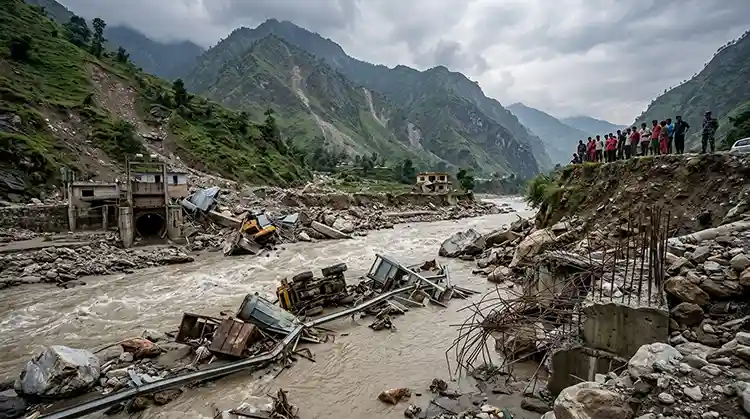
The disaster began on the morning of August 26, when a massive glacial ice-and-rock collapse broke off the northern flank of the Langtang Himal and thundered roughly 1,500 meters downhill. The resulting slurry of ice, rock and water surged into the Lhende stream before crashing into the Bhotekoshi and Trishuli rivers, according to on-the-ground reporting compiled by NPR.
The scale of destruction has been staggering. Nepal’s disaster management authorities say the death toll from the flash floods has climbed past 1,300, with thousands more still listed as missing across the affected districts, as reported by Al Jazeera. On the Tibetan side of the border, Chinese state media has separately reported dozens killed and hundreds missing from the same weather system, according to coverage syndicated by NPR.
Along the Nepal side of the corridor alone, roughly a dozen hydropower stations were directly in the flood’s path. Collectively, these projects represent more than 431 megawatts of generation capacity — close to a tenth of Nepal’s total installed national power capacity — now sitting damaged, buried, or destroyed.
Why So Many Workers Were Trapped Underground
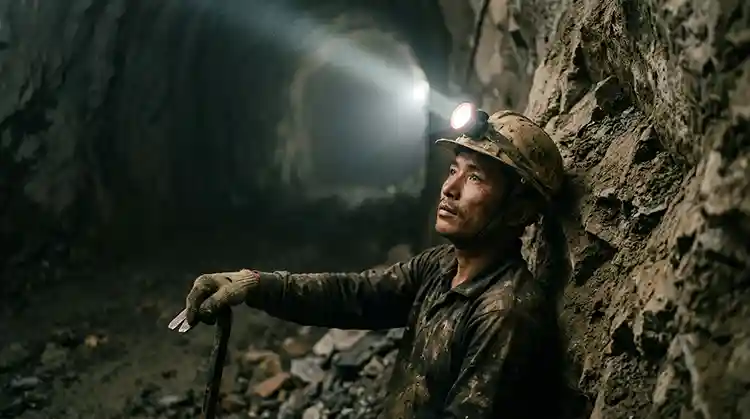
Hydropower plants of this scale rely on long headrace tunnels that channel river water from an intake structure (called the “headworks”) down to an underground powerhouse, where turbines generate electricity. Workers are routinely stationed deep inside these tunnels and powerhouses for construction, maintenance, and monitoring shifts — which is exactly why so many people were trapped the moment floodwater and debris sealed the tunnel entrances.
Officials with the Independent Power Producers’ Association of Nepal estimate that about 900 workers tied to a dozen hydropower projects were initially reported missing, with roughly 500 believed trapped specifically inside tunnel systems, based on figures cited by NPR.
Rasuwagadhi Hydropower Project: Reopened Just Months Before Disaster
At the very top of the Trishuli corridor, close to the Nepal-China border crossing, sits the headworks of the 111-megawatt Rasuwagadhi Hydropower Project. The dam and intake structures channel water through a tunnel to an underground powerhouse — but that access tunnel is now completely blocked by debris.
Rasuwagadhi is built and operated under Chilime Hydropower Company, a subsidiary of the Nepal Electricity Authority. The project’s office building in Timure has also been swept away.
At the moment the flood struck, 12 employees were reportedly working inside the underground powerhouse, while the total headcount of staff and contractor laborers on site stood at 97. The project had only just returned to full operation this past May (Jestha, in the Nepali calendar) after suffering flood damage the previous monsoon season — which explains why extra repair and reconstruction crews were present.
Of the 97 people on site, only four contractor workers have been confirmed safe. The remaining 93 are still unaccounted for. Company officials say rescue teams managed to push roughly 250 meters into the tunnel before a massive boulder blocked further progress, forcing the team to retreat with no update since.
Langtang Khola Hydropower Project: 39 Still Missing After Trial Run
About 24 kilometers downstream from the Rasuwagadhi border checkpoint, on a steep cliff face near Syabrubesi, sat the 20-megawatt Langtang Khola Hydropower Project — a privately financed plant that was still in trial production when disaster struck.
The plant had finished construction and was undergoing test operations, with a maintenance crew also on site to fix minor issues, when the flood hit. Its surface-level powerhouse has been completely washed away.
Of the 60 people working at the project, 19 have been rescued alive. Two bodies were recovered on Thursday. That leaves 39 workers still missing. An Indian rescue team has conducted aerial reconnaissance of the site, but progress on the ground remains extremely difficult given the terrain.
Chilime Hydropower Project: 6 Workers Trapped in Underground Control Room
Also located in Syabrubesi, right beside the concrete bridge over the Trishuli River, is the powerhouse of the Chilime Hydropower Project — a 22-megawatt plant that also operates under the Nepal Electricity Authority’s subsidiary structure. Chilime holds a special place in Nepal’s hydropower history: it was one of the earliest projects to offer local residents of Rasuwa district a direct equity share, a model that helped popularize community shareholding in Nepali hydropower.
The plant’s main access tunnel runs roughly 250 meters to reach the powerhouse structure, but rescuers have only managed to clear about 90 meters before hitting an impassable wall of mud. The tailrace — the outlet where water normally exits the powerhouse — is similarly blocked by sludge and large boulders, cutting off that route as well.
Six technical staff are believed trapped inside the underground powerhouse’s control room, which sits roughly 20 meters above the underground floor level. Because the structure includes a third floor, rescue officials believe there’s a reasonable chance the trapped workers found safety above the floodwaters. A combined team of the Nepali Army, Indian tunnel-rescue specialists, rock and climbing units, and Nepal Electricity Authority technicians is working the site.
Upper Trishuli-1: The Corridor’s Deadliest Site, With Nearly 560 Still Missing
The single largest hydropower project on the main stem of the Trishuli River is Upper Trishuli-1 — and it has suffered the corridor’s heaviest human toll. Financed by South Korean investors, the 216-megawatt project was about 86 percent complete when the flood struck.
At the time, work crews were active across four separate zones — the dam area, the headworks, the underground powerhouse and additional support sites — meaning an unusually large workforce was present. Roughly 1,400 Nepali, Indian, South Korean and Chinese workers were on site. Of those, 876 have since been confirmed safe, leaving approximately 557 people still unaccounted for.
Chinese Worker Rescued Alive 10 Days After Flood
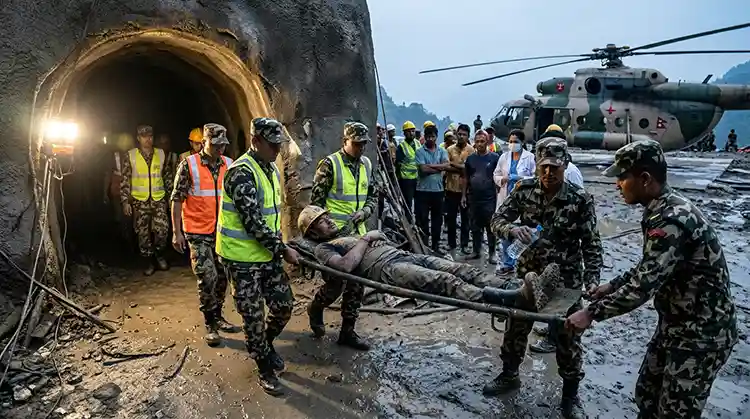
On day 11 of the search, a Chinese national identified as Lu Haitao was pulled alive from the tunnel — a rescue that has injected fresh hope into the broader search effort. According to Nepal’s national broadcaster and multiple Nepali outlets, he was located and freed from a point roughly 225 meters inside the project’s Audit-4 tunnel at around 1:20–1:30 pm on Saturday, in a joint operation involving the Nepali Army and South Korean disaster-response experts, as reported by Republica and Himalayan Tribune.
He was reportedly found close to 15 meters above the base of a 26-meter-tall “de-sander” structure — a facility designed to settle sediment out of river water before it enters the headrace tunnel. Upper Trishuli-1’s de-sander structures each measure about 110 meters in length and 26 meters in height, and three such units exist at the site. Technical staff believe he likely climbed the maintenance ladder built into the structure — either while working, or as the floodwaters rose — which may have kept him above the worst of the deluge.
A 9-Kilometer Tunnel, Half Buried in Sand
From the de-sander, filtered water normally travels through a headrace tunnel toward the powerhouse. At Upper Trishuli-1, that tunnel stretches roughly 9.1 kilometers, and rescuers say as much as 4 kilometers of it is now packed with sand and sediment — a stretch rescue teams describe as extraordinarily difficult to clear.
Long tunnels like this aren’t excavated in a single continuous dig; construction crews instead build a series of shorter “adit” tunnels that branch off to reach the main horizontal shaft, and these adits double as access and escape routes during construction. Rescue teams see these adits as a possible alternate path to reach trapped workers, but many are themselves clogged with flood-driven mud and abandoned excavators, slowing progress further.
Upper Trishuli-1 is being built by the Nepal Water and Energy Development Company, a South Korean-financed entity, with South Korea’s Doosan Enerbility serving as the main contractor. Indian firm Andritz Hydro and China’s PowerChina are also involved as subcontractors — which explains the presence of South Korean and Chinese rescue specialists at the site.
Upper Trishuli-3A: Where the First Survivors Emerged
The first confirmed rescues of the entire disaster came from the 60-megawatt Upper Trishuli-3A project, built by the Nepal Electricity Authority on the Rasuwa-Nuwakot border and commercially operational since mid-2019.
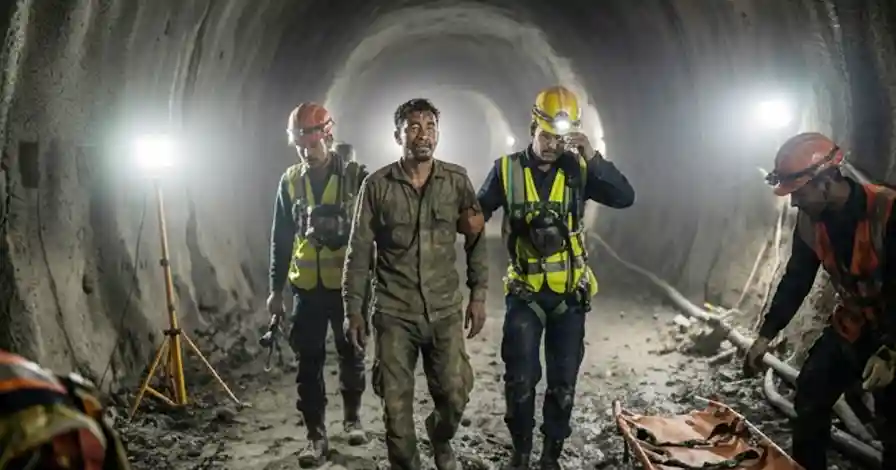
The flood destroyed the project’s headworks and de-sander structures outright, and completely blocked the main access tunnel leading to its underground powerhouse. With the primary route sealed, rescue teams instead entered through the plant’s cable tunnel — the passage normally used to run electrical cables from the powerhouse to the surface — and it was through this route that mechanical foreman Sanjay Sah, 30, and mechanical supervisor Kabir Maharjan, 45, were pulled out alive on Friday morning, as confirmed by CNN and Al Jazeera.
According to relatives who spoke with international media, Sah had watched the headworks wash away on a monitoring camera feed from the underground control room and shouted for his colleagues to run. It’s unclear exactly how far his colleagues made it before the water hit — 38 workers from the site remain unaccounted for. While a plant of this size doesn’t typically require a large operating staff, ongoing routine maintenance meant around 40 people were present underground when the flood struck.
Family members told CNN that Sah’s father initially refused to believe the rescue news until he saw a photograph, while Kabir Maharjan’s brother said the family was overwhelmed with relief, according to accounts carried by NBC News.
Upper Trishuli-3B: Nearly 200 People Unaccounted For
Just downstream, near Betrawati on the Nuwakot-Rasuwa boundary, the 37-megawatt Upper Trishuli-3B project was still under construction under Nepal’s “People’s Hydropower Program,” jointly financed by the Nepal Electricity Authority and Nepal Telecom.
Workers inside the project’s main headrace tunnel managed to escape on their own once the water flow subsided, but the dam, offices, staff housing and powerhouse have all been severely damaged or destroyed. Nearly 200 people connected to the site — including staff of contractor Fewa Construction, consultancy firm Chilime Engineering, interns from Kathmandu University, and security guards — remain unaccounted for. A site contact told reporters that many of those still missing are feared to have been inside the office and residential buildings when disaster struck.
Nearby, the 15.6-megawatt Middle Trishuli Ganga project was also under construction at the time of the flood, though detailed casualty or rescue figures for that site have not yet been made public.

Trishuli Bazar and Devighat: Early Warnings Prevented Deaths
Further downstream, two of Nepal’s oldest hydropower facilities — the 24-megawatt Trishuli Hydropower Center at Trishuli Bazar and the 14.1-megawatt Devighat plant, which uses water diverted from the Trishuli plant — largely escaped the worst outcomes.
According to Nuwakot’s Chief District Officer, Shambhu Prasad Regmi, both plants sit at comparatively lower elevation and benefited from advance flood warnings, allowing most staff to be evacuated in time. Even so, three people remain missing from the Trishuli plant and one from Devighat.
The Bigger Picture: Nine Projects, Seven With Trapped or Missing Workers
Taken together, at least nine hydropower projects along the Trishuli-Bhotekoshi corridor were affected by the flood, and seven of them have confirmed workers who were trapped or are still missing. The heaviest uncertainty by far remains at Upper Trishuli-1, where roughly 557 people are still unaccounted for.
Yet hope has not disappeared. Saturday’s rescue of a Chinese worker alive from Upper Trishuli-1 came just a day after two Nepali workers were successfully freed from Upper Trishuli-3A — evidence, rescuers say, that survivors may still be sheltering in pockets of air deep within these tunnel systems.
Adding to the danger, geologists have warned that a temporary glacial lake is still forming in the Lhende stream near the site of the original ice-and-rock collapse. If that lake breaches, experts caution it could trigger a second wave of flooding down the same corridor — a risk that is shaping how rescue teams plan their operations near riverbanks and tunnel mouths.
International Rescue Effort and Ongoing Search
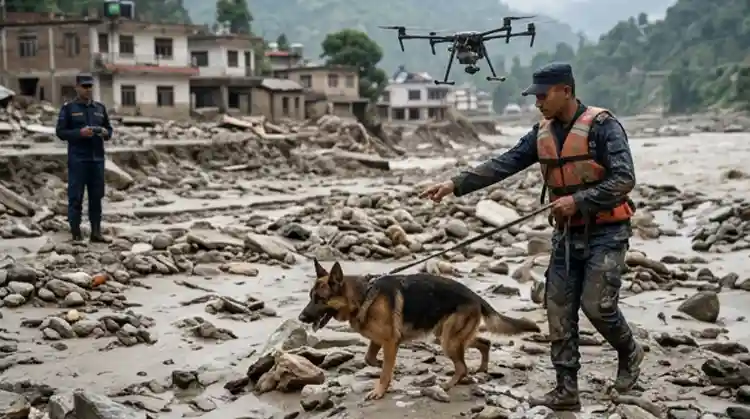
The search and rescue effort has become a genuinely multinational undertaking. Nepal’s army has deployed thousands of personnel across the flood zone, alongside specialist tunnel-rescue teams from India, China and South Korea, and geological and engineering advisors assisting with excavation planning, according to reporting from CNN.
Rescue crews have used a combination of heavy excavators, controlled use of explosives to clear blocked passages, hand-digging in the most delicate zones, and rafts and pumps to navigate flooded tunnel sections. Teams have reported making incremental progress at several sites, including clearing hundreds of meters of access route between the Upper Trishuli-1 and Trishuli-3B tunnels in an effort to link up rescue operations across the two projects.
The United Nations and humanitarian partners have also stepped in, launching a multimillion-dollar emergency appeal to fund life-saving assistance for tens of thousands of people affected by the flooding across Nepal’s northern districts.
What Comes Next for Nepal’s Flood-Hit Hydropower Corridor
For the families of hundreds of missing hydropower workers, the wait continues. At shelters and hospitals across Kathmandu, relatives are holding on to a single question: where is our person? Every rescue — however rare — keeps that hope alive, and rescue teams have vowed to continue searching until the last worker is accounted for.
Beyond the human toll, the disaster carries major implications for Nepal’s energy sector. With more than 431 megawatts of hydropower capacity damaged or destroyed — close to 10 percent of the country’s installed national capacity — the flood has exposed how concentrated, and how vulnerable, hydropower development has become along a single glacier-fed river corridor. Questions about tunnel safety protocols, early-warning systems for glacial lake outburst floods, and worker evacuation planning are likely to shape how Nepal — and other Himalayan nations relying on similar river-corridor hydropower — approach future project design.
For now, though, the story remains one of search and hope: soldiers, engineers and volunteers pushing meter by meter through mud-choked tunnels, listening for the faintest sound of a voice in the dark.

Economic Affair
- Budhigandaki Flood: 47 Rescued as Bridges Washed Away
- Nepal Supreme Court Handcuff Order: Police Barred From Routine Use
- 250+ Officials Deploy to Assess Rasuwa-Bhotekoshi Flood Damage
- Electricity VAT: Energy and Finance Ministers Strike Landmark Deal After Just 2 Months
- Nepal Inflation Shockingly Triples to 5.96% — Food and Transport Hit Hardest



Comments