



Nepal’s government has taken a decisive step toward closing one of the most painful chapters of the year. The two separate probe committees investigating the deadly Sunsari and Siraha clashes have formally submitted their findings to Home Minister Sudhan Gurung, the Ministry of Home Affairs confirmed on Tuesday. The Sunsari-Siraha investigation report marks the first concrete move toward accountability since the violence broke out in Kaptanganj in late July, a tragedy that eventually claimed four lives and shook confidence in inter-community relations across the eastern Tarai.
Home Ministry Deputy Spokesperson Rama Acharya confirmed to media outlets that both panels handed over their reports on the same day. “The committee has submitted the report today. Now it will move toward action after a review,” Acharya said, signaling that the ministry’s next step will involve studying the findings before deciding on further measures, including possible disciplinary or legal action against those found responsible.
Why The Sunsari-Siraha Investigation Report Matters
For the families of the victims, local communities, and political observers across Nepal, this report is more than a bureaucratic formality. It represents the government’s first official attempt to establish exactly what happened on the night of July 26, why the situation spiraled into gunfire, and who bears responsibility for a chain of events that ultimately spread unrest across four districts of Madhesh province. Given the scale of public anger that followed the incident, the credibility of this investigation carries real weight for Nepal’s efforts to restore communal trust in the Tarai-Madhesh belt.
How The Kaptanganj Clash Began
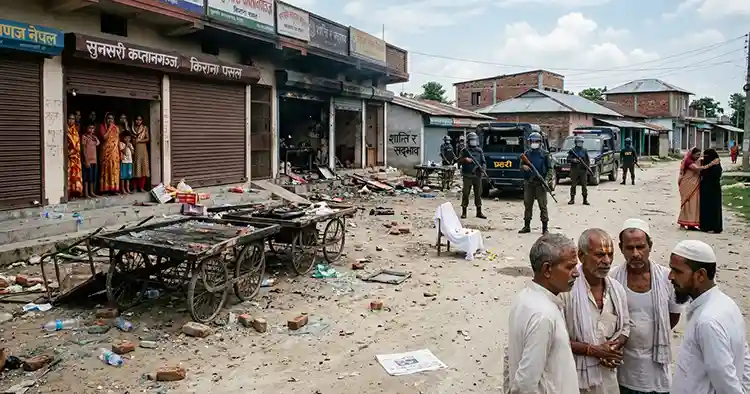
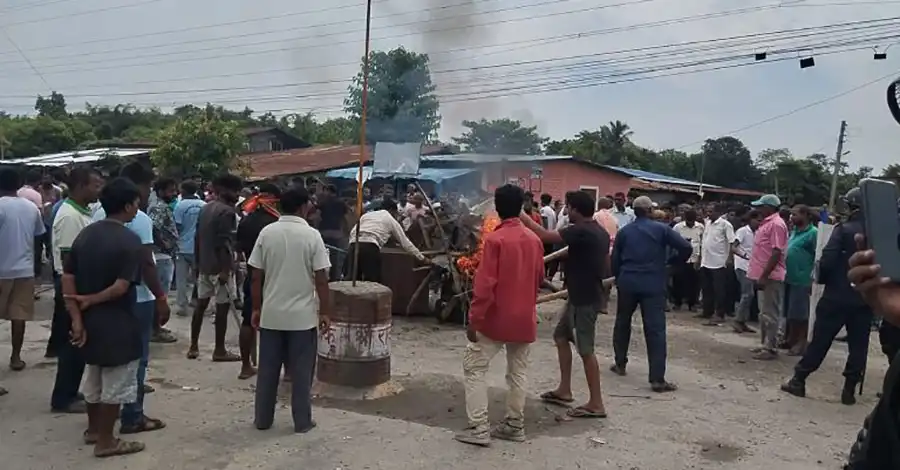
The unrest originated in Kaptanganj, Ward No. 3 of Dewanganj Rural Municipality in Sunsari district, a border town close to the Indian state of Bihar. According to Sunsari District Police Office accounts reported by local media, a group of Hindu devotees were returning from the Koshi Barrage on the night of July 26 carrying holy water for the Bolbam festival observed during the month of Shrawan, playing loud DJ music as part of the procession.
Members of another community objected to the volume of the music near a local mosque and temple area. What began as a verbal disagreement escalated quickly into pushing and shoving. Reports also point to an earlier flashpoint the same day: a flag belonging to the Muslim community that had been mounted on an electricity pole in the market area was reportedly taken down and replaced with a saffron flag, a type of dispute that has repeatedly triggered friction in other Tarai towns where flags and banners are informally used to mark territory along religious lines.
A police team from the Kaptanganj Police Post, led by an inspector, initially attempted to mediate between the two groups. However, the situation deteriorated as more people from both communities gathered at the scene, some carrying sticks, bamboo poles, stones and, according to certain accounts, sharp implements. Reinforcements from the Dewanganj Area Police Office, nearby police posts, and the Armed Police Force (APF) were rushed in to contain the escalating mob.
The Night Security Forces Opened Fire
As stone-pelting intensified from both sides, at least eight Nepal Police personnel were injured, including an inspector from the Dewanganj Area Police Office. In an effort to disperse the crowd, police fired warning shots into the air. Shortly afterward, the Armed Police Force team present at the scene also opened fire. In total, security personnel are reported to have fired several rounds during the operation.
That gunfire proved fatal. Om Prakash Mehta, a young resident of Dewanganj-3, sustained a fatal gunshot wound and died that night, becoming the first casualty of the violence. Local authorities said a total of 22 people, including both civilians and security personnel, were injured during the initial confrontation.
Death Toll Climbs As Unrest Spreads Beyond Sunsari
What could have remained a localized, tragic incident instead widened into a broader crisis over the following days.
- Jaya Prakash Mehta, 20, who had been critically injured during the initial clash, died while undergoing treatment at Neuro Hospital in Biratnagar days later, becoming the second fatality linked to the Kaptanganj violence.
- Ganesh Yadav, a 17-year-old from Aurahi Rural Municipality in Siraha, was shot and killed during renewed clashes in Golbazar, Siraha, after protesters reportedly defied a curfew order. His death extended the unrest beyond Sunsari’s borders and confirmed that the tension had spread to a second district.
- Rabindra Mehta, another Sunsari victim who had been critically wounded, succumbed to his injuries in early August, bringing the confirmed death toll to four.
As the violence spread, authorities imposed curfews and prohibitory orders across Sunsari, Siraha, Saptari and Dhanusha districts, while a prohibitory order was also enforced in Parsa as tensions rippled toward the Madhesh provincial capital of Janakpur. Markets shut down, an indefinite curfew was declared in Janakpurdham Sub-Metropolitan City, and reports of arson, including the vandalism of a shopping complex in Siraha, added to the scale of destruction. The Nepal Police, Armed Police Force and units of the Nepali Army were deployed in large numbers to bring the situation under control.
Formation Of The Two Investigation Committees
Facing mounting pressure over the handling of the crisis, the Ministry of Home Affairs constituted two separate fact-finding panels within days of the violence.
The Sunsari Committee: Formed under the coordination of Home Ministry Joint Secretary Bhupendra Thapa, this five-member panel was initially tasked with examining the Kaptanganj shooting, the sequence of command decisions, and determining official accountability within seven days. The panel was later expanded to seven members after the ministry added Police Inspector Dipesh Awasthi and Deputy Superintendent of Police Mohan Singh Dhami specifically to handle ballistic and forensic aspects of the case, given the central question of whether the use of firearms was proportionate to the threat on the ground.
The Siraha Committee: A separate panel was constituted under fellow Home Ministry Joint Secretary Pushpa Raj Shahi to independently investigate the Golbazar shooting and the circumstances surrounding Ganesh Yadav’s death, since the Siraha unrest, while connected to the Sunsari flashpoint, involved a distinct chain of events, a separate curfew order, and different security personnel on the ground.
Both committees have now completed their work and handed over their findings to Home Minister Gurung on the same day, according to the ministry.

What Happens Next
According to the Home Ministry, the reports will first undergo internal review before the government decides on a course of action. Sunsari’s Chief District Officer had earlier indicated that identifying those primarily responsible for the escalation, including examining whether the use of force by security personnel was justified, would be a central focus. Officials have also said that any individual found culpable, whether from the security establishment or among civilian instigators, would face legal consequences based on the findings.
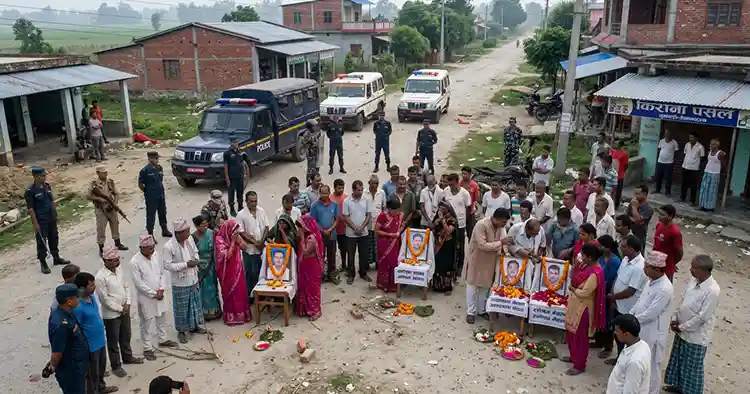
The victims’ families, who staged repeated protests in Kaptanganj in the weeks following the incident and at one point refused to accept the bodies of the deceased until concrete commitments were made, will be watching closely to see whether the ministry acts on the report’s recommendations rather than allowing the matter to fade from public attention. Home Minister Gurung had earlier reached a formal agreement with the families of the first two victims, which reportedly included a commitment to investigate the legal status of a madrasa in the area, alongside broader assurances of a fair and transparent probe.
The Broader Political Fallout
The Sunsari-Siraha violence triggered significant political fallout even before the investigation reports were finalized. Prime Minister Balendra Shah faced sharp criticism for what commentators described as a delayed public response, breaking his silence only several days after the violence began to appeal for calm and unity. Cabinet meetings in the immediate aftermath reportedly did not formally discuss the Sunsari crisis, drawing further criticism from opposition voices and civil society commentators who accused the government of being slow to grasp the scale of the unrest.
An all-party meeting convened by Rastriya Swatantra Party leader Rabi Lamichhane was credited with helping produce a joint appeal for peace among political leaders, a move seen as a rare moment of cross-party cooperation during the crisis. Meanwhile, security agencies were instructed to prioritize proportionate crowd-control measures, including tear gas and baton charges, over the use of firearms in any future incidents of this nature.
A Deeper Pattern Along Nepal’s Southern Border
Analysts who have studied the incident note that it fits into a broader, troubling pattern of religious flashpoints along Nepal’s border districts with India, from Birgunj to Dhanusha and Sarlahi. Nepal has historically prided itself on centuries of peaceful coexistence between its Hindu majority and Muslim minority communities, a relationship that traces back to medieval-era rulers who invited Muslim traders to settle in the hills and Tarai. However, disputes over loudspeakers, religious processions, and flag placements have increasingly tested that history in the Tarai-Madhesh belt in recent years, with observers pointing to the need for sustained, structured political and interfaith dialogue rather than reactive crisis management after each incident.
The Ministry of Home Affairs has said it is working to strengthen coordination through Chief District Officers in other sensitive districts, including Banke, Kapilvastu, Dhanusha, Siraha and Saptari, to help maintain communal harmony and prevent similar flashpoints from recurring.
Civil Society And Community Reaction
Beyond party politics, civil society groups, religious leaders, and human rights advocates have repeatedly called for the investigation to be conducted without bias toward either community. Several rights groups urged the Home Ministry to ensure that the ballistic and forensic review, added later to the Sunsari committee’s mandate, would independently establish whether the force used by police and the Armed Police Force was proportionate to the threat they faced that night, rather than simply endorsing the official version of events.
Interfaith leaders from both the Hindu and Muslim communities in Sunsari and Siraha have also appealed publicly for restraint, warning that prolonged uncertainty over accountability risks deepening mistrust rather than resolving it. Local representatives from Dewanganj Rural Municipality have stressed that the region has a long history of shared festivals, markets, and social ties between communities, and that isolated disputes over noise or symbols should not be allowed to define relations going forward. Several ward-level peace committees were reportedly reactivated in the weeks following the clash to help mediate day-to-day frictions before they escalate.
Meanwhile, the families of the four deceased have continued to press the government for a public, transparent account of exactly how the fatal decision to open fire was made, who authorized it, and why non-lethal alternatives were not exhausted first. Their persistence, including daily protests and, at one point, a refusal to accept a victim’s body until formal commitments were made, is widely seen as one of the key factors that kept pressure on the Home Ministry to expand the investigation and set a firm timeline for its conclusion.
Security Lapses And Institutional Questions
One of the recurring criticisms raised in the aftermath of the Kaptanganj clash concerns local intelligence and preparedness. Given that tension over the flag dispute had reportedly already reached the ward chairperson and rural municipality chairperson earlier the same day, questions have been raised about why local authorities and the Kaptanganj Police Post were not better prepared to manage the planned religious procession that night. Police headquarters has since directed field units nationwide to prioritize proportionate, non-lethal crowd-control measures such as tear gas and baton charges, while maintaining continuous dialogue with community leaders and local representatives in areas considered sensitive.
The Home Ministry has also acknowledged, through its spokesperson, that command-and-control coordination between the Nepal Police and the Armed Police Force at the scene needs closer scrutiny, particularly regarding how the decision to escalate from warning shots to live rounds was reached within a span of roughly thirty minutes. This is expected to be one of the more consequential findings contained in the submitted report, since it speaks directly to whether procedural safeguards around the use of lethal force were properly followed.
Comparisons With Past Communal Incidents In Nepal’s Tarai
While the scale of the Kaptanganj and Golbazar violence stands out, it is not the first time religious or cultural friction has flared into unrest in Nepal’s southern plains. Similar disputes, often triggered by loudspeakers, processions, or symbolic markers such as flags and banners, have periodically surfaced in towns along the Nepal-India border, including in parts of Birgunj, Dhanusha and Sarlahi. In most previous cases, however, tensions were defused at the local level before turning fatal. What set the Sunsari incident apart, according to several analysts, was the rapid involvement of security forces with live ammunition and the speed with which unrest subsequently spread to neighboring districts, drawing in Saptari, Dhanusha and Parsa within a matter of days.
This pattern has renewed a long-standing debate among policy commentators about whether Nepal’s local and provincial administrations are adequately equipped, both in terms of training and standard operating procedures, to manage religious and cultural friction before it escalates into violence. The Sunsari-Siraha investigation report is expected to feed directly into that broader conversation, since any recommendations it makes on crowd management, communication protocols, or oversight of firearms use could shape how future incidents are handled nationwide.
Key Facts At A Glance
- Location: Kaptanganj, Ward 3, Dewanganj Rural Municipality, Sunsari district, with unrest later spreading to Golbazar, Siraha, and other Madhesh districts.
- Date of initial clash: Night of July 26, 2026.
- Trigger: Dispute over loud music during a Hindu religious procession and an earlier flag-related dispute.
- Confirmed deaths: Four — Om Prakash Mehta, Jaya Prakash Mehta and Rabindra Mehta of Sunsari, and Ganesh Yadav of Siraha.
- Injuries: More than 20 people, including both civilians and security personnel.
- Investigating bodies: Two Home Ministry committees, led by Joint Secretaries Bhupendra Thapa (Sunsari) and Pushpa Raj Shahi (Siraha).
- Report submitted to: Home Minister Sudhan Gurung, at the Ministry of Home Affairs, Kathmandu.
- Next step: Ministry review of findings, followed by a decision on accountability and any legal action.
Frequently Asked Questions
What caused the Sunsari clash in Kaptanganj? The clash was triggered by a dispute over loud DJ music played during a Hindu religious procession returning from the Koshi Barrage, compounded by an earlier disagreement over a religious flag placed on an electricity pole in the local market area.
How many people died in the Sunsari-Siraha violence? Four people died in total: three in Sunsari (Om Prakash Mehta, Jaya Prakash Mehta and Rabindra Mehta) and one in Siraha (Ganesh Yadav).
Who submitted the investigation report? Two separate Home Ministry probe committees, one for the Sunsari incident led by Joint Secretary Bhupendra Thapa and one for the Siraha incident led by Joint Secretary Pushpa Raj Shahi, jointly submitted their reports to Home Minister Sudhan Gurung.
What will happen after the report submission? The Home Ministry has said it will study the findings before deciding on further action, which could include disciplinary steps or legal proceedings against those found responsible for the escalation and the use of force.
Conclusion
The submission of the Sunsari-Siraha investigation report closes an important chapter in the government’s response to one of the deadliest incidents of communal unrest Nepal has witnessed in years. Yet for the families who lost loved ones and the communities still living under the shadow of curfews and mistrust, the real test lies ahead: whether the findings translate into transparent accountability, and whether the government follows through on its repeated promises of justice and long-term measures to prevent a repeat of the Kaptanganj tragedy.
Related External Sources
- Kathmandu Post — One killed as police open fire after clash in Sunsari
- Al Jazeera — Nepal’s PM urges calm as three people killed after Hindu-Muslim unrest
- Kathmandu Post — Violence spreads across Madhesh days after Sunsari clash, death toll rises to three
- myRepublica — Kaptanganj violence: Several arrested over Sunsari clash that left three dead

Economic Affair
- Budhigandaki Flood: 47 Rescued as Bridges Washed Away
- Nepal Supreme Court Handcuff Order: Police Barred From Routine Use
- 250+ Officials Deploy to Assess Rasuwa-Bhotekoshi Flood Damage
- Electricity VAT: Energy and Finance Ministers Strike Landmark Deal After Just 2 Months
- Nepal Inflation Shockingly Triples to 5.96% — Food and Transport Hit Hardest



Comments