









The landscape of US-China agricultural trade is experiencing a significant shift as American exporters demonstrate growing confidence following a breakthrough framework agreement between the two economic superpowers. At the prestigious China International Import Expo (CIIE) in Shanghai, the atmosphere among US agricultural businesses reflects cautious optimism about future bilateral trade prospects.
The timing couldn’t be more critical for American farmers and exporters who have weathered months of trade tensions and market uncertainty.
Record-Breaking US Presence at China’s Largest Import Exhibition
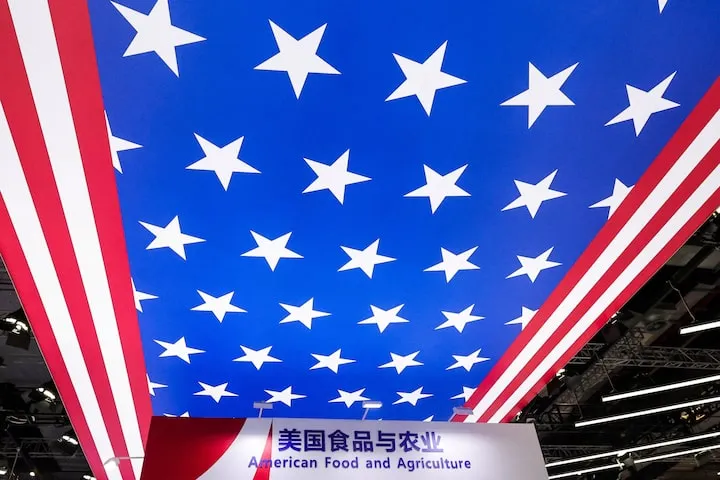
Expanded American Pavilion Signals Strong Commercial Interest
The US pavilion at CIIE has expanded dramatically, growing 50% larger compared to the previous year’s exhibition space. This substantial increase demonstrates American businesses’ commitment to maintaining strong commercial relationships with Chinese partners despite recent challenges.
Jeffrey Lehman, chair of the American Chamber of Commerce in Shanghai, representing over 1,000 member companies, emphasized the positive sentiment: “People are very hopeful. They’re here because they want to engage with new customers and find new opportunities for partnership.”
The exhibition featured diverse agricultural sectors including wine producers, ginseng suppliers, potato growers, and grain exporters, showcasing America’s agricultural diversity and export capabilities.
CIIE 2025: Breaking Records with $83.49 Billion in Intended Turnover
This year’s expo achieved remarkable success, generating $83.49 billion in intended turnover, marking a 4.4% increase from the previous year and setting a new record high. The event attracted participation from more than 155 countries, regions, and international organizations, with over 4,100 overseas enterprises taking part.
Notably, US companies maintained the largest exhibition area for the seventh consecutive year, underscoring America’s position as a key trading partner for China despite recent tensions.
Xi-Trump Framework Agreement: Turning Point for Agricultural Exports
Busan Meeting Delivers Critical Breakthrough
The framework agreement reached during the meeting between Chinese President Xi Jinping and US President Donald Trump in South Korea represents a potential turning point for US-China trade relations. The accord aims to roll back numerous tariffs and export control measures implemented earlier in the year.
Agricultural products, particularly soybeans and sorghum, had been significantly impacted by these trade restrictions, making the agreement especially crucial for American farmers and exporters.
Jim Sutter, CEO of the US Soybean Export Council, noted: “We’re celebrating this successful meeting in Busan, but we had plans to come even before that meeting. We didn’t give up on the relationship—we were working to maintain and strengthen it, even during troubles.”
Soybean and Sorghum Trade: Signs of Recovery
China Resumes Purchases from 2025 US Harvest
After months of avoiding purchases from the 2025 US soybean harvest due to escalating trade tensions, China has recently resumed buying American soybeans. This development signals a potential return to normal trading patterns that benefit both nations.
Mark Wilson, chairman of the US Grains and BioProducts Council, highlighted recent shipments as positive indicators: “I have hope they continue talking, because if they can keep talking, they can hopefully work things out.”
Prior to 2025, China accounted for an impressive 95% of the US export market for sorghum, making the Chinese market absolutely critical for American sorghum producers.
According to the USDA Foreign Agricultural Service, agricultural exports play a vital role in supporting American farm income and rural economies, making stable trade relationships essential.
Challenges Remain Despite Growing Optimism
13% Tariff Continues to Impact Competitiveness
While optimism is growing, analysts caution that significant challenges persist. US soybeans still face a 13% tariff in the Chinese market, making American shipments considerably more expensive compared to Brazilian alternatives.
This price disadvantage poses ongoing concerns for commercial viability, as Chinese buyers naturally gravitate toward more cost-effective options from competing suppliers.
Fragile Truce in Ongoing Trade Tensions
Trade experts characterize the recent détente as potentially fragile, noting that root causes of the US-China trade war remain largely unresolved. The framework agreement, while encouraging, may represent only a temporary pause rather than a permanent resolution.
China’s Trade Surplus Continues Expanding
Record $1 Trillion Surplus Projected
Despite CIIE’s stated goal of promoting China’s free trade credentials, the country’s trade surplus continues expanding. Projections indicate China’s trade surplus will exceed last year’s record of approximately $1 trillion.
Chinese exporters have offset declining US sales resulting from higher American tariffs by aggressively pursuing market share in other regions, sometimes selling at a loss to maintain global presence.
The World Trade Organization continues monitoring these trade imbalances as they impact global commerce patterns and international trade relations.
Looking Forward: Cautious Optimism in Agricultural Trade
Continued Dialogue Essential for Long-Term Stability
The consensus among US agricultural exporters emphasizes the critical importance of maintaining open communication channels between Washington and Beijing. Sustained dialogue offers the best pathway toward resolving outstanding issues and establishing predictable trade frameworks.
For American farmers who depend heavily on Chinese demand, particularly for soybeans and sorghum, stable trade relations translate directly into economic security and business planning confidence.
Market Diversification Remains Strategic Priority
While renewing focus on the Chinese market, US agricultural exporters recognize the importance of market diversification to reduce vulnerability to bilateral tensions. Developing strong relationships across multiple international markets provides resilience against future trade disruptions.
The US-China agricultural trade relationship appears to be entering a new phase characterized by renewed engagement and cautious optimism. While significant challenges remain, including tariff barriers and unresolved structural issues, the commitment demonstrated by American exporters at CIIE 2025 suggests resilience and long-term strategic thinking.
As both nations navigate complex economic and geopolitical considerations, the agricultural sector continues serving as a vital bridge in bilateral relations, supporting jobs and economic growth in both countries.

Economic Affair
- Budhigandaki Flood: 47 Rescued as Bridges Washed Away
- Nepal Supreme Court Handcuff Order: Police Barred From Routine Use
- 250+ Officials Deploy to Assess Rasuwa-Bhotekoshi Flood Damage
- Electricity VAT: Energy and Finance Ministers Strike Landmark Deal After Just 2 Months
- Nepal Inflation Shockingly Triples to 5.96% — Food and Transport Hit Hardest





Comments