







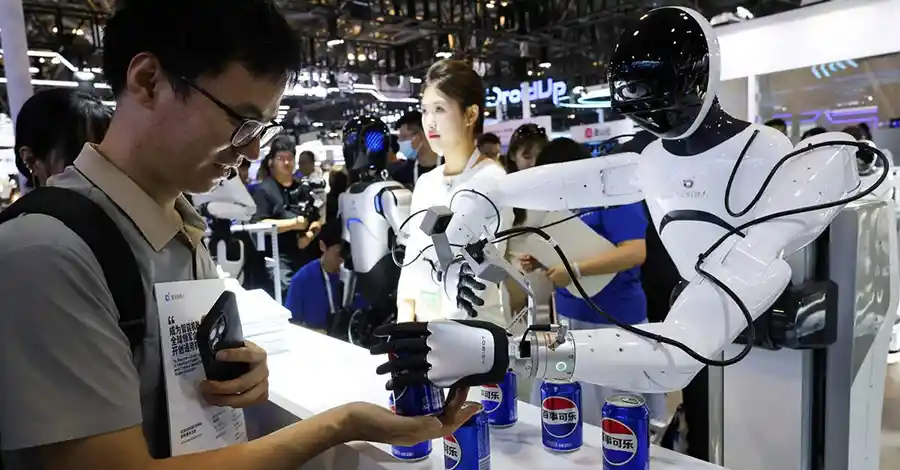




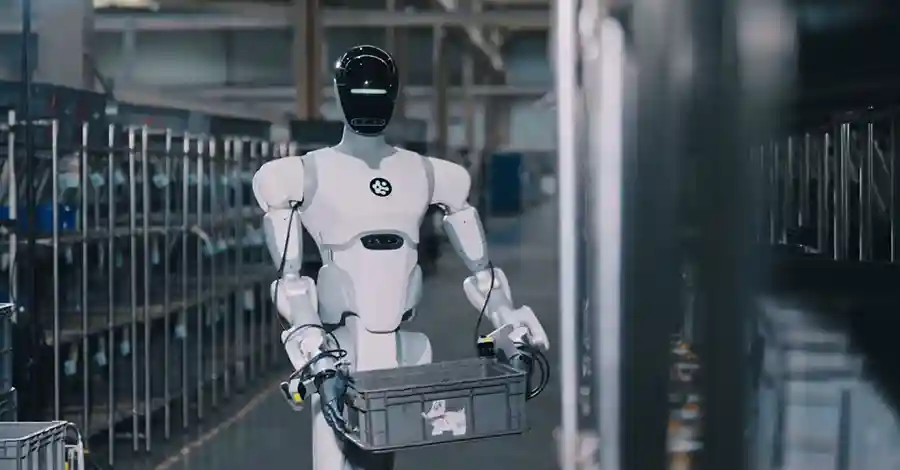
The manufacturing landscape is witnessing a groundbreaking transformation as AlphaBot 2 collaborative robots deploy across Chinese automobile factories, working shoulder-to-shoulder with human workers without safety cages. Developed by Shenzhen-based AI² Robotics, these next-generation humanoid robots represent a significant leap in smart manufacturing, particularly within electric vehicle production facilities.
Unlike traditional industrial robots confined behind safety barriers, AlphaBot 2 operates safely alongside human employees, fundamentally changing how modern automotive assembly lines function. This breakthrough technology is positioning China as a global leader in Industry 4.0 and intelligent manufacturing solutions.
What Makes AlphaBot 2 Different from Traditional Industrial Robots?
Advanced Embodied AI Technology
AlphaBot 2 stands apart from conventional factory robots through its integration of embodied artificial intelligence. The system, powered by AI² Robotics’ proprietary Alpha Brain platform and GOVLA AI model, enables the robot to understand, learn from, and adapt to real-world manufacturing environments autonomously.
According to Interesting Engineering, AlphaBot 2 features over 34 degrees of freedom, 360-degree mobility, and a 700mm single-arm reach, allowing it to perform complex tasks with near-human dexterity. The robot operates continuously for more than six hours on a single charge, making it ideal for extended production shifts.
Safe Human-Robot Collaboration
The most revolutionary aspect of AlphaBot 2 is its ability to work directly with human operators without physical barriers. Advanced sensors detect human presence and adjust movements accordingly, creating a genuinely collaborative workspace that enhances both safety and productivity.
Key Applications of AlphaBot 2 in Automotive Manufacturing
Precision Quality Inspection Systems
Quality control represents one of AlphaBot 2’s most impactful applications. Equipped with advanced AI-powered camera systems, these collaborative robots detect microscopic defects invisible to the human eye. The vision-guided inspection technology ensures consistent quality across every vehicle component.
According to Global Times, this marks the first full-scenario validation of domestically developed embodied AI in China’s automotive sector, demonstrating the technology’s maturity and reliability.
High-Precision Assembly Operations
In assembly operations, AlphaBot 2 excels at joining small, intricate automotive components with exceptional accuracy. The robot’s fine force feedback system enables delicate manipulation, essential for modern electric vehicle battery assembly and sensitive electronic components.
The dual “Fast + Slow” system architecture allows immediate responses for real-time tasks while managing complex decision-making processes, according to Aparobot specifications.
Intelligent Logistics and Material Handling
AlphaBot 2 transforms factory logistics by safely transporting heavy materials throughout production facilities. The robots autonomously navigate factory floors, avoiding obstacles and optimizing routes using real-time environmental sensing. They can lift items with high precision and tow carts weighing up to 500 kilograms.
Predictive Maintenance Capabilities
Using Internet of Things (IoT) connectivity, AlphaBot 2 monitors equipment conditions and predicts maintenance requirements before machinery failures occur. This predictive approach significantly reduces unexpected production downtime and improves overall equipment effectiveness.
Strategic Partnership: AI² Robotics and Dongfeng Liuzhou Motor
The deployment at Dongfeng Liuzhou Motor Co. (DFLZM) facilities represents a strategic milestone in automotive robotics. Following a cooperation agreement, AlphaBot 2 now handles multiple tasks including material loading, cart towing, windshield labeling, and comprehensive quality inspections.
This partnership demonstrates how collaborative robots integrate into existing production lines without requiring complete facility redesigns, a critical advantage for manufacturers transitioning to smart manufacturing.
Benefits of Collaborative Robots in Automotive Production
Reduced Production Costs
According to Eclipse Automation, collaborative robots reduce labor costs by handling repetitive tasks with minimal errors. Their precision minimizes waste and rework, leading to substantial cost savings across production cycles.
Enhanced Production Speed
AlphaBot 2 operates continuously without breaks, significantly boosting throughput. The robots handle repetitive precision tasks efficiently, reducing production time while increasing overall output quality.
Improved Workplace Safety
Collaborative robots take over physically demanding and potentially hazardous tasks, improving ergonomics and reducing workplace injuries. This allows human workers to focus on higher-value activities requiring creativity, problem-solving, and quality oversight.
Flexible Manufacturing Capabilities
Unlike rigid traditional automation, collaborative robots adapt quickly to production changes. According to Quality Magazine, cobots can be reprogrammed for different tasks during a single lunch break, making them ideal for high-mix, low-volume electric vehicle production.
Learning Capabilities: The Future of Manufacturing AI
One of AlphaBot 2’s most impressive features is its ability to learn new tasks by observing demonstrations. As reported by CNN Business, the robot requires only 5-10 examples to master new operations, dramatically reducing training time compared to traditional robot programming.
Real-world deployment data continuously feeds back into the GOVLA model, enhancing spatial intelligence, precision, and task-specific understanding. This learning loop allows performance improvements in increasingly complex manufacturing scenarios.
China’s Leadership in Smart Manufacturing and Industry 4.0
The successful implementation of AlphaBot 2 technology reinforces China’s position as a global leader in smart manufacturing and Industry 4.0 initiatives. The technology demonstrates the optimal combination of advanced robotics and human expertise, creating efficient production ecosystems that balance automation with human creativity.
According to IBM’s analysis, the automotive industry worldwide is experiencing a robotics revolution, with humanoid robots walking onto factory floors at unprecedented rates. China’s domestic development of embodied AI technology positions the country at the forefront of this transformation.
Beyond Automotive: Future Applications for AlphaBot 2
While currently focused on automotive manufacturing, AI² Robotics CEO Yandong Guo envisions broader applications. The company plans to deploy AlphaBot 2 in Chinese airports by late 2025 for luggage cart organization and passenger assistance.
Long-term goals include household applications where robots could serve tea, clean dishes, and assist with elderly care, making AlphaBot 2 a potential “robot for every family.” The recently unveiled ZhiCube modular service units already showcase AlphaBot 2 in coffee shops and retail environments.
Technical Specifications and Performance
Key Technical Features:
- 34 degrees of freedom for human-like flexibility
- 700mm single-arm reach (excluding end-effector)
- 0-240cm vertical working range with lifting waist-leg mechanism
- 360° spatial sensing capability
- Over 6 hours continuous runtime
- Real-time motion planning with deep task decomposition
- Facial expression analysis for human interaction
- Advanced force feedback for delicate manipulation
Industry Impact and Market Growth
The collaborative robotics market is experiencing explosive growth. According to Techman Robot, cobots accounted for approximately 10.5% of all industrial robots installed in 2023, with about 57,000 units deployed worldwide.
Asia leads with 70% of new robot installations, and the automotive industry has emerged as the primary adopter, particularly for final assembly and finishing tasks requiring flexibility and precision.
Challenges and Considerations
While collaborative robots offer tremendous benefits, implementation requires careful planning. Melton Machine & Control emphasizes that proper system design remains critical—even collaborative robots can become unsafe if installed incorrectly without proper safety engineering.
Risk assessments must evaluate applications against ISO/TS 15066 biomechanical limits, ensuring force and pressure thresholds remain safe for different body regions during human-robot interaction.
The Road Ahead: Human-Robot Collaboration
The future of automotive manufacturing lies not in replacing human workers but in creating synergistic partnerships between people and intelligent machines. As Automotive Technology notes, collaborative robots relieve workers of routine and dangerous tasks, allowing them to focus on value-added activities like inspection, quality control, and programming.
This human-centered approach to automation represents the core vision of Industry 5.0, where technology and human expertise combine to create more efficient, safer, and more satisfying work environments.
Conclusion: A New Era in Automotive Manufacturing
AlphaBot 2 collaborative robots represent more than technological innovation—they symbolize a fundamental shift in manufacturing philosophy. By seamlessly integrating AI-powered robotics with human expertise, Chinese automotive manufacturers are creating the smart factories of tomorrow.
The combination of precision automation, adaptive learning capabilities, and safe human collaboration positions AlphaBot 2 at the forefront of the global manufacturing revolution. As electric vehicle production accelerates and Industry 4.0 principles expand worldwide, collaborative robots will play an increasingly vital role in building efficient, flexible, and sustainable automotive production systems.
For manufacturers seeking competitive advantages in quality, speed, and cost-effectiveness, collaborative robotics technology offers a proven path forward—one where humans and machines work together to achieve what neither could accomplish alone.
External Links Used:
- Interesting Engineering – China’s Humanoid Robot
- Global Times – Embodied AI in Manufacturing
- CNN Business – AlphaBot 2 Features
- Eclipse Automation – Cobots in Automotive
- Quality Magazine – Flexibility and Precision
- IBM – Rise of Robotics
- Techman Robot – Collaborative Robots Transforming Automotive
- Aparobot – AlphaBot 2 Specifications

Economic Affair
- Budhigandaki Flood: 47 Rescued as Bridges Washed Away
- Nepal Supreme Court Handcuff Order: Police Barred From Routine Use
- 250+ Officials Deploy to Assess Rasuwa-Bhotekoshi Flood Damage
- Electricity VAT: Energy and Finance Ministers Strike Landmark Deal After Just 2 Months
- Nepal Inflation Shockingly Triples to 5.96% — Food and Transport Hit Hardest






Comments