










Nepal Telecom’s net profit has surged by an impressive 47.58 percent, marking one of the state-owned carrier’s strongest quarterly performances in recent years. The company, formally known as Nepal Doorsanchar Company Limited, reported a net profit of Rs 8.86 billion by the fourth quarter of fiscal year 2082/83, a sharp turnaround that has caught the attention of investors and industry watchers across the country.
The unaudited financial statement, released by the company on Saturday, shows that both operating income and pre-tax profit climbed significantly compared to the same period a year earlier. For a company that posted a steep profit decline just one fiscal year ago, the rebound signals a meaningful shift in Nepal Telecom’s financial trajectory heading into the new fiscal year.
Net Profit Climbs Sharply Year-On-Year
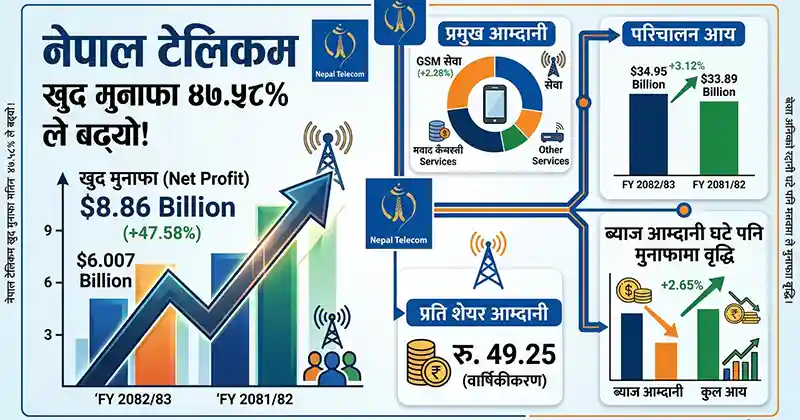
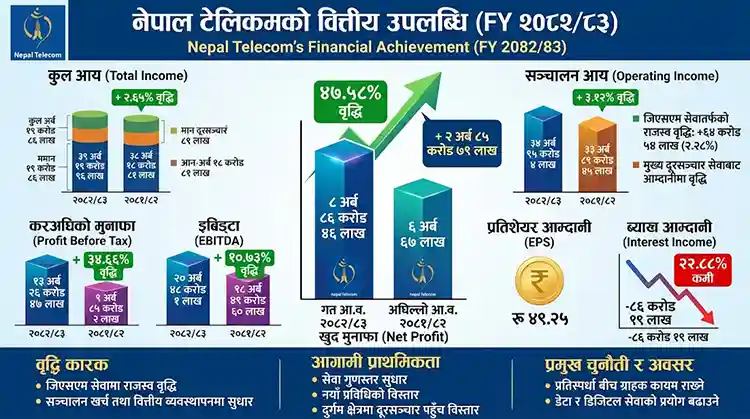
According to the unaudited report, Nepal Telecom’s net profit reached Rs 8.86 billion by the fourth quarter of FY 2082/83, compared to Rs 6.007 billion recorded during the same period of the previous fiscal year, FY 2081/82. That works out to an increase of roughly Rs 2.86 billion, or 47.58 percent, in just twelve months.
The jump is particularly notable given that Nepal Telecom’s profits had been under pressure in recent years. As reported by NepaliTelecom, the company’s net profit for FY 2081/82 had actually fallen by more than 57 percent to around Rs 2.66 billion, a decline blamed largely on the growing popularity of OTT communication apps, unauthorized WiFi mobility services eating into data revenue, and higher pension provisioning costs. Saturday’s Q4 FY 2082/83 numbers suggest the company has begun clawing back some of that lost ground.
Pre-Tax Profit Also Sees a Major Boost
The improvement was not limited to the bottom line. Nepal Telecom’s profit before tax reached Rs 13.26 billion by the fourth quarter of FY 2082/83, up from Rs 9.85 billion during the same period the previous year. That amounts to a 34.66 percent increase in pre-tax earnings, reinforcing the picture of a company whose core operations are generating meaningfully stronger returns than a year ago.
Executives at the company have pointed to a mix of rising telecom service revenue and improved cost management as the main drivers behind the stronger pre-tax numbers, even as certain income streams, such as interest earnings, moved in the opposite direction.
EBITDA and Operating Income Both Show Healthy Growth
Nepal Telecom’s earnings before interest, tax, depreciation, and amortization, commonly referred to as EBITDA, rose to Rs 20.48 billion in the review period, compared to Rs 18.50 billion recorded during the same quarter of the prior fiscal year. That represents a 10.73 percent year-on-year increase, a figure analysts often watch closely because it reflects the underlying cash-generating strength of a company’s core business before accounting adjustments.
Total operating income for the company also moved higher, reaching Rs 34.95 billion by the fourth quarter of FY 2082/83, up from Rs 33.89 billion in the same period a year earlier. That is a comparatively modest increase of 3.12 percent, or just over Rs 1.05 billion, suggesting that much of the profit growth came from improved margins and cost efficiency rather than from a dramatic expansion in top-line sales alone.

Total Revenue Crosses Rs 39 Billion
Nepal Telecom’s total income, which includes operating revenue alongside other income sources such as interest earnings, rose to Rs 39.20 billion in the fourth quarter of FY 2082/83. That compares to Rs 38.19 billion recorded during the same period of the previous fiscal year, an increase of about Rs 1.01 billion, or 2.65 percent.
The company’s annualized earnings per share also improved as a result of the stronger profit performance, climbing to Rs 49.25. That marks a continued recovery from the depressed per-share earnings levels the company reported during its difficult FY 2081/82 results, when EPS had dropped sharply alongside the broader profit decline.
Falling Interest Income Couldn’t Slow the Profit Rebound
One of the more notable details buried in Nepal Telecom’s latest filing is that the company’s profit grew even as its interest income shrank. Gradually declining interest rates across Nepal’s banking sector caused the company’s interest earnings to fall by around Rs 860 million, a drop of roughly 22.88 percent compared to the same quarter last year.
That decline mirrors a broader trend already visible in Nepal Telecom’s earlier quarterly filings for the same fiscal year. As reported by Ratopati English covering the company’s third-quarter results, interest income had already fallen by close to 20.57 percent through the first nine months of FY 2082/83, as the company’s returns on its bank deposits and investments continued to soften alongside Nepal’s easing interest rate environment.
Despite that headwind, the company’s overall profit still climbed sharply, which points to the core telecom business, rather than passive interest earnings, doing the heavy lifting behind this year’s turnaround.
GSM Revenue Growth Powers the Recovery
Nepal Telecom credited the improvement primarily to stronger revenue from its core telecommunications services, particularly its GSM mobile network. According to the company’s statement, GSM service revenue rose by Rs 645.4 million, or 2.28 percent, compared to the same quarter of the previous fiscal year.
That continues a pattern seen earlier in the fiscal year as well. Nepal Telecom’s third-quarter results, detailed by industry outlet NepaliTelecom, had already shown GSM revenue climbing by about Rs 577.4 million, or 2.76 percent, alongside a notable reduction in depreciation expenses that also helped support profitability during that quarter.
Together, the steady rise in mobile service revenue and improved expense management appear to have offset the drag from falling interest income, allowing the company’s full fourth-quarter profit figure to post such a large annual gain.
A Difficult Prior Year Sets the Stage for the Rebound
To fully understand why a 47.58 percent jump stands out so much, it helps to look back at where Nepal Telecom’s numbers stood a year earlier. During FY 2081/82, the company had posted one of its weakest profit performances in years, with net profit falling by more than 57 percent to around Rs 2.66 billion for the full year, according to reporting from NepaliTelecom.
That earlier decline was tied to several factors, including a large lump-sum license payment obligation, rising pension provisioning under Nepal’s accounting standards, decreasing interest income as deposit rates fell, and shrinking voice, SMS, and data revenue as customers increasingly shifted toward OTT messaging and calling apps. A separate audited filing covering Q4 of FY 2023/24, reported by NEPSE Trading, similarly showed net income falling to less than half of the prior year’s figure, underlining just how much pressure the company had been under heading into the current fiscal year.
Viewed against that backdrop, the current year’s rebound looks less like an isolated spike and more like the early stages of a broader financial recovery, assuming the trends seen through the first three quarters continue to hold.
What the Numbers Mean for Nepal’s Telecom Sector
Nepal Telecom remains the country’s dominant state-owned telecom operator, and its financial health carries weight well beyond its own balance sheet. As a partially government-owned enterprise, stronger profits typically translate into higher dividend potential for shareholders, including the Government of Nepal itself, which holds a significant ownership stake in the company.
The company has also stressed that it continues to expand telecom infrastructure into remote and economically less attractive regions of Nepal, areas where private operators are often reluctant to invest due to high costs and limited returns. According to the company’s own statement, this expansion work has added extra operational costs even as the firm works to improve its overall financial performance, a balancing act between commercial profitability and its broader mandate as the national telecom service provider.
Comparison With Ncell and the Broader Market
Nepal Telecom’s rebound comes at a time when Nepal’s telecom sector as a whole continues to grapple with intensifying competition, both from private rival Ncell and from an expanding range of OTT communication platforms that have steadily eaten into traditional voice and SMS revenue across the industry. Retaining and growing the existing subscriber base while pushing customers toward higher-margin data and digital services remains one of the central challenges facing Nepal Telecom’s management team, according to the company’s own outlook shared alongside its latest results.
Additional context on Nepal Telecom’s broader corporate structure, historical financial statements, and annual reports is available directly through the company’s official channels, including its financial statements archive published on the Nepal Telecom website.
About Nepal Telecom: The Country’s Legacy Carrier
Nepal Telecom, officially registered as Nepal Doorsanchar Company Limited, traces its roots back to Nepal’s original state telecommunications department and has long served as the country’s primary national telecom operator. Even as private competitors entered the market over the past two decades, Nepal Telecom has retained one of the largest subscriber bases in the country across both its GSM mobile network and its fixed-line and broadband services.
The company operates under a dual mandate that sets it apart from purely commercial competitors: alongside pursuing profitability for its shareholders, it also carries an obligation to extend telecom access into Nepal’s mountainous and often sparsely populated regions, areas where the cost of building and maintaining infrastructure can far outweigh the revenue those regions generate. That mandate has repeatedly shown up in the company’s own explanations for elevated operating costs, including in this latest quarterly statement, where management again pointed to the added expense of serving remote and geographically difficult terrain.
Because a meaningful share of Nepal Telecom’s ownership rests with the Government of Nepal, the company’s financial results also carry implications for state revenue. Stronger annual profits generally translate into larger dividend payouts, a portion of which flows back to the national treasury, making quarterly filings like this one closely watched not just by private shareholders but by government stakeholders as well.
Dividend and Investor Implications
For shareholders, a sharp rise in both net profit and earnings per share is typically a welcome signal, particularly after a fiscal year in which the company’s profitability had fallen so sharply. With annualized EPS climbing to Rs 49.25, some market analysts and retail investors on Nepal’s stock exchange, the NEPSE, will likely be watching closely to see whether the company’s board proposes a stronger dividend distribution once the fiscal year’s audited results are finalized.
It is worth noting that these figures remain unaudited, meaning the final numbers confirmed in Nepal Telecom’s audited annual report, expected to follow in the coming months, could see modest adjustments. Historically, Nepal Telecom’s audited results have closely tracked its unaudited quarterly filings, though investors are typically advised to treat interim figures as indicative rather than final.
The improvement in pre-tax profit, EBITDA, and total income across the fourth quarter also suggests the company’s underlying operational performance, not just one-off accounting adjustments, contributed meaningfully to the year-on-year turnaround, which may offer additional reassurance to investors who had grown cautious after the previous fiscal year’s steep decline.

Industry Outlook: Balancing Growth With Rising Competition
Nepal’s telecom sector has undergone significant change in recent years, with data and digital services increasingly displacing traditional voice and SMS revenue as the industry’s primary growth driver. Nepal Telecom’s own commentary alongside its latest results pointed to this shift, noting that retaining its existing customer base while expanding data and digital service usage will remain a central challenge and opportunity going forward.
The rise of OTT communication platforms, which allow users to make calls and send messages over the internet rather than through traditional cellular networks, has been repeatedly cited by Nepal Telecom as a factor reshaping its revenue mix. While this shift contributed to sharp profit declines in earlier fiscal years, the latest quarter’s results suggest the company may be adapting its strategy, leaning more heavily on GSM data revenue and operational efficiency to offset the erosion of legacy voice and messaging income.
Regulatory developments are also shaping the competitive landscape. Nepal’s telecom regulator has previously taken action against unauthorized WiFi mobility services offered by internet service providers, a practice that had been cutting into mobile data revenue for both Nepal Telecom and its private-sector rival, Ncell. Continued regulatory enforcement in this area could further support Nepal Telecom’s mobile data revenue trajectory in future quarters.
Company’s Strategic Priorities Going Forward
Alongside its latest financial disclosure, Nepal Telecom reiterated its commitment to a set of strategic priorities for the months ahead. These include continuing to improve overall service quality across its network, expanding newer technology offerings to keep pace with evolving customer demand, and pushing further into remote and underserved parts of the country where telecom access remains limited.
The company’s management has framed this expansion work as part of its broader responsibility as Nepal’s national telecom infrastructure provider, distinguishing its strategic priorities from those of a purely profit-driven private operator. That framing has repeatedly appeared in Nepal Telecom’s quarterly statements, including this latest one, where the company again emphasized that operating in low-return, high-cost areas remains a deliberate part of its national service obligation rather than an oversight in its cost structure.
Whether this quarter’s strong profit rebound proves to be a lasting trend or a temporary bounce will likely depend on how well the company continues balancing that public-service mandate against the commercial pressures of a fast-changing telecom market increasingly shaped by data services, digital competition, and shifting consumer habits.
Key Financial Highlights at a Glance
- Net profit: Rs 8.86 billion, up 47.58 percent year-on-year
- Profit before tax: Rs 13.26 billion, up 34.66 percent
- EBITDA: Rs 20.48 billion, up 10.73 percent
- Total operating income: Rs 34.95 billion, up 3.12 percent
- Total income: Rs 39.20 billion, up 2.65 percent
- Annualized earnings per share: Rs 49.25
- Interest income: Down approximately 22.88 percent due to falling interest rates
- GSM revenue growth: Up approximately 2.28 percent year-on-year
Frequently Asked Questions About Nepal Telecom’s Q4 Results
How much did Nepal Telecom’s net profit increase in Q4 FY 2082/83? Nepal Telecom’s net profit rose by 47.58 percent, reaching Rs 8.86 billion by the fourth quarter of FY 2082/83, compared to roughly Rs 6.007 billion in the same period a year earlier.
Why did Nepal Telecom’s profit grow despite falling interest income? The company’s interest income dropped by close to 23 percent due to declining interest rates, but growth in GSM service revenue and improved cost management more than offset that decline.
What is Nepal Telecom’s earnings per share for this period? The company’s annualized earnings per share stood at Rs 49.25 for the review period, an improvement from the depressed levels reported during FY 2081/82.
Is this Nepal Telecom’s full-year result? This figure covers cumulative results through the fourth quarter of FY 2082/83, based on the company’s unaudited financial statement; a final audited annual report typically follows later.
How does this compare to the previous fiscal year’s decline? FY 2081/82 saw Nepal Telecom’s net profit fall by more than 57 percent, making this year’s 47.58 percent rebound a significant reversal of that downward trend.
Conclusion: A Strong Rebound, But Challenges Remain
Nepal Telecom’s latest unaudited financial statement paints the picture of a company pulling itself out of a difficult stretch, powered largely by steady growth in its core GSM mobile revenue and tighter cost discipline, even as falling interest rates weighed on its non-operating income. With net profit up 47.58 percent and pre-tax profit climbing by more than a third, the fourth-quarter numbers mark one of the state-run carrier’s stronger performances in recent memory.
Still, the company faces an increasingly competitive telecom landscape, shrinking traditional voice and SMS demand due to OTT platforms, and the ongoing costs of extending network coverage into Nepal’s more remote regions. How Nepal Telecom balances those pressures against its latest profit momentum will likely shape its financial results in the fiscal years ahead.
This article is based on Nepal Telecom’s unaudited financial statement for the fourth quarter of FY 2082/83 and will be updated if the company releases further audited figures.

Economic Affair
- Budhigandaki Flood: 47 Rescued as Bridges Washed Away
- Nepal Supreme Court Handcuff Order: Police Barred From Routine Use
- 250+ Officials Deploy to Assess Rasuwa-Bhotekoshi Flood Damage
- Electricity VAT: Energy and Finance Ministers Strike Landmark Deal After Just 2 Months
- Nepal Inflation Shockingly Triples to 5.96% — Food and Transport Hit Hardest





Comments