



Nepal’s biggest esports breakthrough in years has collapsed into heartbreak. The Nepal PUBG Mobile Asian Games exclusion has left five hard-fighting players stripped of a golden opportunity they earned fair and square on the battlefield, only to lose it in a boardroom. Kathmandu, Nepal — a country that once dreamed of an Asian Games podium finish in PUBG Mobile — now watches helplessly as its qualified national squad is benched by a bureaucratic tug-of-war that nobody in power seems willing to end.
The Nepal PUBG Mobile Asian Games exclusion did not happen because the players underperformed. It happened because two rival organizations, and the government body that oversees them, could not agree on who actually speaks for Nepali esports. The result: a nation’s flag will not fly in one of PUBG Mobile’s biggest international stages this year, despite the team’s own success on the server.
How Nepal Qualified for the 20th Asian Games in PUBG Mobile
On 21 June, Nepali gamers had every reason to celebrate. A five-man PUBG Mobile roster carried the country’s colors through a grueling regional qualifier in Vietnam, held from 13 to 21 June, and came away with a seventh-place finish among the competing nations. That result was enough to punch Nepal’s ticket to the 20th Asian Games, officially known as the 2026 Asian Games or Aichi-Nagoya 2026, scheduled to be hosted in Japan.
The five players who delivered that milestone were Samir “Zyo” Costello, Rohit “Jordy” Tamang, Deepesh “DeltaX” Gurung, Saurav “TMG-8” Tamang, and Sonu “ByBy” Karki. For a nation whose esports program had finished fifth in PUBG Mobile at the 19th Asian Games in China, this qualification represented real progress — a shot at Nepal’s first-ever Asian Games medal in competitive mobile gaming.
The squad returned home and threw themselves into intensive training, fully expecting to represent Nepal on the international stage. Instead, roughly seven weeks later, they discovered their names had quietly vanished from the country’s official Asian Games participant list.
A Dream Crushed Without Warning
According to reporting from the Kathmandu Post, the Nepal Olympic Committee itself was blindsided by the decision. Executive secretary Sujan Lal Shrestha reportedly told the outlet that the Olympic Council of Asia was startled to learn Nepal had withdrawn from esports altogether, since the country had legitimately qualified in not one but three separate titles — PUBG Mobile, Honor of Kings, and Mobile Legends: Bang Bang. That detail matters: this was not a one-game fluke. Nepali gamers had proven themselves across multiple competitive titles in the same Asian Games qualification window.
Despite that broader success, none of the qualified esports athletes made it onto Nepal’s final Asian Games roster.
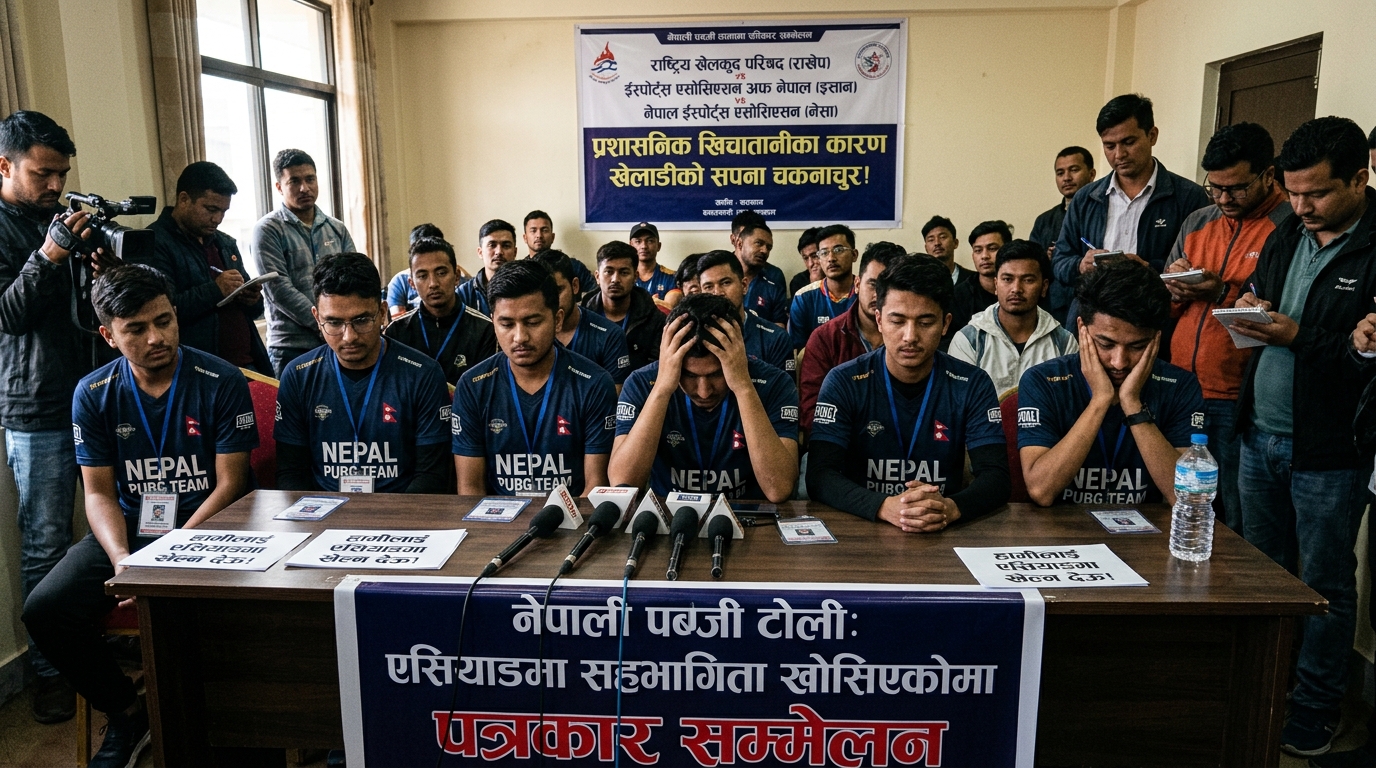
Why Was the Team Removed? Understanding the Nepal PUBG Mobile Asian Games Exclusion
On 11 August, the National Sports Council of Nepal, known locally as Rashtriya Khelkud Parishad (RaKheP), released the finalized list of 22 sports for Nepal’s Asian Games delegation. Esports, including the already-qualified PUBG Mobile squad, was missing entirely.
The timing stunned not just the athletes but the wider Nepali gaming community, which had spent weeks anticipating a historic international run. The players had already cleared the hardest part — qualification on the field. What they could not clear was Nepal’s tangled sports administration.
The Root Cause: One Sport, Two Rival Federations
At the center of the Nepal PUBG Mobile Asian Games exclusion lies a structural problem that has plagued Nepali esports for years: the country effectively has two competing national esports federations, even though Nepal’s National Sports Development Act 2077 (Section 22, sub-section 2A) explicitly states that only one recognized association may govern each sport.
The two bodies are:
- Nepal Esports Association (NESA) — internationally recognized by the Asian Electronic Sports Federation (AESF) and the International Esports Federation (IESF), and the organization that has historically sent Nepali teams to global competitions.
- Esports Association of Nepal (ESAN), sometimes referred to locally as “Isan” — registered domestically with the National Sports Council and considered the government-recognized body inside Nepal.
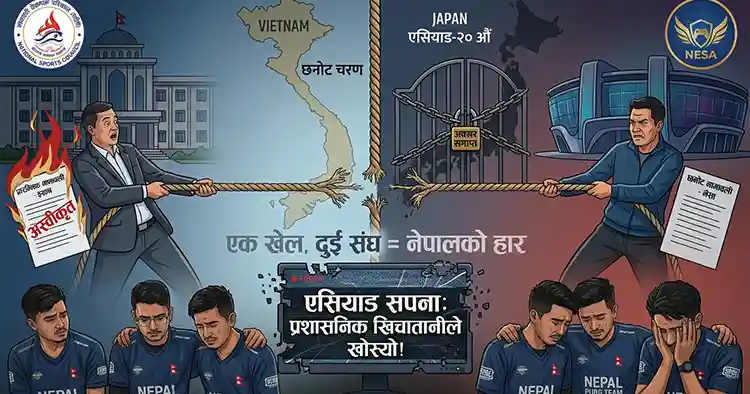
Because these two organizations do not recognize each other’s authority, Nepal effectively arrived at the Asian Games deadline with two conflicting sets of information about who its qualified athletes even were.
Conflicting Lists, Missing Names
RaKheP initially included esports, PUBG Mobile among them, on its preliminary list of sports for the Asian Games. But by the final submission, the sport had been dropped entirely.
Officials say the confusion traces back to the preliminary roster RaKheP received from ESAN, the domestically registered federation. That list reportedly included players from a team called Horaa Esports — a squad that had actually been eliminated during the qualification process — while leaving out the five players who had genuinely qualified in Vietnam.
ESAN president Anjan Dhamala has defended the association’s list, stating that it forwarded the names of the players who had previously won domestic qualifying tournaments, and argued that NESA never formally notified the government that a different team had qualified internationally.
NESA, for its part, insists it followed every required protocol. NESA president Suraj Dangol has said the association repeatedly tried to register the qualified players directly but was turned away by RaKheP, which allegedly refused to acknowledge NESA as a legitimate point of contact. According to Dangol, even when players personally visited government offices to register, officials declined to process their paperwork.
The Blame Game: Government, Federations Trade Accusations
Rather than resolving the dispute, Nepal’s sports administration spent the weeks following the announcement pointing fingers.
What the National Sports Council Says
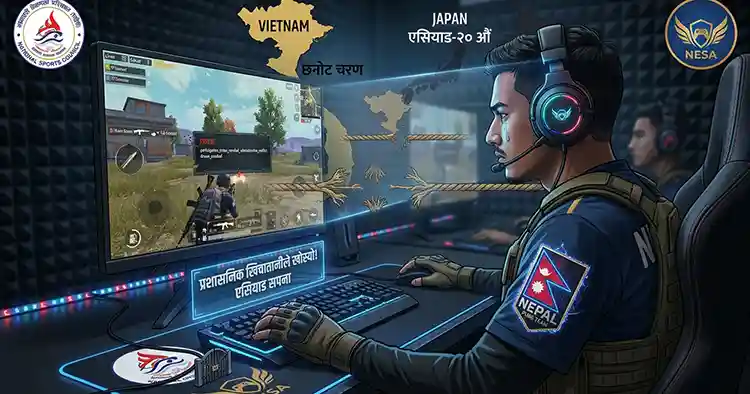
The National Sports Council and ESAN maintain that the fault lies squarely with NESA for failing to communicate the qualified roster through proper channels before the registration deadline. Nepal’s Minister for Education and Sports, Sasmita Pokharel, has publicly stated that the ministry kept a slot open for esports until the very last day but never received a formal recommendation naming the qualified athletes. Only after the deadline passed, she said, did NESA representatives make contact.
Separately, according to reporting from Rising Nepal Daily, the Olympic Council of Asia had extended its entry deadline specifically to give Nepal more time to sort out its paperwork. No official response was ever submitted, and the OCA finalized its participating esports nations on 8 August without Nepal included.
What Nepal Esports Association Says
NESA rejects the government’s version of events entirely. Association leadership says it followed up continuously with the Ministry of Youth and Sports and was repeatedly denied meetings with the minister. Dangol has also claimed his organization offered to fund the team’s participation entirely out of pocket, asking only for official government approval to travel — a request he says was ignored until it was too late.
What ESAN Says
ESAN, meanwhile, argues that NESA operated outside government authority altogether, accusing the rival body of undermining Nepal’s sports legislation by acting without state approval. Dhamala has called for a formal investigation into what he describes as reckless promises made to athletes about their Asian Games participation, arguing that ESAN — as the government-registered federation — was simply following legal protocol.
Caught in the middle of these accusations are five athletes who did everything the rulebook asked of them, only to be told their qualification does not matter.
The Human Cost: Players Left in Limbo
For the athletes themselves, the fallout goes far beyond missing a tournament. Several of the qualified players have reportedly held press conferences demanding an explanation, asking a simple but painful question: why should players who cleared international qualification be denied the chance to represent their country?
Reports from Nepali outlets including Hamro Patro and Ratopati describe an emotional toll on the athletes and their families. Some players say relatives have urged them to abandon competitive gaming altogether and refocus on their studies or careers, framing esports as a path with no future in Nepal given how the state has treated its qualified representatives. That sentiment reflects a broader fear voiced by the players: that Nepal risks driving away a new generation of competitive gaming talent right as the country was beginning to gain international recognition in the field.
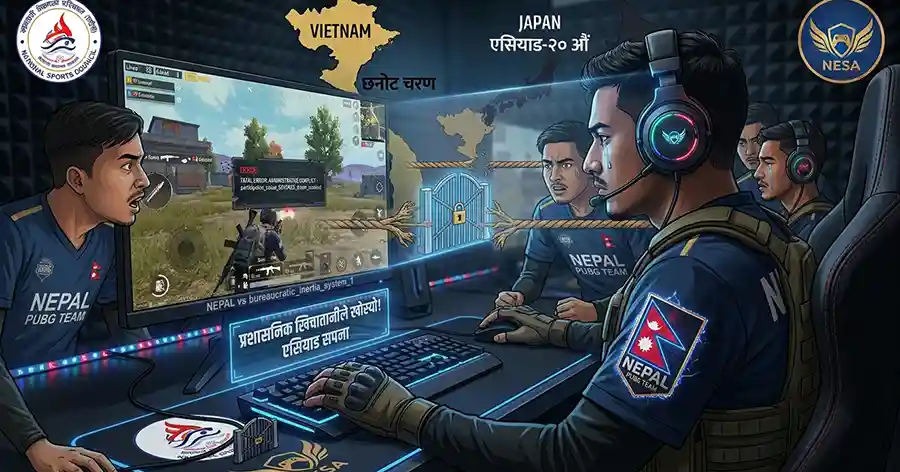
Nepal’s Slot Reportedly Reassigned
Multiple community reports and social media posts tracking the PUBG Mobile Asian Games bracket indicate that Nepal’s vacated slot has since been reallocated to another qualifying nation, reportedly Jordan, meaning the opportunity is now permanently gone for this Asian Games cycle regardless of how the domestic dispute is eventually resolved.
Nepal’s Esports Legacy at Stake
This is not Nepal’s first appearance in Asian Games esports. At the 19th Asian Games in Hangzhou, China, Nepal fielded a squad through NESA and finished fifth in PUBG Mobile — a genuinely competitive result against some of Asia’s strongest mobile esports programs. Coming into the 20th Asian Games, expectations were higher than ever, with players and fans alike believing a podium finish was realistic given the team’s growing experience and improved regional form.
Instead of building on that momentum, Nepal now heads into the Asian Games with its esports program sidelined entirely — not due to a lack of talent, but due to institutional dysfunction that has festered for years without resolution.
A Legal Battle Now Looms
With no administrative solution in sight, the affected players are reportedly turning to Nepal’s court system to seek redress, arguing that having lawfully qualified through an internationally recognized process, they should not be denied participation because of a domestic turf war between rival federations. Whether the courts can act quickly enough to matter — given that the Olympic Council of Asia has already finalized its participant list — remains uncertain.
What This Means for the Future of Nepali Esports
The Nepal PUBG Mobile Asian Games exclusion is likely to intensify pressure on the government to finally resolve the “one sport, two federations” problem once and for all. Nepal’s own sports law is unambiguous: each sport should have a single recognized governing association. Yet years after that law was enacted, esports in Nepal continues to operate under two competing authorities, with athletes paying the price for the ambiguity.
Industry observers note that Asian esports federations, including the AESF, generally require a single, internationally affiliated national body to coordinate athlete registration for events like the Asian Games. As long as Nepal maintains two rival associations claiming that authority, similar situations could recur at future international tournaments, jeopardizing Nepal’s credibility with global esports governing bodies.
For now, Nepal’s qualified PUBG Mobile roster — Samir Costello, Rohit Tamang, Deepesh Gurung, Saurav Tamang, and Sonu Karki — are left watching from home as a tournament they earned their place in unfolds without them. Their qualification stands as proof that Nepali talent can compete with the best in Asia. What failed them was not their skill on the battlefield, but the system meant to support them off it.
PUBG Mobile’s Growing Role at the Asian Games
Esports has steadily gained legitimacy on Asia’s biggest multi-sport stage. PUBG Mobile has featured as a medal event since the 19th Asian Games in Hangzhou, drawing some of the continent’s strongest mobile gaming talent from countries such as Indonesia, Pakistan, and Mongolia. The Vietnam qualifier that Nepal’s squad competed in this June was itself a high-stakes affair, drawing competing rosters from across Asia and reportedly attracting hundreds of thousands of live viewers online, a sign of just how seriously the region now treats competitive PUBG Mobile.
For a smaller esports market like Nepal, simply reaching that qualifier stage and finishing in the top eight was already a significant achievement. It placed Nepali players in direct competition with esports programs that receive far greater institutional backing from their national governments. That context makes the Nepal PUBG Mobile Asian Games exclusion even harder for fans to accept — the team did not fail on the biggest stage; it was never allowed to reach it.
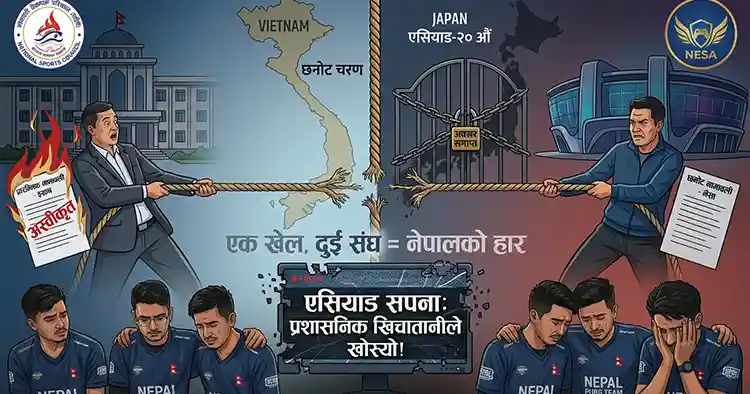
Comparing Nepal’s 2022 and 2026 Campaigns
At the 19th Asian Games, Nepal’s PUBG Mobile roster, fielded through NESA, finished fifth overall — a result that put the country firmly on the regional esports map and fueled optimism heading into the 20th edition. Coaches and players reportedly viewed the 2026 qualification as a natural next step, believing the squad had matured enough to challenge for a podium spot in Japan.
That narrative arc — from a promising fifth-place debut to a maiden Asian Games medal bid — is precisely what has now been cut short. Instead of building a two-cycle success story, Nepal’s esports program faces the prospect of explaining to the Olympic Council of Asia, and to its own athletes, why a qualified team never made it to the start line.
Lessons From Other Countries’ Esports Governance
Nepal is not the only nation to have wrestled with the growing pains of formalizing esports as an official sport. Several countries that now field competitive Asian Games esports rosters went through similar disputes over recognition and governance before settling on a single, internationally affiliated national federation. The common thread in those resolutions has typically been direct government intervention: sports ministries stepping in to formally recognize one association, aligning domestic law with international federation requirements, and setting clear deadlines for athlete registration well ahead of major events.
Nepal’s National Sports Development Act already provides the legal foundation for that kind of resolution — it explicitly limits recognition to one federation per sport. What has been missing is enforcement. Until the Ministry of Youth and Sports or the National Sports Council formally decides whether NESA or ESAN holds legitimate authority over esports, Nepali athletes will remain vulnerable to exactly the kind of last-minute exclusion that just cost this PUBG Mobile squad its Asian Games debut.
What Needs to Happen Next
Several concrete steps could prevent a repeat of this situation at future tournaments, including the Asian Games’ next edition and other continental esports events:
- A single, government-ratified esports federation recognized both domestically and by international bodies such as the AESF and IESF, removing the ambiguity that caused this year’s breakdown.
- Clear, published deadlines for athlete registration communicated directly to qualified teams, not just to federation leadership, so players are not blindsided by paperwork failures.
- A dispute-resolution mechanism within the National Sports Council specifically for cases where rival federations submit conflicting athlete lists, rather than defaulting to exclusion.
- Direct engagement with qualified athletes during any federation dispute, ensuring players are not left discovering their exclusion through a public announcement rather than official communication.
Without structural reform, Nepal risks repeating this same story every time a domestic team punches above its weight and qualifies for an international esports event.
Frequently Asked Questions
Why was Nepal’s PUBG Mobile team removed from the 20th Asian Games? Nepal’s National Sports Council excluded the qualified PUBG Mobile team from its final 22-sport delegation after a dispute between two rival esports federations — NESA and ESAN — left the athletes’ names off the official registration submitted before the deadline.
Who are the Nepali players who qualified for the Asian Games in PUBG Mobile? The qualified roster included Samir “Zyo” Costello, Rohit “Jordy” Tamang, Deepesh “DeltaX” Gurung, Saurav “TMG-8” Tamang, and Sonu “ByBy” Karki, who finished seventh at the regional qualifier in Vietnam in June.
Can Nepal still send its team to the Asian Games? As of now, no. The Olympic Council of Asia finalized its list of participating esports nations on 8 August without Nepal, and reports indicate Nepal’s slot has already been reassigned to another qualifying country.
What is causing the ongoing dispute in Nepali esports? Nepal currently has two organizations claiming authority over esports — the internationally recognized Nepal Esports Association (NESA) and the government-registered Esports Association of Nepal (ESAN) — despite national law requiring a single governing body per sport.
Sources referenced: Kathmandu Post, Rising Nepal Daily, and additional Nepali sports coverage. This article has been independently rewritten and contextualized based on original national reporting.

Economic Affair
- Budhigandaki Flood: 47 Rescued as Bridges Washed Away
- Nepal Supreme Court Handcuff Order: Police Barred From Routine Use
- 250+ Officials Deploy to Assess Rasuwa-Bhotekoshi Flood Damage
- Electricity VAT: Energy and Finance Ministers Strike Landmark Deal After Just 2 Months
- Nepal Inflation Shockingly Triples to 5.96% — Food and Transport Hit Hardest



Comments