


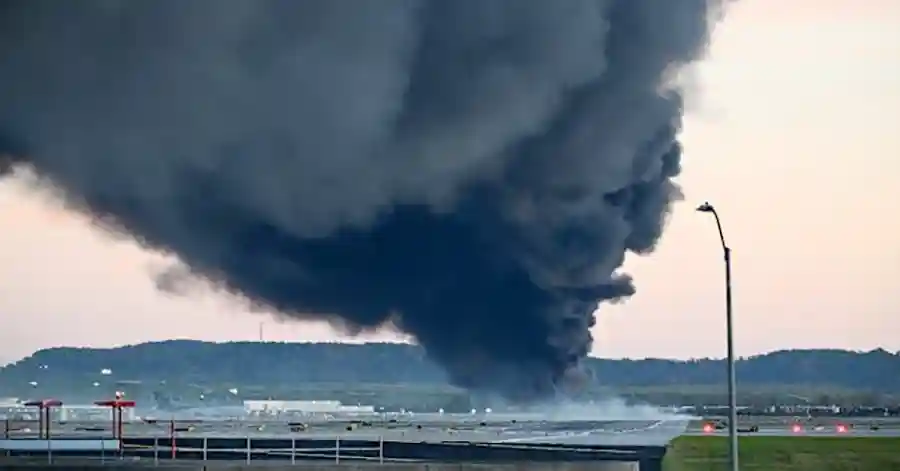




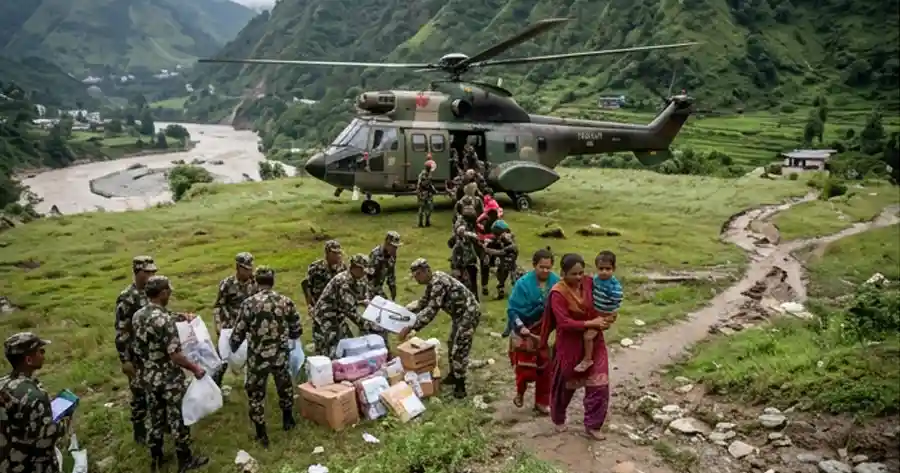
Nepal loses roughly 500 lives to disasters every single year — not to war, not to pandemics, but to landslides, fires, lightning, floods, and road accidents that keep repeating in nearly identical patterns. Nepal disaster risk management has improved on paper over the past decade, with new laws, a dedicated federal authority, and thousands of trained volunteers. Yet the government’s own six-year data tells a harder truth: Nepal is still organized to react to disasters, not to prevent them.
The 2026 Rasuwa flash flood, which killed over a thousand people in under 30 minutes, is only the latest and most extreme proof point. But it sits on top of a decade of quieter, cumulative losses that Nepal’s disaster statistics have been recording all along — and that policymakers have been slow to act on.
Why Disaster Risk in Nepal Is a National Development Problem, Not Just a Weather Problem
Nepal ranks among the most disaster-prone countries in the world because of its fragile mountain geology and its exposure to accelerating climate change. But in Nepal, disaster is not simply a seasonal inconvenience. It is a structural risk woven directly into development planning, public finance, infrastructure investment, poverty reduction, and food and water security.
Despite institutional and legal frameworks built specifically to reduce disaster risk, three practical gaps remain stubbornly unresolved: real-world preparedness on the ground, functioning early-warning systems that actually reach communities in time, and infrastructure development that accounts for risk before it is built, not after it collapses.
The Numbers Behind Nepal’s Disaster Decade (2018–2024)
The National Disaster Risk Reduction and Management Authority’s (NDRRMA) own six-year dataset, covering mid-2018 to mid-2024, lays out the scale of the problem in stark terms. Nationwide, 32,375 disaster incidents were officially recorded, resulting in 2,996 deaths, 446 people missing, and 11,752 injuries — figures independently corroborated by the Nepal Disaster Report 2024, prepared with support from USAID and coordinated by NDRRMA.
Landslides Are Nepal’s Deadliest Natural Hazard
Excluding the exceptional casualties from earthquakes and road accidents, landslides were the single deadliest natural hazard category during this period, responsible for 859 deaths — 28.6 percent of all fatalities. Fires killed 593 people, lightning strikes killed 408, and floods killed 245 during the same six-year window.
Fires Caused the Greatest Economic Damage
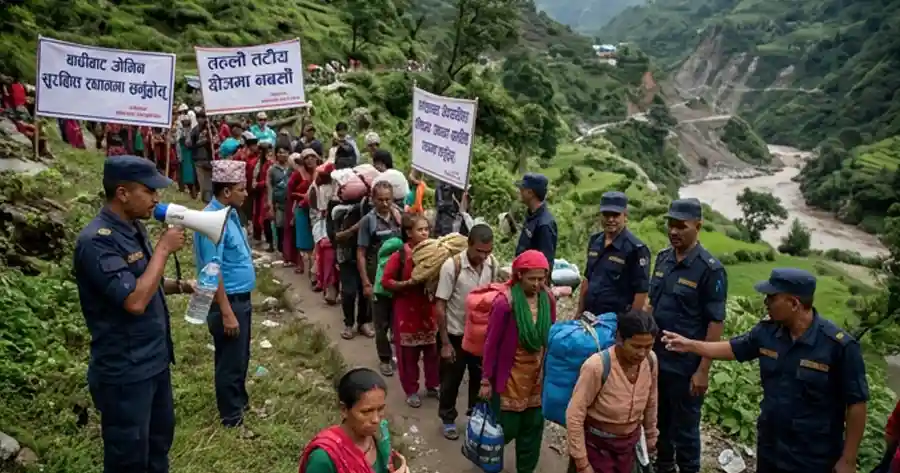
Beyond the human toll, Nepal absorbed an estimated NPR 23.6 billion in direct economic losses over these six years. Fires alone accounted for nearly three-quarters of that figure — NPR 17.63 billion, or 74.68 percent of total losses — confirming that Nepal’s preparedness gap extends well beyond natural hazards into human-caused and non-natural disasters, particularly firefighting and fire-control infrastructure.
The physical toll was equally significant: 57,271 houses were directly affected and 43,168 structures were destroyed or damaged. The loss of 18,336 livestock, a primary economic asset for Nepal’s rural households, added a long-term livelihood crisis on top of the immediate destruction for thousands of small farming families.
Recent Fiscal Years Show Road Accidents and Earthquakes Getting Worse
The most recent two fiscal years of government progress data show an especially troubling trend: road accidents and seismic risk are intensifying even as other disaster categories fluctuate.
Fiscal Year 2080/81 (2023/24): 2,928 Deaths, Most From Road Accidents
In fiscal year 2080/81, earthquakes, fires, landslides, floods, lightning, snakebites, and road accidents combined caused 2,928 deaths, 43 people missing, and 33,733 injuries. Road accidents alone accounted for 2,369 deaths — the single largest cause of disaster-related death that year, underlining that road safety needs to be formally addressed as a leading non-natural disaster category, not treated separately from disaster policy.
That same fiscal year, 109,389 households were affected and total property losses reached roughly NPR 56 billion, close to 1 percent of Nepal’s entire GDP. Of that figure, NPR 52.43 billion came from earthquake damage alone. On the preparedness side, the same year saw genuine progress: 113,000 volunteers were formally integrated into the disaster-response system, smart sirens were installed at 49 locations, and geological studies were completed in 34 local government units.
Fiscal Year 2081/82 (2024/25): 3,197 Deaths, Fires Lead Economic Losses
The following fiscal year, 2081/82, recorded 3,197 deaths, 48 missing, and 45,982 injuries from floods, landslides, fires, snakebites, wildfires, and road accidents. Once again, road accidents were the leading cause of death, at 2,549 fatalities. Total physical damage reached NPR 2.75 billion, with fires again the largest single contributor at NPR 1.95 billion.
The Missing Persons Crisis: Worse Than the Statistics Suggest
Nepal’s disaster data tends to foreground death tolls, but missing-persons figures — though numerically smaller — carry outsized importance for disaster research and for the families left behind without closure. Government records show 281 people went missing in 2015–2016 alone, of whom 195 were linked to the devastating Gorkha earthquake.
A separate dataset spanning 2015 to 2021 recorded 1,162 missing persons, while the Nepal Disaster Report 2024, covering 2018 to 2024, documents 446 missing. Disappearances are especially common in fast-moving hazards — floods, landslides, glacial lake outburst floods, and ice avalanches — where victims are swept away entirely rather than found at the disaster site. The trauma experienced by families during the 2021 Melamchi-Helambu flood, when relatives vanished in the surging water with no trace, remains one of the clearest examples of this specific and under-addressed dimension of disaster loss.
The True Economic Cost Is Far Higher Than Official Figures Show
Analysis of government data from 2015 to 2024 shows that approximately 825,000 houses were completely destroyed and 379,000 partially damaged nationwide. But these totals need careful interpretation: they can involve double-counting, inconsistent definitions of “affected” versus “destroyed,” and the outsized statistical weight of the 2015 earthquake, which dwarfs other events in scale.
Crucially, Nepal’s official disaster database mostly tracks immediate, direct losses. It does not capture the secondary costs that economists consider essential to a full damage assessment: lost productivity, forgone income, tourism disruption, school closures, healthcare costs, supply chain interruptions, or long-term psychosocial harm. That means treating the officially reported figures as the “total ten-year economic cost” significantly understates reality — the true economic burden is almost certainly several multiples higher than what appears in government reports.
The September 2024 Floods: A Case Study in Underestimated Costs
The devastating floods and landslides of September 2024 illustrate this gap clearly. According to NDRRMA’s own sectoral damage assessment, cited in a ReliefWeb preliminary loss and damage report, that single event caused an estimated NPR 46.68 billion in economic losses. The damage included 41 road sections, 44 bridges, 26 hydropower projects, 1,678 water supply and sanitation structures, and 446 telecommunications units. A further 5,996 houses were completely destroyed and 13,049 partially damaged.
This single flood event alone shows that disaster in Nepal is no longer simply a matter of “relief and rescue spending” — it is now a primary obstacle to national economic productivity and development.
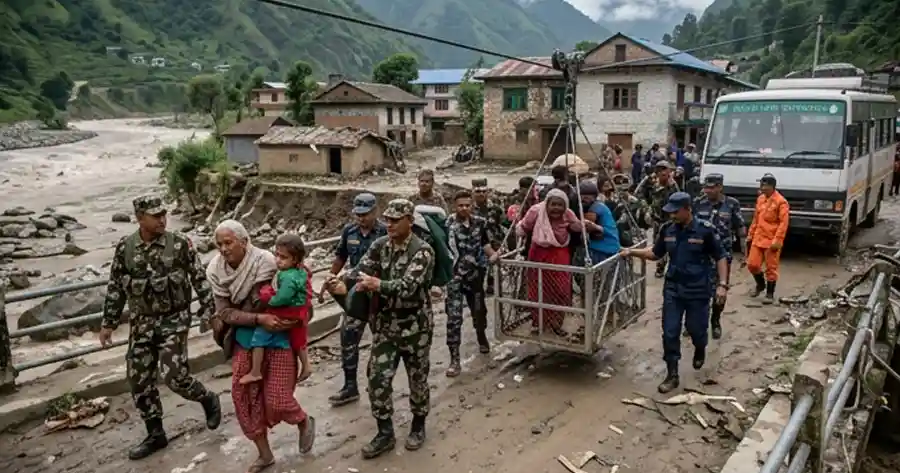
Nepal Spends Rs. 50 Billion a Year — Almost Entirely After Disasters Happen
According to a 2025 UNDP analysis, the Government of Nepal spent an estimated average of NPR 50 billion per year on disaster response between 2012 and 2020. That figure reveals a costly policy pattern: rather than investing upfront in preparedness and risk reduction, Nepal’s spending is overwhelmingly reactive, funding relief and reconstruction only after disaster strikes.
International research, including studies by the World Bank, consistently shows that pre-disaster risk-reduction investment delivers returns many times greater than post-disaster relief spending. Nepal, experts argue, can no longer afford to delay a strategic shift toward proactive investment.
Nepal’s Legal and Institutional Framework: Real Progress, Real Gaps
The Disaster Risk Reduction and Management Act of 2074 (2017)
The single biggest institutional reform in Nepal’s disaster management sector over the past decade is the Disaster Risk Reduction and Management Act, 2074. Rather than confining disaster management to relief work, the Act formally defines it as a complete cycle spanning risk reduction, response, and recovery. It also created a clear legal foundation for the National Council, Executive Committee, the Authority (NDRRMA) itself, and matching structures at the provincial, district, and local levels — further operationalized through the 2076 regulations.
Aligning With the Sendai Framework
Nepal’s National Disaster Risk Reduction Policy and Strategic Action Plan (2018–2030), issued in 2018, adapts the Sendai Framework’s four global priorities — understanding risk, strengthening risk governance, investing in preparedness and response, and “building back better” during recovery — to Nepal’s specific context.
Federalism Brought Disaster Management Closer to Communities
Since federalization, provincial and local governments have been given direct responsibility for disaster management. NDRRMA has institutionalized tools including the BIPAD Portal (Nepal’s national disaster information management system), an emergency communication center, and structured information management systems.
A national review workshop held in 2026 found genuine progress in some local governments — municipal-level Emergency Operations Centers, school-based disaster risk reduction programs, risk transfer mechanisms, and simulation exercises. But the same review flagged that scaling these successful pilot models to every local government across the country will require sustained financial and technical resources that are not yet guaranteed.
What’s Working — and What Still Isn’t
Achievement One: Early Warning Systems Have Genuinely Improved
Nepal’s capacity for river-level monitoring, community-based flood forecasting, meteorological forecasting from the Department of Hydrology and Meteorology, and information dissemination via SMS and social media has expanded meaningfully. Community-based flood early warning systems along the border with India have already demonstrated a practical cross-border benefit, relaying upstream river data to downstream communities in time to act.
Achievement Two: Post-2015 “Build Back Better” Awareness
The “Build Back Better” principle adopted after the 2015 earthquake, combined with greater public awareness of building codes, has measurably improved seismic safety in both private and public construction.
The Core Weakness: A Gap Between Policy and Implementation
Nepal’s central weakness remains the persistent gap between what policy says and what actually gets implemented on the ground. The Nepal Disaster Report 2024 itself notes that even where local governments have built the necessary legal frameworks, they still lack multi-sector planning, integrated data systems, and technical capacity. Development and road infrastructure projects frequently skip detailed geotechnical assessment, slope-stability analysis, and drainage planning as a mandatory part of design — a pattern that ends up creating brand-new disaster risk rather than reducing existing risk.
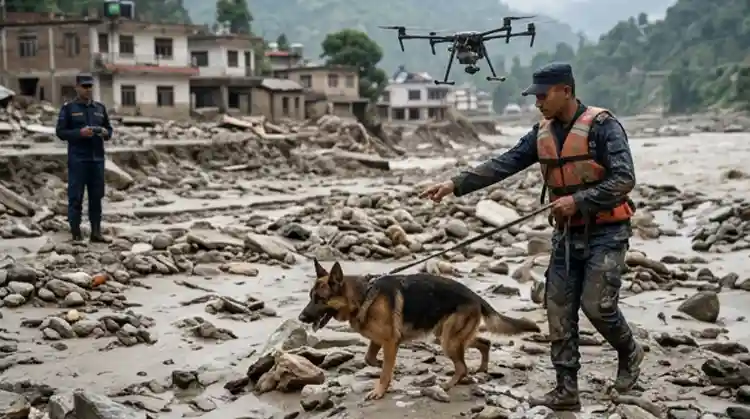
Nepal’s disaster response capacity is comparatively strong. The Nepal Army, Nepal Police, Armed Police Force, and district administrations have solid experience and capability in search, rescue, and relief operations. But disaster risk reduction — relocating at-risk settlements before disaster strikes, halting unsafe road construction, protecting river floodplains from encroachment, and building redundancy into critical infrastructure — routinely runs into political and administrative resistance. As a result, the state’s overall attention remains concentrated on short-term relief and rescue rather than long-term risk reduction.
Four Root Causes of Nepal’s Disaster Management Failures
Analysts point to four specific, recurring failure points across Nepal’s disaster management system:
- The forecast-to-preparedness gap. Issuing a technical flood or rainfall warning is not the same as a community actually reaching safety in time. Practical coordination between the two remains weak.
- Disconnected planning and implementation. Risk mapping, land-use policy, and infrastructure approval processes are not properly coordinated with one another.
- Weak inter-agency coordination. Although constitutional authority is divided among federal, provincial, and local governments, an integrated database, seamless budget transfers, and unified emergency command structures have not been achieved.
- A reactive development mindset. Disaster risk reduction is still not treated as a mandatory cost of infrastructure development — the traditional pattern of “find the budget only after disaster strikes” persists.
The Rasuwa-Bhotekoshi Flood: A 10-Year Test Nepal Failed
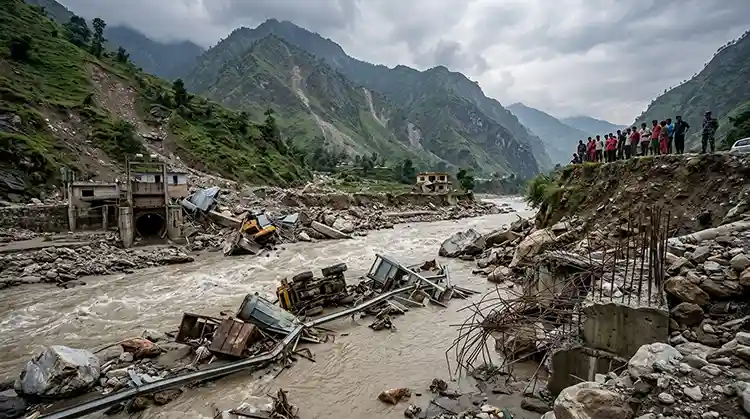
The catastrophic flood that tore through Rasuwa’s Bhotekoshi corridor and down into the Trishuli River on 26 August 2026 exposed a genuinely new and terrifying dimension of cross-border disaster risk between Nepal and China. Preliminary studies indicate that an ice-rock collapse in the upper mountain region generated an extremely fast-moving debris flow, causing irreparable damage to roads, permanent bridges, border infrastructure, settlements, and hydropower projects across Rasuwa and Nuwakot districts.
Nepal’s Ministry of Home Affairs, in its official relief appeal issued the following day, cautioned that because full damage assessment was still underway, early casualty figures circulating on media and social platforms could not yet be treated as final government data — a caution that reflects how genuinely chaotic and fast-moving the first hours of such a disaster are.
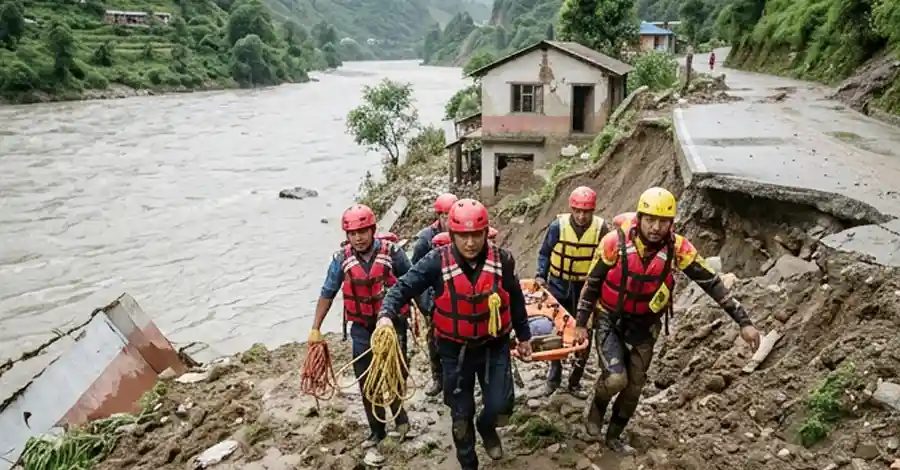
Eyewitness Accounts Reveal How Little Warning There Was
Eyewitness Tulsi Bahadur Bhandari described watching a massive boulder fall from the mountainside, raising a cloud of dust, immediately followed by a terrifying wave of mud and water that swept away vehicles. Another survivor recalled the ground shaking “as if an earthquake had struck,” followed instantly by a massive wave of mud, rock, and water.
These firsthand accounts underline the sharp limits of Nepal’s existing early-warning infrastructure. In cascading geological disasters that unfold within minutes, ordinary weather forecasting alone is nowhere near sufficient. This event connects directly to glacial lake outburst flood and ice-avalanche risks that had already been flagged in the Rasuwa region back in 2025. It demonstrates that while Nepal has developed response mechanisms for after a disaster occurs, it still lacks the institutional capacity for real-time, basin-wide data exchange on glacial and high-mountain hazards across its northern border.
Why Nepal, China, and India Need a Trilateral Disaster Partnership
Technical and scientific cooperation between Nepal, China, and India has become essential for managing Himalayan disaster risk. The Koshi River basin alone touches all three countries — China (Tibet), Nepal, and India — meaning a glacial lake outburst or landslide in the upper basin can trigger a cascading chain of destruction all the way down to downstream communities. ICIMOD’s Koshi Basin Disaster Risk Reduction Knowledge Hub has been coordinating scientists and policymakers from all three countries through cross-border working groups since 2018.
Six Practical Pillars for Future Cooperation
- A Koshi-Himalaya Multi-Hazard Early Warning Grid — linking China’s upper glacier and glacial-lake data, Nepal’s river and landslide monitoring, and India’s downstream flood forecasting into a single shared digital system.
- A minimum data-sharing protocol — a clear technical agreement on which sensor data gets shared, within what timeframe, in what format, and with which emergency agency.
- Joint satellite monitoring — coordinated satellite surveillance of high-altitude Himalayan zones, with pre-monsoon joint risk assessments.
- A cross-border humanitarian corridor — dedicated protocols for joint search-and-rescue exercises and rapid relief access during emergencies.
- Joint disaster-safety audits — cross-border risk audits assessing how hydropower, dams, or road infrastructure built on shared rivers could affect downstream countries.
- An open scientific forum — a platform for universities, geological institutions, and ICIMOD across all three countries to exchange scientific data and research.
Sovereignty concerns, security sensitivities, and the political complexity of data-sharing will remain real obstacles to this kind of partnership. That is precisely why experts recommend starting cooperation through non-political, scientific, and humanitarian channels first, before attempting anything more politically sensitive.
A 10-Point Strategic Action Plan for Nepal’s Disaster Future
Based on the patterns in a decade of data, the following ten actions are being proposed as Nepal’s path forward:
- Build an integrated disaster loss accounting system — a single national standard for recording deaths, missing persons, housing damage, and losses to roads, agriculture, hydropower, education, and production.
- Adopt risk-sensitive land-use policy — complete multi-hazard mapping in every municipality and mandatorily link it to land-use planning and building permits.
- Invest in modern early-warning systems — expand smart sirens, SMS alerts, cell broadcast technology, and trained local volunteer networks for floods, landslides, glacial lake outbursts, and debris flows.
- Mandate safe infrastructure construction — no road project should receive tender approval or clearance without detailed geotechnical, hydrological, and comprehensive risk assessment.
- Relocate high-risk settlements — run voluntary relocation programs for rural communities in high-hazard zones, paired with integrated, risk-sensitive settlement development.
- Strengthen real-time inter-agency coordination — establish shared emergency operating procedures across NDRRMA, the Department of Hydrology and Meteorology, the Survey Department, the Department of Roads, Nepal Electricity Authority, and security agencies.
- Expand disaster financial risk transfer — move beyond dependence on emergency relief funds alone, expanding risk transfer mechanisms, disaster insurance, disaster risk financing, and resilient infrastructure funds.
- Set critical infrastructure resilience standards — bring schools, hospitals, hydropower plants, road bridges, and telecommunication towers under a formal “critical infrastructure resilience standard.”
- Formalize a cross-border technical disaster protocol — operationalize real-time data-sharing protocols between Nepal, China, and India for shared river basins including the Koshi, Trishuli, and Bhotekoshi.
- Ensure independent review and accountability — conduct an independent expert review after every major disaster, with recommendations mandatorily incorporated into future budgets and development projects.
Conclusion: Nepal Must Shift From Reacting to Disasters to Preventing Them
A decade of disaster data shows that Nepal’s disaster risk has not shrunk — it has changed shape, and in several respects, it has grown worse. The 2015 mega-earthquake underscored seismic risk. The 2017 floods, the 2019 windstorms, the 2020-2021 landslides, the 2023 Jajarkot earthquake, and the extraordinary rainfall of 2024 all confirmed the intensifying severity of hydro-meteorological and climate-driven disasters.
Now, the 2026 Rasuwa-Bhotekoshi flood has taught an even harder lesson: Nepal must be prepared not only for disasters originating within its own borders, but for natural hazards crossing in from beyond them.
Nepal already has the essential legal framework, national policy, a dedicated authority, an emergency communication center, and the foundations of international partnership in place. The core weakness going forward is not the absence of a system — it is the system’s failure to fully connect with infrastructure development, land use, national budgeting, local governance, and cross-border scientific information sharing.
Nepal’s national policy must now decisively shift away from the traditional model of rescuing people after disaster strikes, toward a modern strategy centered on reducing risk before disaster ever occurs. If cooperation between Nepal, China, and India can be built on this same practical principle, the vast Himalayan region can be transformed from a geography defined by risk into one defined by shared security and shared prosperity.

Economic Affair
- Budhigandaki Flood: 47 Rescued as Bridges Washed Away
- Nepal Supreme Court Handcuff Order: Police Barred From Routine Use
- 250+ Officials Deploy to Assess Rasuwa-Bhotekoshi Flood Damage
- Electricity VAT: Energy and Finance Ministers Strike Landmark Deal After Just 2 Months
- Nepal Inflation Shockingly Triples to 5.96% — Food and Transport Hit Hardest



Comments