









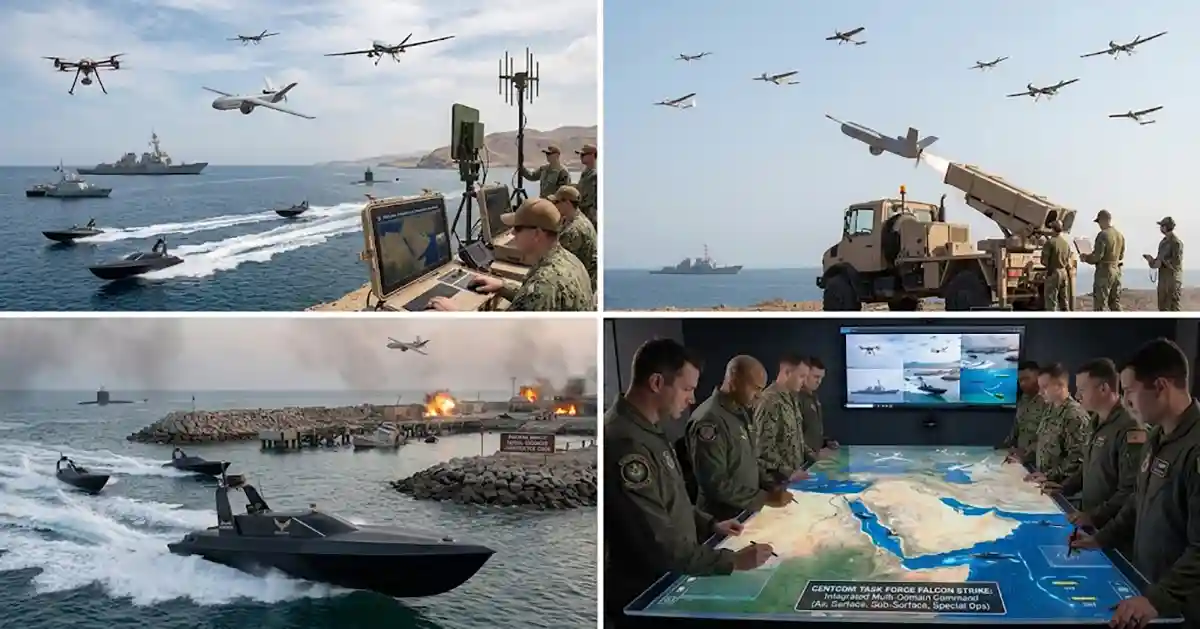
The United States military has taken a major step toward reshaping how it fights in the Middle East. On August 13, 2026, US Central Command (CENTCOM) announced the creation of Task Force Falcon Strike, described as the first-ever multi-domain, multinational attack drone task force in American military history. The unit will combine one-way attack drones operating in the air, on the sea surface, and underwater, drawing on both US technology and systems developed by regional partners across the Middle East.
The announcement comes nine months after CENTCOM stood up Task Force Scorpion Strike, and it arrives while the United States remains locked in an extended military confrontation with Iran that began in February 2026. Below is a complete breakdown of what Falcon Strike is, how it grew out of Scorpion Strike, and why defense analysts see it as a turning point in modern warfare.
What Is Task Force Falcon Strike?
Falcon Strike is not a conventional army unit built around thousands of deployed soldiers. Instead, it is an integration framework — a command structure designed to fuse together one-way attack drones from the United States and its regional partners into a single, coordinated strike capability.
According to CENTCOM,Task Force Falcon Strike will employ one-way attack drones operating in the air, on the sea surface and below the sea, supported by military personnel from the United States and regional partners That three-domain reach — air, surface, and subsurface — is what officials say makes it unprecedented.
The unit, called Task Force Falcon Strike, will employ one-way attack drones consisting of unmanned systems from above, on, and below the sea operated by military support staff from the United States and regional partners. In practical terms, that means aerial kamikaze drones, unmanned surface vessels, and eventually underwater drones will all fall under one operational umbrella instead of being run as separate, siloed programs.
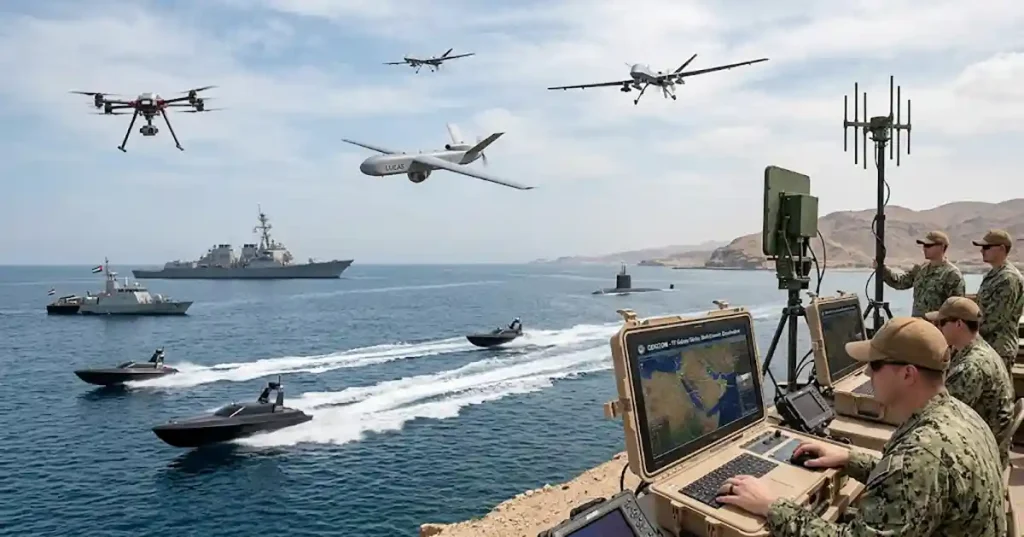
one-way attack drone air sea undersea Falcon Strike task force
From Scorpion Strike to Falcon Strike: The Origin Story
Falcon Strike did not emerge overnight. Its foundation is Task Force Scorpion Strike, which CENTCOM activated roughly nine months earlier. Falcon Strike builds on the experience of Task Force Scorpion Strike, which CENTCOM established in December 2025 as the US military’s first dedicated one-way attack drone squadron in the Middle East.
Scorpion Strike was created in response to a broader Pentagon push for cheap, mass-producible drone technology.Task Force Scorpion Strike was established in response to Defense Secretary Pete Hegseth’s call for rapid acquisition of affordable drone technology, and the announcement of the new squadron at the time came hours after the Pentagon unveiled a multiyear, $1 billion initiative to acquire hundreds of thousands of low-cost, one-way attack drones
At the heart of Scorpion Strike is the LUCAS drone — short for Low-cost Unmanned Combat Attack System. LUCAS is a one-way attack drone reverse-engineered from Iran’s Shahed-136 and produced by Arizona-based SpektreWorks at roughly $35,000 per unit</cite>. That price tag is strikingly low compared to traditional precision-guided munitions, some of which can cost hundreds of thousands or even millions of dollars per unit.
LUCAS Drones Make Their Combat Debut
The LUCAS system moved from testing to actual combat use during a major US-Israeli offensive against Iran. <cite index=”10-1″>LUCAS made its combat debut on February 28, when Scorpion Strike launched the drones against Islamic Revolutionary Guard Corps (IRGC) command centers and air defense infrastructure during Operation Epic Fury, the coordinated US and Israeli campaign against Iran, with CENTCOM describing it as the first time American forces employed one-way attack drones in combat
That operation marked a significant shift: rather than relying exclusively on manned strike aircraft, cruise missiles, and expensive munitions, US forces used a fleet of low-cost, expendable drones to strike hardened targets, sparing costly assets for higher-priority missions.
Notably, even months after the drone’s combat debut, production remained limited. A few weeks after the February strikes, the Pentagon’s top technology officer told DefenseScoop the military had only produced “dozens” of the LUCAS drones at the time — a reminder that scaling up mass drone manufacturing is still a work in progress, even as the strategic vision races ahead.
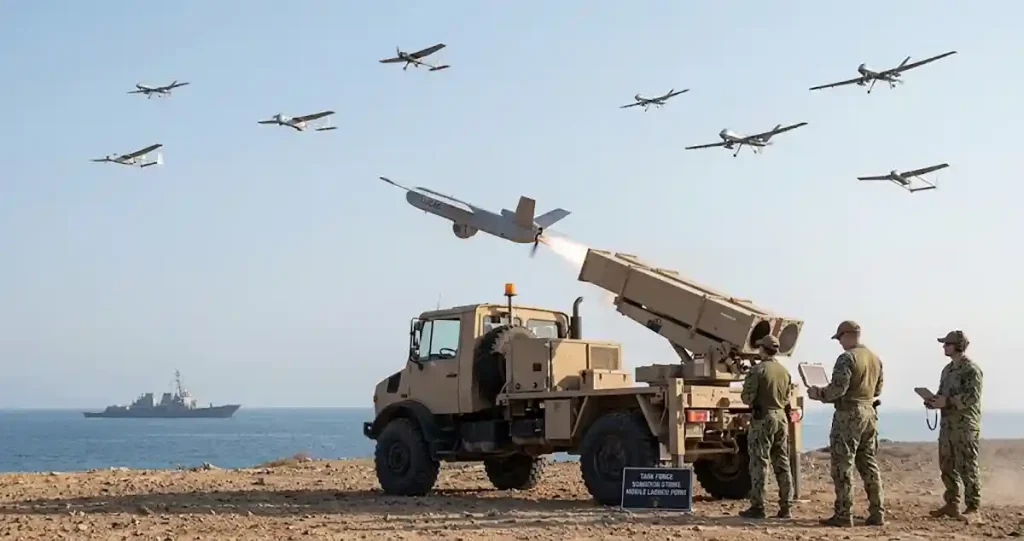
LUCAS low cost unmanned combat attack drone Iran strike
A Warship Launches a Drone for the First Time
Scorpion Strike also achieved a first for naval warfare. In December 2025, the US Navy test-launched a LUCAS drone directly from a warship at sea for the first time. A Low-cost Unmanned Combat Attack System (LUCAS) successfully launched from the flight deck of the Independence-class littoral combat ship USS Santa Barbara while operating in the Arabian Gulf, with Task Force 59 operating the drone as part of Task Force Scorpion Strike.
That milestone matters strategically because it reduces the US military’s dependence on fixed airbases, which can be vulnerable to attack or subject to the political constraints of host nations. A warship, by contrast, can reposition freely and launch strikes from international waters.
Iranian Port Facilities Hit by Sea Drones in July
The multi-domain concept behind Falcon Strike was already being tested in real combat months before its formal announcement. In July 2026, US forces used unmanned surface vessels to strike Iranian naval infrastructure. Unmanned surface vessels attacked a naval base in July, marking one of the first times the US military used a sea drone offensively rather than purely for reconnaissance or logistics.
CENTCOM has also used unmanned surface vehicles for search-and-rescue work in the region. CENTCOM said in June it deployed an unmanned surface vessel known as the Corsair to recover two stranded soldiers in the Strait of Hormuz after Iran shot down their AH-64 Apache helicopter. Combined with the July strikes, this shows the Corsair-class drone boats are being used for both combat and rescue missions as the war continues.
Underwater systems have entered the picture too. Underwater drones cleared mines from the Strait of Hormuz in April, rounding out the three-domain capability — air, surface, and subsurface — that Falcon Strike now formally unifies under a single command.
Why “Multi-Domain” and “Multinational” Matter
Falcon Strike’s significance lies in two words CENTCOM keeps repeating: multi-domain and multinational.
Multi-Domain: One Command, Three Battle Spaces
Instead of treating aerial drones, naval drones, and underwater drones as separate programs run by separate commands, Falcon Strike puts them into one integrated structure. Falcon Strike formally consolidates a three-domain drone capability that CENTCOM has already demonstrated in combat through separate operations against Iran, and it is the first task force to bring all three domains under a single multinational command.
Multinational: Sharing the Load With Regional Allies
CENTCOM has been explicit that Falcon Strike is meant to pull in partner nations’ own drone and sensor technology rather than rely solely on US-built systems. While CENTCOM commander Adm. Brad Cooper touted the task force as a boon for regional security, the command declined to say whether any other countries had joined the unit, even informally, or which nations it expects to participate.
Still, the intent is clear from CENTCOM’s own statements. As regional partners formally join, Task Force Falcon Strike will scale attack drone capabilities across the Middle East into a unified multi-domain, multinational deterrent. Cooper framed the initiative as a matter of collective strength: “The United States military has a lot of strong partnerships and friends in the region. We are collectively stronger when we integrate and deploy new capabilities together.”
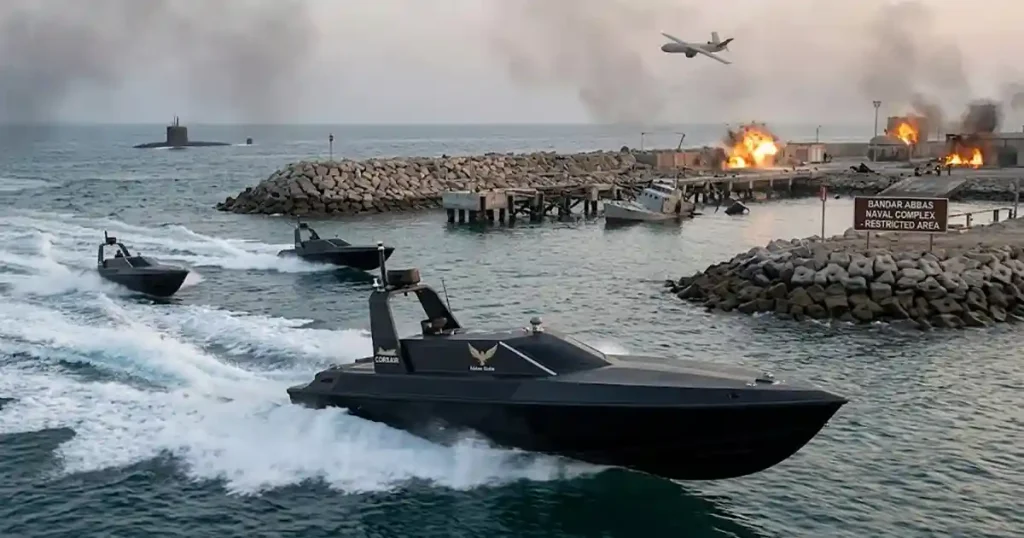
Admiral Brad Cooper CENTCOM commander Falcon Strike announcement
Who Leads Falcon Strike?
Command of the new task force falls to Special Operations Command Central (SOCCENT), the same organization that stood up Scorpion Strike. US Special Operations Command Central will lead Falcon Strike’s staff, which will include US and regional military representatives, and SOCCENT also launched Task Force Scorpion Strike, providing the organizational foundation for the new multinational initiative
SOCCENT’s reach extends well beyond drone warfare alone. SOCCENT is headquartered at MacDill Air Force Base in Tampa, Florida, and plans and conducts special operations across CENTCOM’s 21-country area of responsibility, with a geographic remit covering the Middle East, Central Asia and South Asia. That broad mandate suggests Falcon Strike’s model could eventually extend beyond the immediate Iran conflict into other parts of the region.
The Bigger Picture: Iran War and a Munitions Crunch
Falcon Strike is emerging directly out of the pressures of an ongoing war. The conflict with Iran began with US and Israeli strikes on Feb. 28 under Operation Epic Fury and has since expanded into a broader regional confrontation, with the US deploying tens of thousands of troops and more than 20 warships to the region while maintaining a naval blockade of Iranian ports.
That prolonged fight has strained America’s supply of expensive precision weapons. The American military has rushed to build a stable of unmanned systems and drone countermeasures as the Iran war drains expensive US munition stockpiles, putting in stark relief the imbalance between using costly weapons against cheap, mass-producible systems, especially as Iran has launched thousands of drones during the war.
That imbalance — expensive interceptors and munitions against cheap, swarageable enemy drones — is exactly the gap Falcon Strike is designed to close, by giving US and allied forces their own low-cost, high-volume strike option rather than relying purely on defense and expensive offense.
Not “War Without Soldiers” — A Correction Worth Making
It’s tempting to describe Falcon Strike as a step toward “war without soldiers,” but that framing oversimplifies what’s actually happening. Even as drones take on more of the direct strike role, humans remain essential at every stage: target selection, intelligence analysis, communications relay, logistics, and the ultimate decision of when and how force is used.
A more accurate description is that Falcon Strike reduces the direct physical risk to military personnel while expanding the scale and reach of strike operations — not that it removes people from the loop. Drones fly, sail, and dive; humans still decide.
Strategic Advantages CENTCOM Is Betting On
Defense officials and analysts point to three main advantages driving the push toward integrated drone task forces like Falcon Strike:
- Cost efficiency at scale. Low-cost, one-way drones like LUCAS — priced at a fraction of traditional missiles — allow the US and its partners to sustain a higher operational tempo without burning through expensive munitions stockpiles.
- Reduced risk to personnel. Because these systems are unmanned and expendable by design, there’s no pilot or crew placed in harm’s way during a strike mission.
- Multi-directional pressure. By coordinating air, surface, and undersea drones within a single command structure, adversary air defense and coastal defense systems can be stressed simultaneously from multiple directions, making them harder to defend against.
The Risks and Open Questions
The shift toward mass-produced, low-cost autonomous and semi-autonomous weapons also raises serious concerns that defense and human-rights analysts continue to debate:
- Targeting accuracy and civilian harm — as strike volume increases, the risk of misidentified targets or unintended casualties grows.
- Human oversight — questions remain about how much direct human control is maintained over swarms of low-cost drones operating across multiple domains at once.
- International humanitarian law — the legal frameworks governing autonomous and semi-autonomous weapons are still evolving and lag behind the pace of deployment.
- An arms race dynamic — as the US and its allies scale up cheap drone production, adversaries like Iran — which has already relied heavily on mass drone attacks — are likely to respond in kind, potentially accelerating a broader regional drone arms race.
CENTCOM itself has been relatively guarded about operational details, declining so far to confirm which regional partners have formally joined the task force.
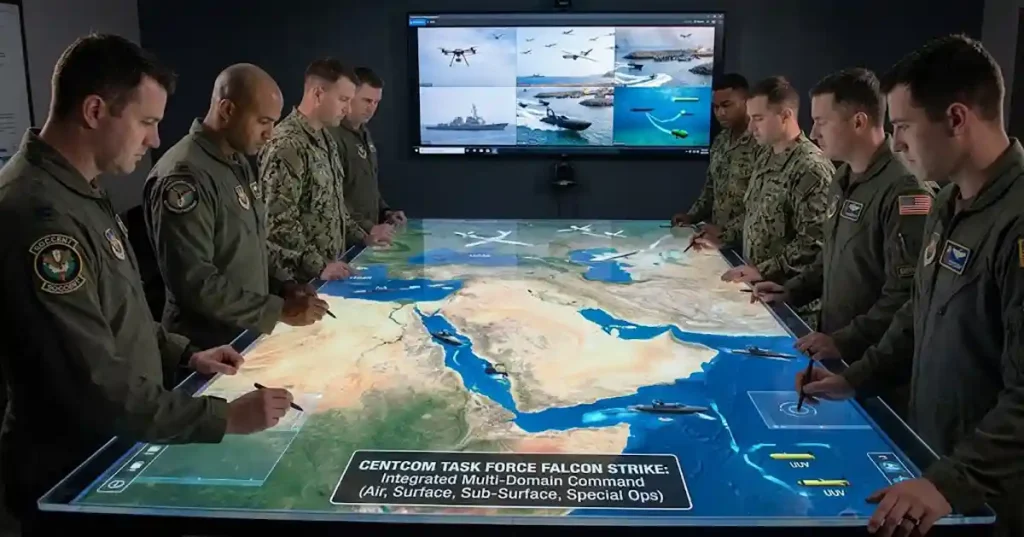
What Happens Next?
CENTCOM has been careful to frame Falcon Strike’s launch as the beginning of a process, not a finished capability. CENTCOM declined to say whether any other countries had joined the unit, even informally, or which nations it expects to participate, indicating that partner integration is still in its early, consultative stages.
CENTCOM has initiated the process of consulting with and inviting regional partners into the task force, and officials have said that as those partnerships are formalized, the task force’s drone capabilities will scale up across the region.
For now, Falcon Strike represents a strategic signal more than an immediate battlefield transformation: the United States is betting that the future of warfare in the Middle East — and potentially beyond — will be defined less by exquisite, expensive, manned platforms and more by networks of cheap, expendable, multi-domain drones operating under unified multinational command.
Key Facts at a Glance
- Task Force Falcon Strike was announced by CENTCOM on August 13, 2026.
- It is billed as the first multi-domain (air, sea-surface, undersea), multinational one-way attack drone task force in US military history.
- It builds on Task Force Scorpion Strike, established in December 2025.
- Scorpion Strike operates the LUCAS drone, built by Arizona-based SpektreWorks at roughly $35,000 per unit, reverse-engineered in concept from Iran’s Shahed-136.
- LUCAS made its combat debut on February 28, 2026, during Operation Epic Fury against Iranian military targets.
- In December 2025, a LUCAS drone was launched from the USS Santa Barbara — the first US Navy shipborne launch of a one-way attack drone.
- In July 2026, unmanned surface vessels struck Iranian naval infrastructure — an early demonstration of the multi-domain concept.
- SOCCENT, headquartered at MacDill Air Force Base, will lead the new task force.
- CENTCOM has not yet confirmed which regional partner nations will formally join.
Sources and Further Reading
- Stars and Stripes: CENTCOM touts multinational attack-drone task force
- DefenseScoop: Centcom creates first ‘multinational’ attack drone task force after months of war with Iran
- Seapower Magazine: CENTCOM Launches First-Ever Multinational Attack Drone Task Force
- SOFX: CENTCOM Unites Three Combat-Proven Drone Domains in First Multinational Task Force
- Al Arabiya English: CENTCOM launches first-ever multinational drone task force

Economic Affair
- Budhigandaki Flood: 47 Rescued as Bridges Washed Away
- Nepal Supreme Court Handcuff Order: Police Barred From Routine Use
- 250+ Officials Deploy to Assess Rasuwa-Bhotekoshi Flood Damage
- Electricity VAT: Energy and Finance Ministers Strike Landmark Deal After Just 2 Months
- Nepal Inflation Shockingly Triples to 5.96% — Food and Transport Hit Hardest




Comments