












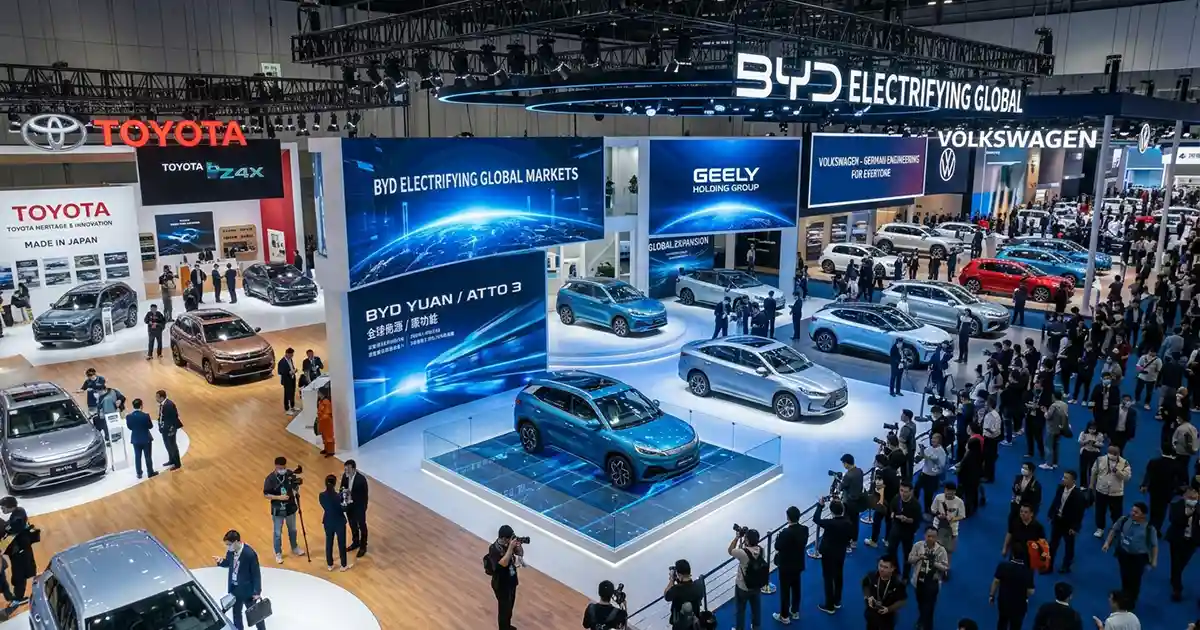
China’s car exports boom is reshaping the global auto industry in real time. From Europe to Southeast Asia, Chinese-made vehicles are flooding into new markets at a pace that has left legacy giants like Toyota and Volkswagen scrambling to respond. Yet back home, the picture could not look more different: Chinese car sales have now fallen for 10 consecutive months, weighed down by weak consumer demand and years of brutal price competition that have left the world’s largest auto market drowning in excess capacity.
This split-screen story — booming abroad, shrinking at home — is no accident. According to analysts and industry insiders, China’s rapid overseas expansion is being driven as much by economic necessity as by ambition, turning what was once a growth strategy into something closer to a survival strategy.
Domestic Sales Fall for the 10th Straight Month
China’s passenger car market extended its losing streak in July, with domestic sales falling 21.1% year-on-year to 1.47 million vehicles, according to data released by the China Passenger Car Association (CPCA). Sales at home slid 21.1% last month from a year earlier to 1.47 million vehicles, while exports rose 88.2% to 923,000, according to CPCA data released Tuesday.
That marks the 10th consecutive month of year-on-year decline for China’s domestic auto market — though Reuters notes the pace of the drop has eased slightly compared with earlier months this year, offering a small sliver of hope that the worst of the slump may be behind it.
CPCA Secretary-General Cui Dongshu attributed the latest weakness to two specific pressures: elevated fuel prices that have dampened demand for gasoline-powered Chinese cars, and continued softness in the entry-level sedan segment, where budget-conscious buyers have pulled back sharply.
Exports Surge 88% as Automakers Look Abroad
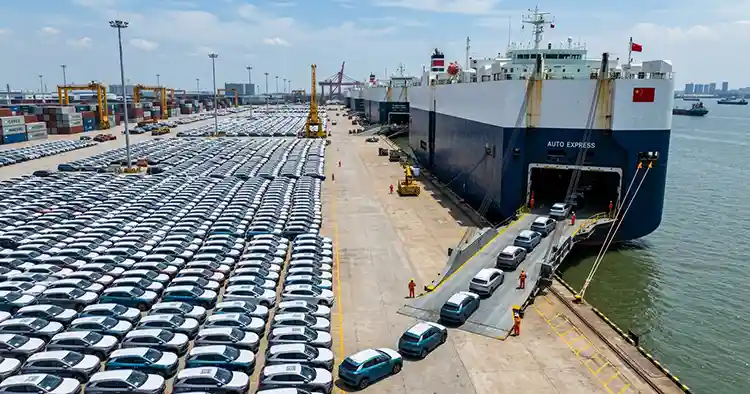
While the domestic market contracts, China’s export engine is running red-hot. Vehicle exports jumped 88% year-on-year to 923,000 units in July alone — nearly matching the total number of cars sold domestically that same month, according to CPCA figures.
This isn’t a one-month blip. Export growth from China’s auto sector has accelerated consistently through 2026. Earlier in the year, exports were already climbing sharply: car exports jumped 82.1% to 882,000 vehicles in June, while domestic passenger vehicle sales fell 23.4% from a year earlier to 1.62 million units, following a 22.3% decline in May, according to Reuters reporting via Goldsea.
Even more striking, China’s NEV (new energy vehicle) export growth has outpaced overall auto export growth in some months. China’s NEV exports surged 148% in July, helping offset weak domestic demand, according to industry tracker ChinaEVHome, which also noted the leading NEV exporters that month were BYD, Chery, Tesla China, Geely and Changan Automobile.
While the official export figures include non-Chinese brands manufactured inside China, analysts say the underlying trend — steep domestic declines paired with double-digit export growth — holds up consistently among purely domestic Chinese automakers as well.
Why Going Global Has Become a “Strategic Necessity”
Chinese automakers like BYD, Geely and Chery have long harbored ambitions of becoming true global heavyweights. But industry watchers say what was once a long-term strategic goal has now become an urgent economic imperative.
“Chinese automakers have excess manufacturing capacity, highly competitive supply chains, increasingly sophisticated products and a strong economic incentive to find growth outside China,” said Bill Russo, CEO of Shanghai-based advisory firm Automobility. Going global, he added, “is becoming a strategic necessity” for the country’s leading carmakers.
That pressure is only going to intensify the squeeze on European and Japanese rivals, who are already struggling to compete with China’s technologically advanced, low-cost electric vehicles on price, features and speed to market.
The broader economic backdrop makes the stakes even clearer. China’s car industry is a microcosm of the dynamics now playing out across the country’s entire economy: booming factories and surging exports are propping up headline growth figures, even as a weak property market and cautious consumer spending continue to drag down demand at home. For policymakers in Beijing, an economy that produces far more than it can sell domestically makes overseas markets an increasingly critical release valve.
A Japan-Sized Hole in China’s Home Market
The scale of China’s domestic auto slump becomes even more striking when compared to an entire foreign market. In the first half of 2026, China’s domestic car sales fell by 2.3 million vehicles compared to the same period a year earlier — a 20% year-on-year decline.
That drop alone is roughly equivalent to all new car registrations in Japan — the world’s fourth-largest auto market — over the same six-month period. Meanwhile, China’s car exports jumped 71% during the first half of the year, according to industry data.
HSBC analyst Yuqian Ding expects domestic demand to gradually stabilize and potentially begin recovering between late August and September, as a fresh cycle of new vehicle models hits showrooms. But she cautioned that a sharp “V-shaped” rebound is unlikely — this looks more like a long, grinding recovery than a quick bounce-back.
BYD: Record Exports Mask a Shrinking Home Base
No company illustrates this divergence better than BYD, China’s largest EV maker and, until recently, the undisputed leader of its domestic market.
BYD posted its strongest month of 2026 in July, with total new-energy vehicle (NEV) sales jumping 21.8% year-on-year to 419,211 units. July marked the third consecutive month of rising sales for BYD, with 419,211 new-energy vehicles delivered worldwide — a 21.8 percent jump year-on-year and the strongest month of 2026 so far, according to a report by Ad-Hoc News.
But that headline number obscures a sharp internal split. Overseas shipments told the real story: BYD shipped 179,841 vehicles abroad in July, a 124.3 percent surge from a year earlier and a fresh record, with foreign deliveries accounting for 43 percent of the monthly total for the first time.
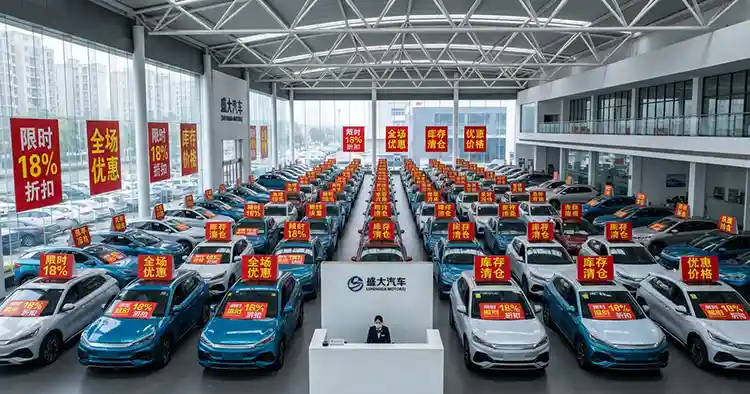
Domestic sales, by contrast, remained under pressure. In China, BYD’s domestic sales slipped about 9% year-over-year to around 239,370 vehicles in July, according to a report from The Cool Down. Through the first seven months of 2026, BYD had sold 2,227,722 EVs globally — still down 10.54% compared to the same stretch of 2025.
The strain shows up in BYD’s broader annual targets too. Bloomberg calculations cited by Ad Hoc News suggest BYD would need to average around 530,000 sales in each remaining month of 2026 just to reach the low end of its 5 million to 5.5 million vehicle target for the year — a pace the company has not yet come close to hitting.
Domestically, the erosion has even cost BYD its long-held crown. According to Ad-Hoc News, Geely claimed the top spot in China’s domestic retail market during the first half of 2026, with 1.021 million units sold — a symbolic shift after years of BYD dominance at home.
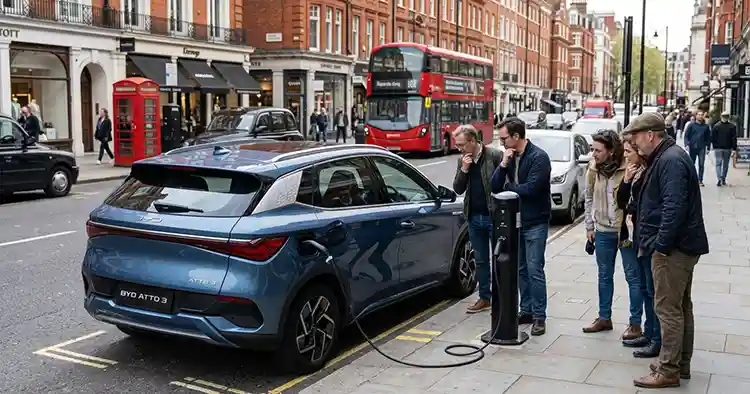
Internationally, though, BYD’s momentum is undeniable. Brazil delivered a July registration record of 23,465 BYD vehicles, up 142.4% year-on-year, making BYD the fourth-best-selling brand in the country overall with a 9.1% market share. The company has also become a major player in Spain, the UK, and France, where BYD sales climbed 237.6% in July alone as the French EV market crossed a 35% battery-electric penetration rate.
Geely and Chery Post Record Months Too
BYD isn’t alone in this pattern. Its domestic rivals Geely and Chery are experiencing an even more extreme version of the same export-led boom.
Geely Auto sold a total of 250,161 vehicles in July, up 5.23% year-on-year, with overseas sales totaling 106,663 units — a surge of 202.40% year-on-year and a new monthly record, marking the second consecutive month that Geely’s exports exceeded 100,000 units, according to CnEVPost. Cumulative exports for the first seven months of 2026 totaled 580,891 units, up nearly 165% year-on-year, even as the company’s domestic market “remained sluggish.”
Chery’s numbers show an even sharper divergence. Chery Group’s domestic deliveries in July totaled about 74,000 units, a decrease of about 30% year-on-year, while the company exported 202,533 vehicles — up 70.1% year-on-year and a new monthly export record for a Chinese automaker, the fifth consecutive month it has set such a record. That made Chery the first Chinese automaker ever to export more than 200,000 vehicles in a single month.
Smaller EV-focused brands are riding the same wave. According to Automotive World, Stellantis-backed Leapmotor topped 100,000 monthly deliveries for the first time ever in July, up 102% year-on-year, while Zeekr set its fourth consecutive monthly sales record — though its month-on-month growth appears to be gradually slowing.
What’s Really Driving the Domestic Slump
China’s homegrown car-buying slowdown isn’t a one-dimensional story. Several overlapping forces are weighing on demand simultaneously:
- Elevated fuel prices have made gasoline-powered vehicles less attractive to cost-sensitive buyers.
- Reduced government subsidies, particularly for budget-friendly vehicles, have hit the lower end of the market hardest. According to Reuters/Goldsea reporting, sales of gasoline and electrified models priced under 80,000 yuan (roughly $11,776) saw declines of 34% and 43% respectively in the first five months of the year.
- Intense price competition among domestic automakers has compressed margins and, paradoxically, made consumers more hesitant, as many buyers wait for prices to fall further before committing to a purchase.
- A weak property market and cautious household spending more broadly are suppressing big-ticket consumer purchases across China’s economy, not just cars.
- Production bottlenecks, in some cases — for instance, BYD’s rollout of its second-generation Blade battery technology reportedly created temporary capacity constraints for popular new models, even as underlying demand for those vehicles remained strong.
Together, these pressures have created a domestic market where automakers are essentially fighting over a shrinking pool of buyers, making overseas expansion look less like an opportunity and more like the only viable path to sustained growth.
China vs Japan: The Battle for Global Market Share
China’s overseas surge is fundamentally reordering the global auto trade — and nowhere is that clearer than in its rivalry with Japan, long the world’s dominant vehicle exporter.
Since 2023, China has held the title of the world’s largest vehicle exporter, a position Japan had occupied for decades. Bill Russo of Automobility frames the shift as fundamentally different in character: “Japan’s rise as an automotive exporter was built around manufacturing efficiency, quality and fuel economy,” he said. China’s advantage today, he argues, is broader still — spanning “electrification, batteries, software, intelligent features, supply-chain scale and very rapid product development.” That combination, he warned, “could make China’s globalization considerably more disruptive” than Japan’s export rise ever was.
That disruption is already visible in Europe, one of the most closely watched battlegrounds. According to Counterpoint Research, Japanese automakers held roughly 12% of Europe’s passenger vehicle market in the first quarter of 2026 — little changed from four years earlier. Chinese automakers, by contrast, expanded their share from just 3% to 16% over the same period, with registration data suggesting the gains came largely at the expense of European, South Korean and US rivals.
The EV Gap Is Where the Real Separation Lies
The starkest divide between Chinese and Japanese automakers isn’t in traditional combustion-engine vehicles — it’s in electric vehicles. Chinese brands now account for nearly a quarter of all EV shipments into Europe, while Japanese automakers make up just under 5% of that same segment.
“The real separation is in EVs,” said Abhilash Gupta, research analyst at Counterpoint Research. “This is an electrification gap, not just a price story.” In other words, Chinese automakers aren’t just winning on cost — they’re winning on technology, software integration and product design in the segment that increasingly defines the future of the industry.
That electrification gap helps explain why legacy Japanese and European brands, many of which built their reputations on combustion-engine reliability and fuel efficiency, have struggled to respond quickly enough as global demand pivots toward EVs.
Chinese Automakers Are Now Building Factories Abroad
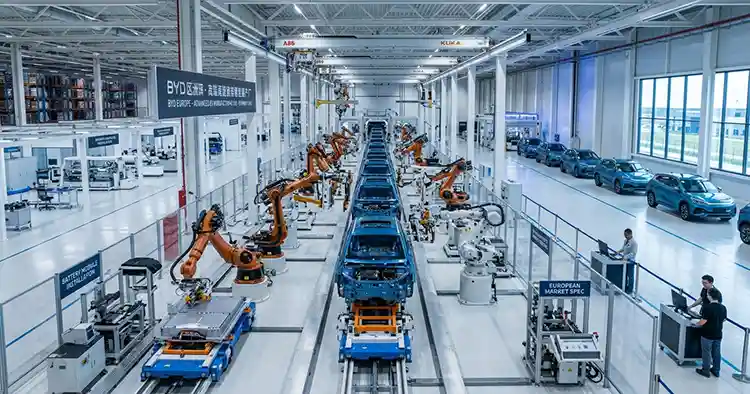
China’s overseas strategy is evolving beyond simple vehicle exports. Increasingly, Chinese automakers are establishing local manufacturing footholds directly inside their target markets — a move that helps sidestep tariffs, shortens supply chains, and signals long-term commitment to those markets.
BYD, for instance, is reportedly close to finalizing a decision on its second manufacturing plant in Europe, following earlier moves to localize production in Hungary and other markets. This “build where you sell” approach mirrors strategies long used by Japanese and South Korean automakers when they expanded into the US and European markets decades ago — except China is moving at a considerably faster pace.
Counterpoint Research forecasts that Chinese brands will capture more than 20% of Europe’s overall passenger vehicle market and 29% of its EV market by 2030. Gupta was blunt about the limits of trade barriers in slowing that trajectory: “Tariffs can slow that curve, but they’re not going to reverse it.”
What Analysts Expect Next
Looking ahead, most analysts expect China’s domestic auto market to stabilize gradually rather than snap back sharply. HSBC’s Yuqian Ding pointed to the upcoming new-model cycle in late August and September as a likely catalyst for a modest recovery in domestic demand, though she stressed that a rapid, V-shaped rebound remains unlikely given the depth of the current slump.
At the same time, few expect China’s export boom to slow anytime soon. With excess manufacturing capacity still weighing on the domestic market, and overseas markets — from Brazil to the UK to Southeast Asia — showing strong appetite for Chinese-made vehicles, the economic incentive to prioritize exports over domestic price wars remains firmly in place.
For legacy automakers like Toyota and Volkswagen, the message from the data is clear: the competitive pressure from Chinese brands isn’t a temporary phase tied to domestic overcapacity — it’s a structural shift in how, and where, the world’s cars are going to be built and sold in the years ahead.
Key Facts at a Glance
- China’s domestic car sales fell 21.1% year-on-year in July 2026, to 1.47 million vehicles — the 10th straight monthly decline.
- Vehicle exports jumped 88.2% year-on-year in July, to 923,000 units.
- First-half 2026 domestic sales fell 20% (down 2.3 million vehicles), roughly equal to all of Japan’s new car registrations over the same period.
- BYD’s July NEV sales rose 21.8% to 419,211 units, with overseas deliveries up 124.3% to a record 179,841 units — 43% of total sales.
- BYD’s domestic sales fell about 9% year-on-year in July, to roughly 239,370 units.
- Geely’s July exports surged 202.4% year-on-year to a record 106,663 units.
- Chery became the first Chinese automaker to export more than 200,000 vehicles in a single month in July.
- China has been the world’s largest vehicle exporter since 2023, overtaking Japan.
- Chinese automakers’ EU passenger vehicle market share rose from 3% to 16% between early 2022 and Q1 2026; Japan’s share stayed near 12%.
- Chinese brands hold nearly 25% of Europe’s EV shipments, versus under 5% for Japanese brands.
- Counterpoint Research forecasts Chinese brands could hold 20%+ of Europe’s total car market and 29% of its EV market by 2030.
Sources and Further Reading
- Reuters via Yahoo Finance: China’s car sales extend slide as shift accelerates to overseas markets
- CnEVPost: Roundup of July 2026 deliveries by major automakers in China
- Ad-Hoc News: BYD’s July numbers tell two stories — record exports mask a home market in retreat
- Automotive World: BYD sales jump in July, but full-year 2026 target slips away
- ChinaEVHome: China NEV exports surge 148% in July, offset weak domestic demand
- Goldsea (Reuters): China domestic car sales fall again but exports stay strong
This article draws on Reuters wire reporting and additional verified industry data from the outlets linked above. Figures reflect the most recently available monthly data as of publication and are subject to revision by the source agencies.

Economic Affair
- Budhigandaki Flood: 47 Rescued as Bridges Washed Away
- Nepal Supreme Court Handcuff Order: Police Barred From Routine Use
- 250+ Officials Deploy to Assess Rasuwa-Bhotekoshi Flood Damage
- Electricity VAT: Energy and Finance Ministers Strike Landmark Deal After Just 2 Months
- Nepal Inflation Shockingly Triples to 5.96% — Food and Transport Hit Hardest






Comments