







Nepal’s government is preparing to scrap the value-added tax it began charging on electricity bills just two months ago, after Energy Minister Biraj Bhakta Shrestha and Finance Minister Dr Swarnim Wagle reached an agreement in principle on Sunday evening. The breakthrough on the contentious Nepal electricity VAT removal question comes amid mounting pressure from households, industrialists and energy experts who had criticized the levy since it was first proposed in this year’s federal budget.
According to a source at the Ministry of Energy, Water Resources and Irrigation, the two ministers arrived at the understanding after Prime Minister Balendra Shah himself signaled support for withdrawing the tax. The matter will now move to the Council of Ministers, where a formal Cabinet decision is expected before the electricity VAT can officially be lifted.
A Tax That Lasted Barely Two Billing Cycles
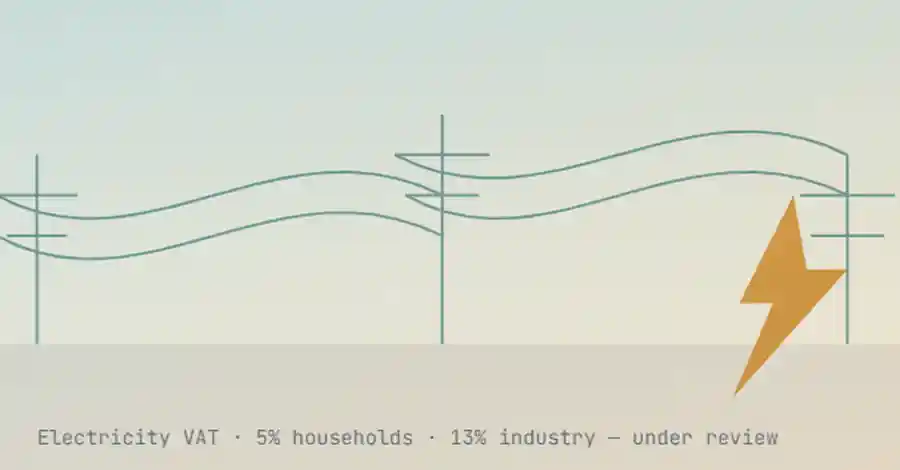
The electricity VAT was introduced through the budget for fiscal year 2026/27 and formally took effect from mid-July 2026, following the Electricity Services VAT Collection Directive issued by the Inland Revenue Department. Under the rule, domestic consumers using more than 50 units of electricity a month were charged 5 percent VAT on the excess consumption, while industrial, commercial and other non-household consumers paid a steeper 13 percent VAT on their entire bill.
The Nepal Electricity Authority (NEA) had estimated that more than three million customers using up to 50 units a month would remain unaffected, while roughly 1.2 million households consuming between 51 and 150 units, and around 250,000 households in the 151–250 unit range, would see higher bills. Even electricity traded between licensed power businesses was brought under scrutiny, requiring suppliers to register for VAT and issue VAT invoices for the first time.
How the Electricity VAT 5% and 13% Slabs Worked
Under the directive, a household consuming 50 units or fewer paid no VAT at all. Once consumption crossed that threshold, the 5 percent charge applied only to the additional units — not the entire bill. For example, a home using 60 units in a month paid VAT only on the extra 10 units above the free limit. Non-domestic consumers, however, received no such concession and were taxed on their full electricity charge at 13 percent.
Key numbers 5% VAT on household electricity use above 50 units per month · 13% VAT for industrial and commercial consumers · Roughly 1.45 million households affected · Tax introduced mid-July 2026, now facing withdrawal within two months
Why the Government Is Reversing Course
Opposition to the electricity VAT began building almost as soon as it was announced in the budget speech. Industrialists warned that a 13 percent levy on power costs would push up manufacturing expenses and, ultimately, consumer prices across the economy. Former Energy Minister and Nepal Electricity Authority chief Kul Man Ghising was among the most vocal critics, arguing publicly that taxing consumption above 50 units would push households to artificially restrict their electricity use, undercutting demand growth precisely when Nepal is trying to promote electric cooking, electric vehicles and industrial electrification, according to reporting by the Kathmandu Post.
Finance Minister Wagle had initially defended the tax as a bold funding mechanism for grid expansion, telling reporters in June that the VAT would remain in place while the government explored relief measures for ordinary consumers, as reported by Peoples’ Review. Prime Minister Shah had also defended the measure in Parliament, arguing that revenue from the tax was needed to upgrade transformers, transmission lines and substations before the country could safely support widespread electric cooking and vehicle charging.
Despite that early resistance, sustained criticism over affordability appears to have shifted the political calculus, leading to Sunday’s agreement between the Energy and Finance ministries to unwind the tax entirely rather than merely adjust its slabs.
What Happens Next: Cabinet Approval Still Required
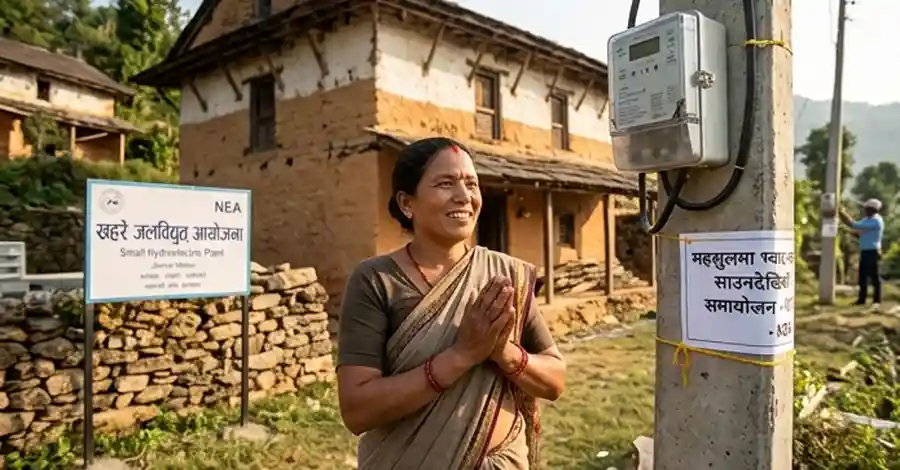
The agreement reached between Minister Shrestha and Minister Wagle is described as being “in principle” only — meaning it is not yet legally binding. For the electricity VAT to be formally withdrawn, the decision must be endorsed at an upcoming Cabinet meeting. Once approved, the Inland Revenue Department and the Nepal Electricity Authority would need to amend billing systems that were only recently updated to accommodate the tax.
Refunds and Billing Adjustments Expected
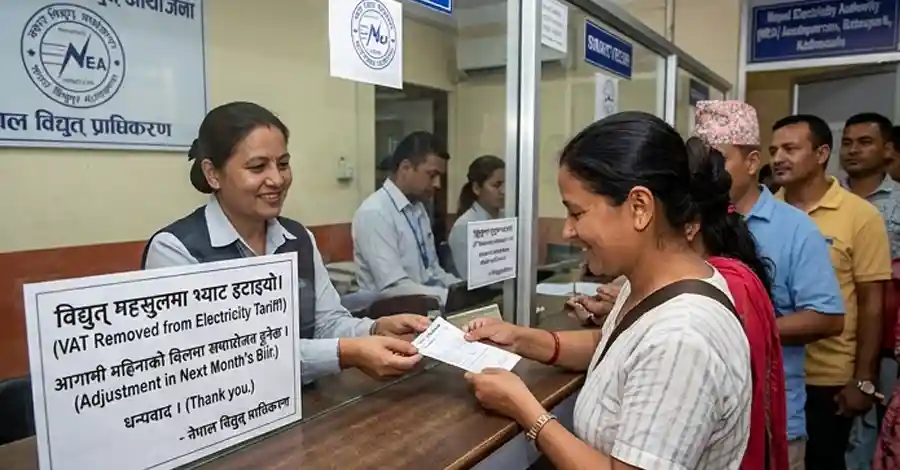
Energy Ministry sources indicate that once the withdrawal is formally implemented, the VAT collected on electricity bills since mid-July will be reconciled and adjusted against future billing cycles. This follows an earlier billing dispute in which VAT was mistakenly deducted from bills for the month of Asar (mid-June to mid-July), even though the tax was meant to apply only from Shrawan (mid-July) onward. The NEA had to seek clarification from the Inland Revenue Department at the time, which confirmed the tax should only apply from Shrawan, prompting the utility to update its billing software accordingly, as detailed by VATupdate.
Industry and Consumer Reaction
- Industrialists have long argued that a 13 percent VAT on commercial power sharply raises production costs in a country already struggling with competitiveness.
- Consumer groups welcomed news of the potential rollback, saying the tax disproportionately burdened middle-income households just above the 50-unit exemption line.
- Energy experts, including Kul Man Ghising, had cautioned that taxing higher consumption ran counter to Nepal’s own clean-energy and electrification goals.
The Bigger Picture: Nepal’s Wider Tax Expansion Drive
The electricity VAT was part of a broader push by the Ministry of Finance this fiscal year to widen Nepal’s tax base into previously untaxed digital and utility sectors. Around the same time, the government also brought ride-sharing platforms under the VAT system, charging riders 5 percent VAT on fares and 13 percent VAT on the commissions and service fees charged by ride-sharing companies. That measure, unlike the electricity tax, has so far remained in place.

What Nepali Electricity Consumers Should Know
For now, households and businesses should continue watching their monthly bills closely, since the electricity VAT remains technically in force until the Cabinet formally approves its withdrawal. If the rollback goes ahead as expected, consumers can anticipate lower electricity bills going forward and a possible credit or adjustment for VAT already paid since mid-July. The Energy Ministry has indicated that further updates will follow once the Cabinet takes up the matter in one of its upcoming meetings.
This is a developing story and will be updated as the Cabinet decision and implementation details become available.
Sources & Further Reading

Economic Affair
- Budhigandaki Flood: 47 Rescued as Bridges Washed Away
- Nepal Supreme Court Handcuff Order: Police Barred From Routine Use
- 250+ Officials Deploy to Assess Rasuwa-Bhotekoshi Flood Damage
- Electricity VAT: Energy and Finance Ministers Strike Landmark Deal After Just 2 Months
- Nepal Inflation Shockingly Triples to 5.96% — Food and Transport Hit Hardest



Comments