






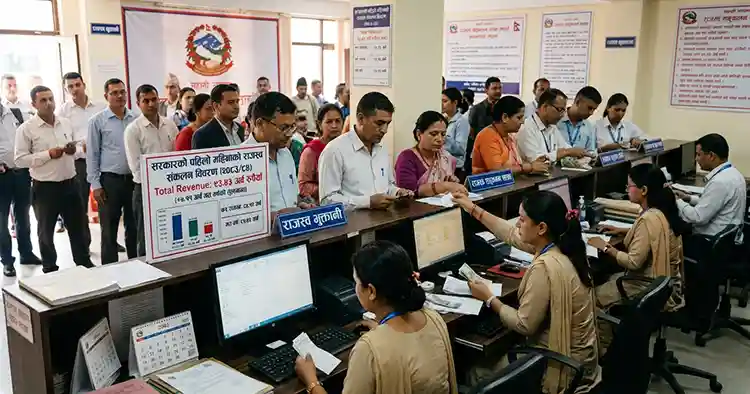
Nepal’s government revenue collection got off to a strong start in the new fiscal year, with the treasury pulling in Rs 93.43 billion during Shrawan, the opening month of fiscal year 2083/84. That figure is Rs 7.91 billion higher than what the government collected in the same month last year, according to fresh data released by the Ministry of Finance. For a country that has spent much of the past two years wrestling with sluggish tax intake and missed budget targets, this early uptick in Nepal revenue collection is being read as a cautiously encouraging signal — though officials and economists alike are quick to note that one strong month does not guarantee a strong year.
A Closer Look at the Numbers
The Ministry of Finance’s statistics show that the government collected Rs 93,43,63,00,000 (Rs 93 arba 43 crore 63 lakh) in total revenue during Shrawan 2083, the first month of the fiscal year that began on July 17, 2026. This compares with Rs 85,51,97,00,000 collected in Shrawan of the previous fiscal year, marking an increase of roughly 9.25 percent year-on-year.
The collection includes income from three broad categories: tax revenue, non-tax revenue, and receipts from grants and other miscellaneous sources. Of these, tax revenue remains by far the largest contributor to the state coffers, as is typical in Nepal’s revenue structure.
Tax Revenue: The Backbone of Collection
Tax revenue alone brought in Rs 85.19 billion in the first month, according to the ministry’s figures. This is a significant number when measured against the government’s full-year target, but it also underscores how much ground remains to be covered. For fiscal year 2083/84, the government has set an ambitious tax revenue target of Rs 1,403.32 billion (Rs 14 kharba 3 arba 31 crore 83 lakh). The Shrawan collection represents just about 6.07 percent of that annual goal — a reminder that even a strong opening month leaves eleven more months of heavy lifting ahead.
Non-Tax Revenue and Other Receipts
Non-tax revenue contributed Rs 7.03 billion to the month’s total. Grants added a modest Rs 24.03 crore, while receipts booked under other miscellaneous headings brought in Rs 97.07 crore. Together, these smaller streams rounded out the government’s first-month revenue base, though tax collection continues to do most of the work in funding the state.
Government Spending: Rs 41.88 Billion Paid Out in Shrawan
On the expenditure side, the government spent Rs 41.88 billion in the first month of the fiscal year — noticeably lower than the Rs 46.30 billion spent in the same month last year. This dip in early spending is not unusual for Nepal, where capital and development budgets typically take time to gain momentum after a new fiscal year begins, as ministries finalize annual programs, contracts, and procurement plans.
Recurrent Expenditure Leads the Spending Mix
The largest chunk of government spending, Rs 21.40 billion, went toward recurrent (current) expenditure — the day-to-day running costs of government, including salaries, administrative expenses, and routine operations. This is consistent with the pattern seen at the start of most fiscal years, when recurrent costs are locked in from day one while development spending ramps up gradually.
Capital Expenditure Off to a Slow Start
Capital, or development, expenditure stood at Rs 13.29 billion for the month. Slow capital spending at the start of the fiscal year has long been a structural weakness in Nepal’s public finance system, with the bulk of infrastructure and development budgets historically getting disbursed in the final months of the fiscal year — a pattern that reduces the effectiveness of public investment and often leads to rushed, lower-quality project execution.
Financial Management Expenditure
The government also spent Rs 19.15 billion on financial management, which includes debt servicing and related obligations. The relatively high share going toward financial management in the very first month points to the pressure that debt repayment and financial obligations continue to place on the national budget, even before major development spending gets underway.

Why the Early Revenue Growth Matters
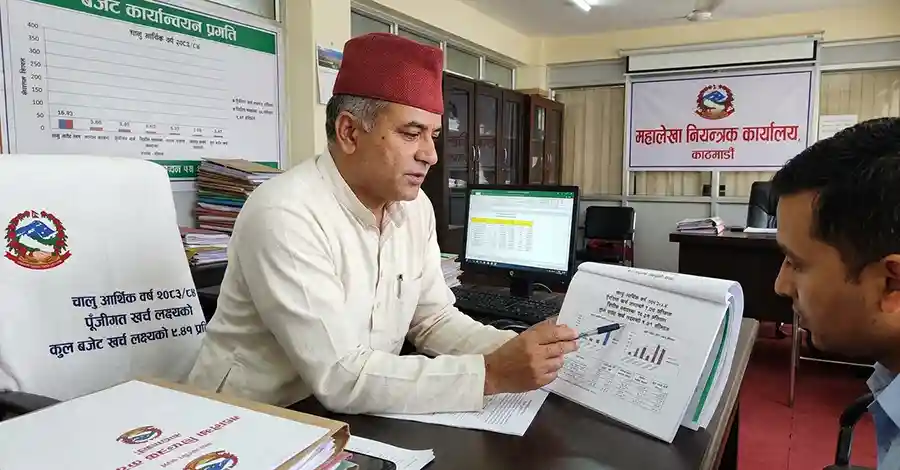
A Rs 7.91 billion year-on-year jump in the first month might look modest against Nepal’s roughly Rs 2,124.34 billion national budget for 2083/84, but first-month trends often set the tone for how analysts, credit rating observers, and development partners read the government’s fiscal trajectory for the rest of the year. The Ministry of Finance has pointed to the improved Shrawan numbers as an early sign that resource mobilization is on a firmer footing than in recent years.
Nepal’s public finances have been under strain for several fiscal years running, with revenue collection repeatedly falling short of ambitious annual targets set at budget time. Weak import volumes, subdued consumer demand, and a slowdown in real estate and construction activity have all weighed on customs duties, VAT, and other major tax heads in recent years. Against that backdrop, any month that shows collection growth above the prior year is being treated by officials as a data point worth watching closely.
Setting the Target: What FY 2083/84’s Budget Actually Promises
To understand why the first month matters so much, it helps to look at the bigger picture. Finance Minister Dr. Swarnim Wagle presented the budget for fiscal year 2083/84 in the Federal Parliament, unveiling a total outlay of billion, split between Rs 1,270.58 billion for recurrent expenditure, Rs 431.10 billion for capital expenditure, and Rs 422.64 billion for financial management. On the financing side, the budget projected that billion would come from revenue, alongside Rs 61.74 billion in foreign grants, Rs 247.28 billion in foreign loans, and Rs 410 billion in domestic borrowing.
That revenue projection — north of Rs 1.4 trillion for the year — is the yardstick against which every month’s collection will now be measured. A government source with the Ministry of Finance’s own numbers shows Shrawan’s tax collection landed at just over 6 percent of the annual tax target, which is broadly in line with what a “good but not spectacular” opening month would look like, given that revenue collection is typically back-loaded toward the final quarter of the Nepali fiscal year when large corporate and business tax payments are due.
The FY 2083/84 budget also carried some of the most significant tax reforms Nepal has seen in years.The personal income tax exemption threshold doubled from Rs 500,000 to Rs 1 million, meaning taxpayers earning under Rs 10 lakh annually now owe no income tax at all, while the top marginal income tax rate was cut by 10 percentage points, from 39 percent to 29 percent. These changes were designed partly to ease the burden on salaried taxpayers and partly to encourage better compliance — but they also mean the government is collecting less per taxpayer at the individual level, which makes strong performance in corporate tax, VAT, and customs even more important for hitting the year’s overall target.
Government employees also received a substantial pay revision under the same budget. Civil servant remuneration rose by roughly 21 percent net, combining a 10 percent increase in the base salary scale with a further 10 percent monthly incentive allowance calculated on the new scale. That raise, effective from the start of the fiscal year, is one reason recurrent expenditure came in as high as it did even in the very first month of 2083/84 — salary costs adjust immediately, while development spending takes longer to flow.

Finance Minister Swarnim Wagle’s Early Test
Dr. Swarnim Wagle, a trained economist who took charge of the Ministry of Finance with a mandate to reform Nepal’s revenue administration and revive private sector confidence, is facing his first real data checkpoint with these Shrawan numbers. Since assuming office, Wagle has repeatedly emphasized three priorities: mobilizing domestic revenue more efficiently, lifting sagging private sector morale, and injecting fresh momentum into an economy that has been running below its potential for several years.
That agenda has not been free of controversy. Questions were raised during the budget-making process over specific tax rate decisions and policy choices, and critics have argued that private sector confidence has not picked up as quickly as the government promised. Business chambers and industry associations have periodically flagged concerns about investment climate, credit growth, and the pace of structural reform.
Against this backdrop, the first month’s revenue numbers are being read, fairly or not, as an early report card. A Rs 7.91 billion year-on-year improvement is undeniably a positive data point. But one month of data is a thin basis for judging an entire fiscal year, let alone a minister’s full economic management record. Economists caution that the real test will come in the months ahead, particularly as festival-season consumption, import patterns, and corporate tax deadlines start to shape the revenue curve more decisively.
The Road Ahead: Can Nepal Sustain This Pace?
The central question hanging over Nepal’s public finances for 2083/84 is whether the government can sustain — or even accelerate — the pace of revenue growth seen in Shrawan. Achieving the full-year target of over Rs 1.4 trillion in revenue would require consistent month-on-month growth well above what a single strong opening month can guarantee.
Several structural factors will determine whether that happens:
- Private sector investment climate: Weak private investment and subdued business confidence have been persistent drags on economic activity, and by extension, on tax collection tied to production, trade, and consumption.
- Import and trade volumes: Customs duties remain a major revenue source for Nepal, making the health of import volumes a key swing factor for monthly collection figures.
- Compliance and administration reforms: The Ministry of Finance has flagged tighter revenue administration, an expanded tax base, and stronger controls on leakage as priorities for the year — reforms that, if implemented effectively, could meaningfully lift collection without further rate changes.
- Capital spending execution: Historically slow capital expenditure in the early months, followed by a scramble to spend before the fiscal year closes, has undermined the quality of Nepal’s public investment. Whether this year breaks that pattern will shape both economic growth and, indirectly, future revenue.
Independent economists cited by Nepali media have pointed out that revenue growth cannot be sustained on its own — it needs to be underpinned by genuine expansion in investment, production, trade, and consumption. Without that broader economic activity picking up, an early revenue bump risks fading rather than compounding through the year.

What This Means for Ordinary Nepalis and Businesses
For everyday taxpayers, the headline revenue numbers may seem abstract, but they carry real consequences. Stronger-than-expected revenue collection gives the government more room to fund development projects, service its debt obligations, and avoid the kind of mid-year budget cuts that have disrupted public services and infrastructure projects in the past. On the other hand, if revenue growth stalls in the coming months, the government could once again face pressure to cut capital spending, delay projects, or lean more heavily on domestic borrowing — all of which have knock-on effects for jobs, business activity, and public services.
For businesses, the doubled income tax exemption threshold and the reduced top tax rate introduced in this year’s budget are likely to be more immediately relevant than the aggregate revenue figures. The budget’s overall Rs 2.124 trillion size, financed substantially through an expected Rs 1.405 trillion in revenue collection, reflects a government betting heavily on stronger domestic resource mobilization to fund its spending plans — which in turn depends on the same private sector activity that ministers have promised to revive.
The Bigger Picture: Nepal’s Fiscal Year Structure
For readers less familiar with Nepal’s fiscal calendar, it’s worth noting that the Nepali fiscal year runs from Shrawan 1 to the end of Ashadh — roughly mid-July to mid-July on the Gregorian calendar. Fiscal year 2083/84 began on July 17, 2026, and will run through mid-July 2027. Because of this structure, the first month’s data (Shrawan) offers only a partial, early snapshot, and revenue collection in Nepal has traditionally been backloaded, with a large share of annual tax receipts coming in during the final quarter as corporate tax deadlines approach.
This seasonal pattern is one reason the Ministry of Finance and independent analysts alike tend to treat single-month comparisons with some caution. A strong Shrawan does not mechanically translate into a strong Mangsir, Falgun, or Ashadh. Even so, year-on-year comparisons for the same month — as opposed to comparisons across different months within a year — are considered a reasonably reliable early indicator, since they control for seasonal effects.
Conclusion: Cautious Optimism, Not Celebration
Nepal’s Rs 93.43 billion revenue collection in the first month of fiscal year 2083/84 is a genuinely positive data point, especially set against a backdrop of repeated revenue shortfalls in recent years. The Rs 7.91 billion year-on-year increase suggests that some combination of improved administration, economic recovery, and possibly base effects from last year’s weaker Shrawan is playing out in the government’s favor.
But the scale of the challenge ahead remains large. With tax revenue at just around 6 percent of its annual target after one month, the government — and Finance Minister Swarnim Wagle in particular — will need many more months like this one to have any realistic shot at hitting the ambitious Rs 1.4 trillion-plus revenue goal built into this year’s Rs 2,124.34 billion national budget. Whether Nepal can convert one strong month into a strong year will depend less on administrative tweaks and more on whether investment, trade, and consumption genuinely pick up across the economy in the months ahead.

Economic Affair
- Budhigandaki Flood: 47 Rescued as Bridges Washed Away
- Nepal Supreme Court Handcuff Order: Police Barred From Routine Use
- 250+ Officials Deploy to Assess Rasuwa-Bhotekoshi Flood Damage
- Electricity VAT: Energy and Finance Ministers Strike Landmark Deal After Just 2 Months
- Nepal Inflation Shockingly Triples to 5.96% — Food and Transport Hit Hardest



Comments