









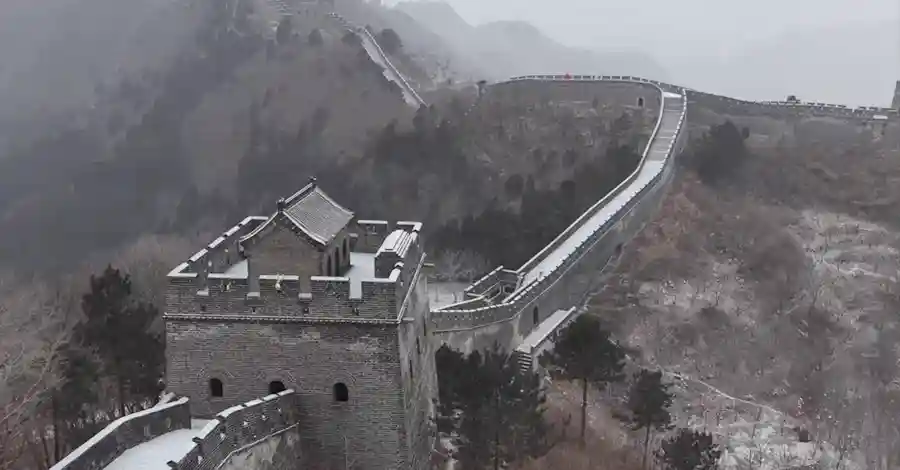
The iconic Huangyaguan section of the Great Wall of China in Tianjin’s Jixian District welcomed its first snowfall of the 2024-2025 winter season this week, creating spectacular scenes that blend 1,500 years of history with nature’s pristine beauty. A powerful cold air mass sweeping across northern China dropped temperatures dramatically, blanketing the ancient fortress and winding battlements in brilliant white snow that has captivated both domestic and international tourists.
The sudden temperature plunge transformed the rugged mountain landscape surrounding Huangyaguan (Yellow Cliff Pass) into a fairy-tale setting, with snow accumulating on watchtowers, defensive walls, and the steep staircases that snake across ridges 738 meters above sea level. This seasonal transformation marks the official beginning of peak winter tourism season for one of China’s most historically significant yet undervisited Great Wall sections.
Cold Wave Brings Dramatic Temperature Drop Across Northern China
China’s National Meteorological Center reports that the recent cold air outbreak pushed temperatures in the Beijing-Tianjin-Hebei region well below freezing, with overnight lows reaching -16°C (3°F) in mountainous areas. According to December weather data for the Great Wall area, temperatures typically range from -9°C to 3°C (16°F to 37°F) during the coldest winter months.
The cold front arrived suddenly, catching many regions off-guard with its intensity. Meteorological stations recorded temperature drops of 10-15°C within 24 hours, accompanied by gusty northwest winds that intensified the perceived cold but created picture-perfect snow accumulation on the ancient stone and brick structures.
Winter Weather Patterns at Great Wall
Winter conditions at Great Wall sections vary considerably based on elevation and exposure:
Temperature Ranges (December-February):
- Daytime: -10°C to 5°C (14°F to 41°F)
- Nighttime: -16°C to -5°C (3°F to 23°F)
- Wind chill factor: Can feel 5-10°C colder
Snowfall Frequency:
- December typically brings two snowfalls to the Great Wall
- Average accumulation: 5-15 centimeters per event
- Snow persists 3-7 days in shaded areas
- January sees heaviest snowfall
The Huangyaguan section, positioned in mountainous terrain 28 kilometers north of Jizhou District, experiences particularly dramatic winter conditions due to its elevated position and exposure to Siberian winds funneling through mountain valleys.
Huangyaguan Great Wall: Hidden Gem of Tianjin
While millions flock to Badaling and Mutianyu sections near Beijing, the Huangyaguan Great Wall represents one of China’s best-kept secrets for travelers seeking authentic experiences without overwhelming crowds. This 42-kilometer section connects Malan Pass in Zunhua City, Hebei Province, with Jiangjun Pass in Beijing’s Pinggu District.
Rich Historical Significance
The Huangyaguan section boasts impressive historical credentials. Originally built during the Northern Qi Dynasty (550-577), remnants of the old beacon tower and sections of ancient wall from that era remain visible. The massive reconstruction occurred during the Ming Dynasty (1368-1644) under legendary General Qi Jiguang, who revolutionized Great Wall defensive architecture.
Between 1984-1987, the Chinese government undertook extensive restoration, repairing 3,025 meters of walls and 20 watchtowers—representing the longest single Great Wall restoration project in modern Chinese history. In 1990, authorities designated Huangyaguan as one of Tianjin’s “Top Ten Scenic Spots,” cementing its status as a premier tourist destination.
Architectural Highlights:
- 66 watchtowers spanning 42 kilometers
- 52 enemy towers for defensive positions
- 14 beacon towers for signal communication
- Unique octagonal “Bagua” (Eight Diagrams) fortress design
- Phoenix Tower commanding strategic viewpoint
- Water gates controlling valley access
- Widow Tower memorial commemorating soldiers’ wives
The name “Huangyaguan” (Yellow Cliff Pass) derives from the predominantly yellow-brown rocks on eastern cliffs, which transform into stunning golden hues at sunset—a phenomenon made even more dramatic when snow covers the surrounding peaks while leaving cliff faces exposed.
Why Snow-Covered Great Wall Captivates Global Travelers
Winter snowfall elevates the Great Wall experience from impressive to unforgettable. The stark contrast between ancient dark brick and pristine white snow creates photographic opportunities impossible during other seasons, while dramatically reduced tourist numbers allow intimate encounters with one of humanity’s greatest architectural achievements.
Magical Atmospheric Transformations
Snow fundamentally alters the Great Wall’s character and mood:
Visual Enhancements:
- Watchtowers capped with snow appear like chess pieces on mountain ridges
- Defensive walls create ribbon-like patterns through white landscape
- Bare tree branches frame architectural elements dramatically
- Minimalist color palette emphasizes structural forms
- Low winter sun creates long shadows and golden hour magic
Experiential Benefits:
- Peaceful silence broken only by crunching footsteps
- Fresh, crisp mountain air with improved visibility
- Intimate connection with history minus crowds
- Unique seasonal atmosphere unavailable other times
- Wildlife tracks visible in fresh snow
Winter brings cold and dry weather from December to March, with occasional snowfall, especially in areas north of the Great Wall. These conditions create the ethereal scenes that have attracted photographers, artists, and adventurers for generations.
Photography Paradise for Winter Enthusiasts
Professional and amateur photographers prize snow-covered Great Wall sessions for several compelling reasons:
Optimal Photography Conditions:
- High contrast between dark structures and white backgrounds
- Reduced atmospheric haze compared to summer months
- Dramatic weather conditions (fog, mist, clear skies)
- Golden hour light enhanced by snow reflection
- Minimal tourist photobombing due to low season
- Unique compositional opportunities with snow patterns
Photographers recommend arriving shortly after snowfall stops, preferably on clear mornings when sunlight illuminates the snow while blue skies provide contrast. The period between 9:00-11:00 AM and 2:00-4:00 PM offers optimal natural lighting for capturing the snow-blanketed fortress.
Essential Winter Visiting Information for Huangyaguan Great Wall
Planning a winter visit to snow-covered Huangyaguan requires careful preparation to ensure both safety and enjoyment. The dramatic winter conditions that create magical scenery also present genuine challenges requiring proper equipment and realistic expectations.
Practical Access Details
Location and Distance:
- Address: Xiaying Town, Jizhou District, Tianjin
- Distance from Beijing: 120 kilometers (75 miles), approximately 2.5-3 hours drive
- Distance from Tianjin city center: 150 kilometers (93 miles), approximately 2 hours drive
- Elevation: 738 meters (2,421 feet) average altitude
Opening Hours and Admission:
- Winter hours: 8:30 AM – 5:00 PM daily
- Winter admission (November 1 – February 28): 35 RMB per person
- Peak season (March 1 – October 31): 40 RMB
- Reduced hours may apply during extreme weather
Transportation Options from Beijing:
- Public Transportation Route:
- Take long-distance bus from Beijing Sihui Bus Station to Jizhou Bus Station (2 hours, 32 RMB)
- Transfer to Bus No. Ji3 to Huangyaguan Village (1.5 hours, 5 RMB)
- Total travel time: approximately 4 hours one-way
- High-Speed Rail Option:
- Train from Beijing Railway Station to Jizhou North Railway Station (42 minutes to 1 hour)
- Taxi or Bus No. Ji3 to Huangyaguan (50 minutes, approximately 100 RMB taxi)
- Total travel time: approximately 2 hours one-way
- Private Transportation:
- Rental car or private driver recommended for flexibility
- Cost: 800-1,000 RMB for full-day private vehicle
- Allows multiple stops and photography sessions en route
Critical Winter Safety Precautions
Winter Great Wall hiking presents legitimate hazards that require serious attention. While the scenery justifies the effort, visitors must prioritize safety over photography ambitions.
Primary Winter Hazards:
- Slippery Surfaces: Snow and ice accumulation makes steep stairs treacherous
- Limited Daylight: December boasts the shortest daylight hours of the year at the Great Wall, with less than 9 hours of daylight
- Temperature Extremes: Wind chill can create dangerous cold exposure
- Limited Services: Fewer vendors and emergency services available
- Wild Sections: Unrestored areas particularly dangerous when snow-covered
Essential Safety Guidelines:
Footwear Requirements:
- Always pay close attention to your footing and ensure each step is secure, as after snow, the ground can turn icy, making walking particularly tricky
- Wear boots with aggressive tread patterns designed for ice/snow
- Consider attaching crampons or traction cleats for steepest sections
- Avoid fashion boots lacking proper grip and ankle support
Clothing Recommendations:
- Tourists are supposed to wear cold-proof winter clothes, like wool sweater, parka, downcoat, padded trousers, long boots, scarf, gloves and hat
- Layer system: thermal base layer, insulating mid-layer, windproof outer shell
- Bring extra layers in backpack as exertion generates heat
- Hand warmers and extra gloves essential for photography stops
Behavioral Precautions:
- Use handrails consistently, even when seemingly unnecessary
- Descend stairs sideways or backward when extremely steep
- Plan route completion before 4:00 PM to avoid sunset darkness
- Inform someone of your hiking plans and expected return
- Carry charged phone with emergency contact numbers
- Adventure-seeking tourists may be tempted to hike the original steep sections of the Wild Great Wall, but winter is by no means a suitable time to do so
Authorities sometimes close the steepest sections when ice accumulation creates unacceptable danger levels. Respect closure signs—they exist for legitimate safety reasons, not arbitrary bureaucracy.
Best Hiking Routes and Scenic Viewpoints
Huangyaguan offers multiple hiking options accommodating various fitness levels and time availability. Winter conditions may influence route accessibility, so verify current conditions before committing to longer treks.
Recommended Winter Routes
Route 1: Main Entrance to Phoenix Tower (Beginner-Friendly)
- Distance: 1.5 kilometers one-way
- Elevation gain: 150 meters
- Duration: 1.5-2 hours round trip
- Difficulty: Moderate with winter conditions
- Highlights: Restored wall sections, excellent photo opportunities, manageable for most fitness levels
Route 2: Taipingzhai Mountain Stronghold Loop (Intermediate)
- Distance: 3 kilometers
- Elevation gain: 200 meters
- Duration: 2-3 hours
- Difficulty: Moderate to challenging
- Highlights: Taipingzhai is a fortress in the eastern part of the defensive system, with altitude about 400-500 meters above sea level, offering panoramic mountain views
Route 3: Full Section Hike (Advanced)
- Distance: 5-7 kilometers
- Elevation gain: 350+ meters
- Duration: 4-5 hours
- Difficulty: Challenging, especially with snow
- Highlights: Complete defensive system experience, multiple watchtowers, wild and restored sections contrast
Prime Photography Locations
Golden Hour Spots:
- Phoenix Tower Summit: 360-degree panoramic views of surrounding peaks
- Eastern Cliff Viewpoint: Captures namesake yellow cliffs against snow
- Widow Tower Memorial: Emotional historical context with dramatic backdrop
- Bagua Fortress Interior: Unique octagonal layout creates geometric compositions
- Watchtower Silhouettes: Backlit towers create iconic Great Wall imagery
Professional photographers recommend scouting locations during midday, noting optimal angles and compositions, then returning during golden hour (one hour after sunrise or before sunset) for final captures.
Comparing Huangyaguan to Other Famous Great Wall Sections
Understanding how Huangyaguan differs from more famous sections helps set appropriate expectations and appreciate its unique character.
Huangyaguan vs. Badaling
Badaling (Most Famous Section):
- Pros: Easy access from Beijing (1 hour), fully restored, cable car available, comprehensive facilities
- Cons: Overwhelming crowds (50,000+ daily in peak season), commercialized atmosphere, limited authentic experience
- Best for: First-time visitors, limited mobility, short time availability
Huangyaguan (Hidden Gem):
- Pros: Far fewer crowds than popular Beijing sections, allowing visitors to truly feel the Great Wall winding along mountains, authentic atmosphere, diverse architectural features
- Cons: Remote location requiring 3+ hours travel, limited English signage, fewer amenities
- Best for: Repeat visitors, photography enthusiasts, history buffs seeking authenticity
Huangyaguan vs. Mutianyu
Mutianyu (Tourist-Friendly Alternative):
- Pros: Less crowded than Badaling, beautiful mountain setting, toboggan descent option, well-maintained
- Cons: Still sees heavy tourist traffic, 90-minute drive from Beijing, commercialized atmosphere
- Best for: Families with children, tourists wanting controlled experience
Huangyaguan:
- Pros: Genuine frontier fortress feel, unique Bagua maze design, combination of wild and restored sections
- Cons: More physically demanding, longer access time, winter closures more common
- Best for: Adventurous travelers, those seeking off-beaten-path experiences
Winter transforms this comparison dramatically. While Badaling and Mutianyu see reduced but still substantial crowds, Huangyaguan becomes genuinely tranquil, with some days seeing fewer than 50 visitors across the entire section.
Cultural and Historical Context: Why Huangyaguan Mattered
Understanding Huangyaguan’s strategic importance enhances appreciation beyond mere scenic beauty. This section represented a critical defensive position protecting Beijing from northern invasions for over 1,400 years.
Strategic Military Significance
The Jizhen garrison, of which Huangyaguan formed the centerpiece, stood as the last major defensive line protecting China’s capital from Mongol and Manchu invasions. The region’s 18 fortresses created a interconnected defensive network where beacon tower signals could transmit warnings to Beijing within hours.
Defensive System Components:
- Inner Fortifications: The unique Bagua (Eight Diagrams) fortress maze confused invaders attempting penetration
- Outer Walls: Multiple parallel walls created fallback defensive positions
- Watchtowers: 66 towers provided observation and troop housing along 42 kilometers
- Beacon Network: Signal fires transmitted invasion warnings across hundreds of kilometers
- Water Control: Gates regulated water flow, preventing siege tactics
General Qi Jiguang’s Ming Dynasty renovations revolutionized Great Wall defensive architecture. He pioneered innovations including hollow watchtowers providing troop shelter, strategic positioning maximizing defensive advantage, and construction techniques enhancing durability—innovations visible today at Huangyaguan.
Living History: The Widow Tower Legend
Among Huangyaguan’s 66 watchtowers, the Widow Tower carries particular poignancy. Legend states that 12 wives contributed money to build a watchtower after discovering their husbands had died defending the wall. This memorial stands as reminder that grand historical structures represent countless individual sacrifices and personal tragedies.
The tower’s position at Taipingzhai stronghold’s western end offers commanding valley views, suggesting the women chose a location their husbands likely defended. A modern statue of General Qi Jiguang erected nearby honors his leadership and the soldiers who served under his command.
Winter Tourism Boom: Economic Impact on Jizhou District
The annual winter snowfall creates significant economic opportunities for Tianjin’s Jizhou District, transforming what was historically a tourism off-season into a profitable winter wonderland destination.
Local Tourism Industry Adaptation
In recent years, Jizhou District authorities and businesses have invested heavily in winter tourism infrastructure:
Winter Tourism Developments:
- Farmhouse guesthouses offering authentic rural experiences and home-cooked meals
- Ski resorts in nearby mountains (Yulong, Nancuiping, Panshan)
- Hot spring resorts providing post-hiking relaxation
- Winter festivals celebrating local culture and cuisine
- Improved snow removal on access roads (while preserving scenic accumulation)
The travel cost is lower in December compared with other peak travel seasons, making winter visits attractive for budget-conscious travelers. Hotels offer discounts of 30-50% compared to peak season rates, while restaurants and services maintain stable pricing year-round.
Sustainable Tourism Challenges
Balancing economic development with historical preservation presents ongoing challenges. Increased winter visitation, while economically beneficial, creates concerns about:
- Wear on restored sections from increased foot traffic on ice
- Environmental impact of support infrastructure development
- Maintaining authentic character amid commercialization pressures
- Waste management during low-temperature months
- Emergency response capacity in harsh weather conditions
UNESCO World Heritage Site status (awarded 1987) requires adherence to preservation standards that sometimes conflict with tourism development goals. Local authorities navigate these tensions through carrying capacity limits, seasonal closures during extreme weather, and mandatory guide requirements for wild sections.
Additional Winter Activities in Jizhou District
Visitors to snow-covered Huangyaguan can combine their Great Wall experience with other winter activities available throughout Jizhou District.
Complementary Winter Attractions
Dule Temple (Temple of Solitary Joy):
- Located 20 kilometers from Huangyaguan
- One of China’s oldest wooden structures (984 AD)
- Spectacular under snow coverage
- Houses impressive ancient Buddhist statuary
- Features architecture preserving Tang and Song Dynasty construction styles
Panshan Mountain Scenic Area:
- Winter hiking trails offering frozen waterfall views
- Buddhist temples dating to Tang Dynasty
- Less crowded than Huangyaguan but equally photogenic
- Cable car access for limited-mobility visitors
Local Ski Resorts:
- Famous ski resorts include Yulong Ski Resort, Nancuiping Mountain Ski Resort and Panshan Ski Resort
- Beginner to advanced slopes available
- Equipment rental and instruction provided
- Convenient for multi-day winter sports vacations
Hot Springs:
- Several natural hot spring resorts within 30 kilometers
- Traditional Chinese medicine-enhanced pools
- Indoor and outdoor bathing options
- Perfect recovery after cold Great Wall hiking
Cultural Experiences
Farmhouse Hospitality: Multiple family-operated guesthouses near Huangyaguan offer authentic rural Chinese experiences. Visitors can enjoy home-cooked regional cuisine, participate in traditional activities, and learn about local agricultural practices adapted to mountain terrain.
Great Wall Museum: Located at Huangyaguan’s base, this specialized museum displays military equipment, daily necessities, and historical documentation from various dynasties. It is the first Great Wall museum in China, displaying historical materials especially from Jizhou District of Tianjin.
Planning Your Snow-Covered Great Wall Adventure
Successful winter Great Wall visits require more detailed planning than summer trips. Weather variability, reduced daylight, and limited services demand flexibility and contingency preparation.
Optimal Timing Strategies
Best Time to Visit After Snowfall:
- If visiting specifically for the Great Wall’s snow scenery, check the weather forecast in advance and select a sunny, windless day following a snowfall
- Day 1-2 after snow: Fresh accumulation, pristine conditions, but possible access restrictions
- Day 3-4 after snow: Paths cleared on main routes, still photogenic, easier hiking
- Day 5+: Snow melting/refreezing creates ice hazards, diminished scenic value
Daily Schedule Recommendations:
- Depart accommodation: 7:30-8:00 AM
- Arrive Huangyaguan: 10:00-10:30 AM
- Visit the Great Wall between 11:00 and 15:00, during which the warm sunlight will help alleviate the harsh cold
- Complete hiking: By 4:00 PM (before sunset)
- Return to accommodation: 6:00-6:30 PM
Essential Packing Checklist
Critical Items:
- Ice cleats or crampons for footwear
- Multiple insulating layers (avoid cotton, prefer wool/synthetic)
- Waterproof outer shell (jacket and pants)
- Insulated, waterproof gloves (bring spares)
- Thermal hat covering ears
- Neck gaiter or balaclava for wind protection
- High-energy snacks (bars, nuts, dried fruit)
- Thermos with hot beverages
- First aid kit including hand/toe warmers
- Headlamp or flashlight (if hiking early/late)
- Portable phone charger (batteries drain faster in cold)
Photography Equipment:
- Extra batteries (cold depletes them rapidly)
- Lens cloths (condensation issues moving between temperatures)
- Tripod for low-light conditions
- Polarizing filter to manage snow glare
- Camera bag with insulation
Accommodation Options
Budget Lodging (¥100-300/night):
- Farmhouse guesthouses near Huangyaguan
- Basic amenities, authentic experience
- Home-cooked meals available
- Book through Chinese travel platforms or on arrival
Mid-Range Hotels (¥300-600/night):
- Jizhou District town center hotels
- Modern amenities, English-speaking staff (limited)
- Restaurant and transportation assistance
- Advance booking recommended
Higher-End Options (¥600-1,200/night):
- Hot spring resorts with Great Wall packages
- Full-service amenities and facilities
- Organized tours available
- Located 20-40 minutes from Huangyaguan
Conclusion: Once-in-a-Lifetime Winter Experience Awaits
The first snowfall transforming Huangyaguan Great Wall into a pristine winter wonderland offers travelers a rare opportunity to experience one of humanity’s greatest architectural achievements in its most dramatic seasonal incarnation. The combination of historical significance, natural beauty, manageable crowds, and photographic potential creates compelling reasons to brave December’s cold temperatures.
While the journey requires more effort than summer visits—colder temperatures, longer travel times, heightened safety precautions—the rewards justify every challenge. Walking ancient battlements where soldiers defended China’s heartland for 1,400 years, with nothing but snow-covered mountains and crisp winter silence surrounding you, creates memories and photographs impossible to replicate during crowded peak seasons.
For adventurous travelers willing to properly prepare and respect winter’s demands, snow-covered Huangyaguan delivers an authentic Great Wall experience increasingly rare in China’s tourism landscape. The magical transformation wrought by nature’s first winter snowfall reminds us that even ancient stone structures continue evolving, offering new perspectives with each passing season.
As climate patterns shift and tourism pressures increase, these pristine winter moments become increasingly precious. The current season’s first snowfall has already begun attracting photographers and adventure travelers from around the globe—each seeking their own connection with this extraordinary convergence of human achievement and natural beauty.
Related External Resources:

Economic Affair
- Budhigandaki Flood: 47 Rescued as Bridges Washed Away
- Nepal Supreme Court Handcuff Order: Police Barred From Routine Use
- 250+ Officials Deploy to Assess Rasuwa-Bhotekoshi Flood Damage
- Electricity VAT: Energy and Finance Ministers Strike Landmark Deal After Just 2 Months
- Nepal Inflation Shockingly Triples to 5.96% — Food and Transport Hit Hardest


Comments