







Nepal’s Real Crisis Is Not Just Unemployment — It Is How We Define a Job
Every year, tens of thousands of young Nepalis enter the labour market. Domestic industry has not expanded fast enough to absorb them, and traditional service sectors cannot carry the load alone. For a large share of these young people, foreign employment has stopped being a choice and become a compulsion.
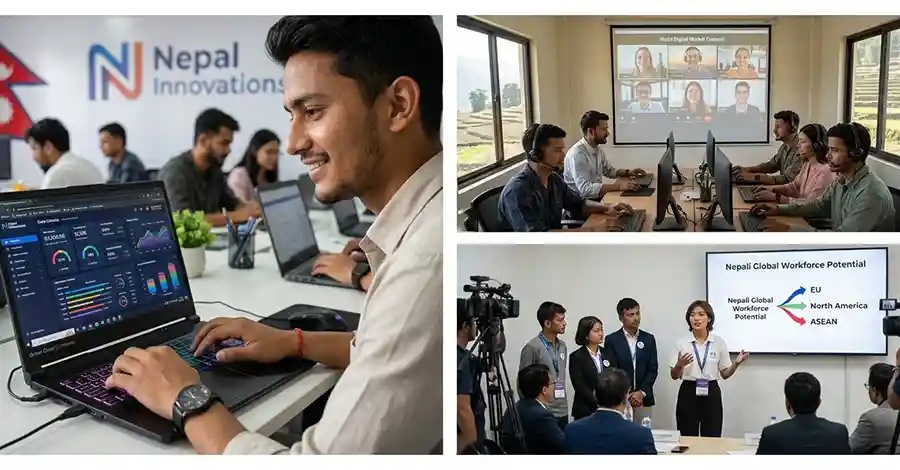
But the way the world works has already changed. A developer sitting in Kathmandu can build software for an American company. A designer in Biratnagar can serve European clients. A young professional in Darchula can deliver digital services to an Australian business. Technology has erased much of the distance between where work happens and where the market is.
So Nepal needs to debate a different question: do we keep sending young people abroad to find work, or do we connect their skills to the global market while they stay right here?

The Numbers: From Rs 68 Billion to Nearly Rs 145 Billion
The debate about whether Nepal can export IT services is over. The country has already proven it.
A study by the Institute for Integrated Development Studies (IIDS), a Kathmandu-based think tank, found that Nepal exported IT services worth USD 515.4 million in 2022 — making it the country’s top exportable product. The report, titled “Unleashing IT: Advancing Nepal’s Digital Economy,” recorded 64.2 percent growth in a single year, with IT service exports accounting for 1.4 percent of GDP and 5.5 percent of foreign exchange reserves. ThehrmnepalThe Annapurna Express
The sector was already broad-based. The study counted 106 IT service export companies, 14,728 IT freelancers in software and technology, and 51,781 ITeS freelancers delivering services through digital platforms. Thehrmnepal
Then came the acceleration. The Nepal Association for Software and IT Services (NAS-IT) now estimates annual IT exports have reached roughly USD 1 billion, describing it as a “best estimate” based on an average annual growth rate of around 20 percent. Industry leaders estimate about 100,000 people now work in Nepal’s IT sector, up from more than 70,000 in the 2022 survey. Kathmandupost
Read the full reporting here: Nepal’s IT exports near $1 billion — The Kathmandu Post and the original IIDS study coverage.
Why This Growth Is Different IT Exports
This was not built by a giant state programme. It was built by young Nepalis, entrepreneurs, IT firms and freelancers who found clients first and asked for policy support later. The industry located the market, trained the talent, won the customers and earned the dollars. Only afterwards did the state begin treating the sector seriously.
Which raises the obvious question: if an industry can reach nearly Rs 145 billion without adequate policy facilitation, where could it go with real support? A multi-trillion-rupee digital export economy is not a fantasy. It is arithmetic.

Announcements Don’t Build Industries — Ecosystems Do
The government has not ignored the opportunity on paper. An “Information Technology Decade” has been declared. The goal of making Nepal an IT hub has been repeated. Budget documents have promised trillions of rupees in IT exports and mass job creation over the coming decade.
Ambitious targets are welcome. Execution matters more.
The 5 Reforms That Actually Matter
1. Frictionless foreign currency inflows. Freelancers and firms need a simple, legal, predictable way to bring earnings home. Today, many earn in dollars and lose time, money and confidence in the process.
2. Easy company formation, closure and investment. Founders should not spend months circling government offices to start, wind down, or raise capital for a startup.
3. Global contracting freedom. Nepali companies need clean pathways to sign with foreign clients, open overseas sales offices, make international payments and collaborate with skilled foreign talent.
4. Intellectual property protection. Export-grade software work requires credible IP safeguards that international clients recognise.
5. Data and visibility. IT earnings barely show up in customs data, which keeps the sector politically invisible. What is not measured is not prioritised.
The state’s job is not to run software companies. It is to create conditions where Nepali software companies can run businesses across the world.

A Degree Is Not the Only Door Into Tech
In Nepal, “good education” still largely means a four-year bachelor’s degree followed by a job. University education has real value — but in IT, a degree is not the only route into the global market.
Not every young person can spend Rs 1–2 million and four years on formal education. That does not disqualify them from a technology career. Short skill-based programmes, professional certifications, consistent practice and a strong portfolio can open the same doors.
Global demand is deep across programming, cloud computing, cybersecurity, data analysis, artificial intelligence, UI/UX design, digital marketing, animation and video production. Free and low-cost credential pathways already exist through platforms like freeCodeCamp and Coursera.
The world market asks one question above all: not how many years you studied, but what you can actually build.
Digital Skill Centres in Every Local Unit
Nepal’s IT momentum cannot stay trapped inside Kathmandu — especially when roughly 90 percent of IT employment is already concentrated in the capital.
Every local government can host a functioning digital skill centre, built through partnership between municipalities, private training institutes, schools, universities and IT companies. The state does not need to construct every building itself.
But basic computer literacy training is not enough. These centres must teach skills that sell: programming, data, cybersecurity, cloud, AI, design, digital marketing and video editing — paired with business English, client communication, portfolio building, and the practical mechanics of remote work and freelancing.
How do you build a global profile? How do you pitch a client? What do you check before signing a contract? How do you legally receive money from abroad? How do you protect your intellectual property? These are core modern skills, not optional extras.
Start in School: Build Creators, Not Just Consumers
IT education should not begin at the bachelor’s level. Digital literacy, computational thinking, basic programming, cybersecurity awareness, problem-solving and responsible technology use can start at school.
Why not aim for every student to have produced at least one real digital artefact by the end of Grade 10? A website. A small app. A design. A video. A data analysis. A problem solved using an AI tool.
Not everyone needs to become a programmer. But everyone should learn to create value with technology, not merely consume it.

Export Skills, Not Bodies
Remittances have supported Nepal’s economy for decades — but at the cost of millions of families living apart. The digital economy offers a fundamentally different bargain.
The worker stays in Nepal. The family stays together. The spending happens here. The taxes are paid here. And the client sits in the United States, the United Kingdom, Japan, Australia or anywhere else on earth.
Telling young people “don’t leave the country” will never work. Giving them the chance to earn world-class income from the country will.
If a young person in Kathmandu can earn from an American company, why must they fly to America for work? If a young woman in Biratnagar can build software for a European firm, why should her passport outrank her skills? If a young man in Darchula can sell services worldwide over the internet, why should geography remain an economic penalty?
Nepal must now leap from an economy that exports labour to one that exports skill, service, knowledge and creativity.
Export software. Export digital services. Export knowledge and creativity.
Our future does not have to be written in an airport departure lounge. It can be written on a laptop in a young Nepali’s hands — and in the global market that laptop connects to.
Send our youth to the world market, not abroad. Export skills, not bodies.

Economic Affair
- Budhigandaki Flood: 47 Rescued as Bridges Washed Away
- Nepal Supreme Court Handcuff Order: Police Barred From Routine Use
- 250+ Officials Deploy to Assess Rasuwa-Bhotekoshi Flood Damage
- Electricity VAT: Energy and Finance Ministers Strike Landmark Deal After Just 2 Months
- Nepal Inflation Shockingly Triples to 5.96% — Food and Transport Hit Hardest








Comments