







Nepal Rastra Bank (NRB) officially released the new 100 rupee denomination banknote on Thursday, November 27, 2024, ending a prolonged delay that had sparked nationwide anticipation. The redesigned currency features Nepal’s revised political map, which has reignited diplomatic tensions with neighboring India over disputed border territories.
The new note bears former Governor Maha Prasad Adhikari’s signature and was printed during Prime Minister K.P. Sharma Oli’s administration. NRB spokesperson Guru Prasad Paudel confirmed that the notes entered circulation immediately and will be available through banks and financial institutions across the country.
Why This Currency Note Has Sparked International Controversy
The Disputed Territories at the Heart of the Issue
The controversial map includes three interconnected areas—Kalapani, Lipulekh, and Limpiyadhura—covering approximately 370 square kilometers that have been under Indian administration for over 60 years. These strategically significant territories lie at the tri-junction between India, Nepal, and Tibet.
The Kalapani region holds particular geopolitical importance as it sits on the route to Kailash Mansarovar, a sacred pilgrimage site. The strategic Lipulekh pass connects Uttarakhand with Tibet, making it a crucial corridor for trade and military movement.
Historical Background of the Border Dispute
The disagreement stems from differing interpretations of the 1816 Treaty of Sugauli, which established the Mahakali River as the western border between Nepal and India. The dispute centers on identifying the exact source of the river, with each nation’s interpretation supporting their territorial claims.
In November 2019, India released a political map that included Lipulekh, Limpiyadhura, and Kalapani as part of India. Nepal responded in May 2020 by unanimously amending its Constitution to formally incorporate these territories into its official map.
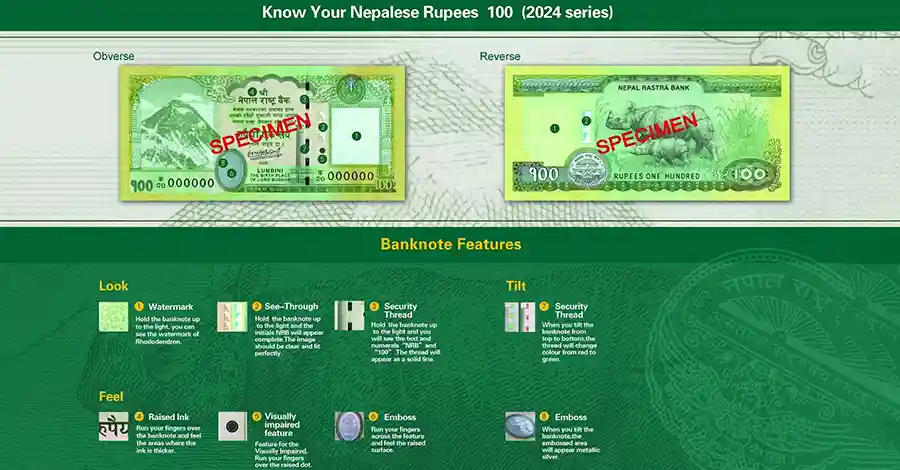
7 Distinctive Security Features of Nepal’s New 100 Rupee Note
Front Side Design Elements
1. Mount Everest Imagery The left side of the note prominently displays Nepal’s iconic Mount Everest, symbolizing national pride and the country’s Himalayan heritage.
2. Rhododendron Watermark The right side features a sophisticated watermark of the rhododendron, Nepal’s national flower, providing an essential security element for authentication.
3. Revised National Map The center of the note displays Nepal’s updated political map in faint green, including the contentious territories. This represents the most significant change from previous versions.
4. Ashoka Pillar and Lumbini Reference Near the map, the Ashoka Pillar is featured with the inscription “LUMBINI THE BIRTH PLACE OF LORD BUDDHA,” emphasizing Nepal’s cultural and religious significance.
5. Color-Changing Security Thread A 2-millimeter wide security thread runs through the note, appearing red when viewed straight on and green when tilted—a cutting-edge anti-counterfeiting measure.
6. Tactile Recognition Feature For visually impaired citizens, the note includes an embossed black dot that can be felt by touch, ensuring currency accessibility for all.
7. Official Signatures and Serial Numbers The note bears former Governor Maha Prasad Adhikari’s signature, with series numbers printed in both Nepali (B.S. 2081) and English (2024 A.D.).
Reverse Side Features
The back of the note showcases Nepal’s wildlife conservation efforts with an image of a one-horned rhinoceros mother and calf—an endangered species that has become a conservation success story in Nepal’s protected areas.
The reverse also includes “NEPAL RASTRA BANK” in English at the top and “RUPEES ONE HUNDRED” at the bottom border, maintaining international currency standards.
Political Implications and Timeline
Why Now? The Political Context
The decision to finally release these notes came after Prime Minister Pushpa Kamal Dahal switched coalition partners, joining hands with K.P. Sharma Oli’s Communist Party of Nepal-United Marxist Leninist (CPN-UML). This political realignment made it possible to move forward with Oli’s 2020 constitutional amendment.
The note’s release had been delayed for years due to political pressure and concerns about damaging India-Nepal relations. The previous government had even halted the distribution of new currency notes during the Vijaya Dashami festival due to the unavailability of the redesigned 100 rupee denomination.
China’s Role in Production
The China Banknote Printing and Minting Corporation won the contract to design, print, supply, and deliver 300 million pieces of the new banknotes at a cost of USD 8,996,592. This choice of a Chinese company for printing currency featuring disputed territories with India added another layer of complexity to the trilateral relationship.
India’s Official Response
Diplomatic Reaction and Statements
India’s External Affairs Minister S. Jaishankar stated that the unilateral decision would not alter the situation between the two nations or the reality on the ground. India had previously characterized Nepal’s 2020 map revision as an “artificial enlargement” of territorial claims that was “neither based on historical fact or evidence nor tenable.”
Despite the tensions, both nations have acknowledged that the boundary dispute should be resolved through diplomatic channels and established mechanisms. Nepal’s Deputy Prime Minister and Foreign Minister Narayan Kaji Shrestha emphasized the preference for fixing the boundary issue through diplomatic means and table talks.
Technical Specifications and Legal Framework
Nepal Rastra Bank Act Provisions
According to the Nepal Rastra Bank Act, the central bank holds responsibility for designing currency notes. However, any modifications to note design or dimensions require explicit government approval—a process that was completed through cabinet meetings on April 25 and May 2, 2024.
Among various denominations including 10, 50, 500, and 1,000 rupee notes, only the 100 rupee note displays Nepal’s complete map. This selective placement minimizes the controversy while still making a political statement through the most widely circulated denomination.
Currency Circulation Details
The Nepal Rastra Bank announced that notes with series numbers from 20,000,001 to 40,999,999 would enter circulation. The official statement reads: “Guaranteed by the Government of Nepal, anyone demanding payment in this currency shall immediately receive 100 rupees from Nepal Rastra Bank.”
The notes officially entered circulation from Mangsir 11, 2082 in the Nepali calendar (November 27, 2024 in the Gregorian calendar), and will gradually replace older versions through normal banking channels.
Broader Regional Implications
The Strategic Significance of Kalapani
The Kalapani area is strategically significant in South Asian diplomacy as it sits at the tri-junction between India, Tibet, and Nepal, with Nepal functioning as a buffer state between China and India. This geographic positioning gives the territory outsized importance in regional power dynamics.
The entirety of the Limpiyadhura-Kalapani-Lipulekh area remains under Indian administration as part of Pithoragarh district in Uttarakhand’s Kumaon Division. People living in these areas are Indian citizens who pay taxes in India and vote in Indian elections.
Nepal-India Border Relations
Nepal shares an extensive border of over 1,850 kilometers with five Indian states: Sikkim, West Bengal, Bihar, Uttar Pradesh, and Uttarakhand. The Kalapani dispute represents only one of several unresolved border issues, including the Susta area in West Champaran district, Bihar, where the changing course of the Gandak River has created territorial ambiguity.
Public Reaction and Internal Controversy
Domestic Political Divisions
The decision to feature the revised map sparked internal controversy within Nepal. Chiranjeevi Nepal, the President’s economic advisor and former central bank governor, resigned in May 2024 after criticizing the move as “inappropriate” and calling it an “irresponsible diversion.”
Civil society groups demanded his removal, arguing that his public statements against the government’s decision damaged national interests and dragged the President’s office into unnecessary controversy. The incident highlighted the delicate balance between nationalist sentiment and diplomatic pragmatism in Nepali politics.
Nationalist Sentiment vs. Diplomatic Relations
For many Nepalis, the inclusion of disputed territories on currency represents a assertion of sovereignty and territorial integrity. The 2020 constitutional amendment passed unanimously in Parliament, reflecting broad political consensus on the issue regardless of party affiliations.
However, critics worried that the move could harm the negotiating environment needed to resolve the dispute diplomatically. Some Madhesh-based parties initially opposed featuring the new map on banknotes, fearing it could damage relations with India—Nepal’s largest trading partner and a crucial ally.
What This Means for Currency Users
Authenticity Verification
Citizens and businesses should familiarize themselves with the new security features to avoid counterfeiting issues. The color-changing security thread, watermarks, and tactile elements make the new note significantly more secure than previous versions.
Banks and financial institutions have been instructed to accept both old and new 100 rupee notes as legal tender. There is no timeline for demonetizing the older version, meaning both will circulate simultaneously for the foreseeable future.
Economic Impact
NRB spokesperson Paudel clarified that the redesign maintains the same dimensions and base color scheme as previous 100 rupee notes, minimizing disruption to ATM machines, counting equipment, and vending machines that process currency.
Looking Ahead: Future of Nepal-India Relations
Potential for Dialogue
Both nations agree that the boundary dispute should be resolved through established mechanisms. Despite the current tensions, historical ties between Nepal and India run deep, encompassing cultural, economic, and people-to-people connections that transcend political disagreements.
The currency note controversy represents what experts call a “cartographic war”—a battle fought through maps rather than military force. While such symbolic actions can strain bilateral relationships, they also create pressure for eventual dialogue and resolution.
Regional Stability Concerns
As China’s influence in Nepal grows—evidenced by Chinese companies printing Nepali currency—India faces increasing competition for influence in a region it has traditionally considered within its sphere of interest. The triangle of relationships between India, Nepal, and China will continue to shape South Asian geopolitics in coming years.
For more detailed information about Nepal’s currency and banking system, visit the Nepal Rastra Bank official website. To understand the broader context of India-Nepal relations, refer to the Ministry of External Affairs, Government of India.

Economic Affair
- Budhigandaki Flood: 47 Rescued as Bridges Washed Away
- Nepal Supreme Court Handcuff Order: Police Barred From Routine Use
- 250+ Officials Deploy to Assess Rasuwa-Bhotekoshi Flood Damage
- Electricity VAT: Energy and Finance Ministers Strike Landmark Deal After Just 2 Months
- Nepal Inflation Shockingly Triples to 5.96% — Food and Transport Hit Hardest


Comments