




Two government-appointed investigation committees have delivered a damning verdict on the deadly unrest that shook Nepal’s Sunsari and Siraha districts in July 2026: there was no outside infiltration, and all four young men who died were killed by bullets fired by Nepal’s own security forces. The Sunsari Siraha police shooting investigation report, submitted to the Ministry of Home Affairs, has also recommended disciplinary action against the officers who pulled the trigger — a finding that is likely to intensify pressure on the government to deliver accountability.
The twin reports close the door on weeks of speculation that had gripped the Tarai-Madhesh region, where rumors of “outsiders” stoking communal tension and of unidentified gunmen firing into crowds had spread rapidly on social media. Instead, investigators found a far simpler, more troubling explanation: overwhelmed local police posts, panicked crowd-control decisions, and live ammunition fired into unarmed civilians.
What the Investigation Report Found
According to committee members who briefed reporters, the inquiry into the Kaptanganj incident in Sunsari and the Golbazar incident in Siraha concluded independently that no external or unidentified armed groups were involved in either clash. The violence, they found, was entirely the product of local disputes that escalated into confrontations between security personnel and crowds — after which officers opened fire.
Home Ministry spokesperson Anand Kafle confirmed that both panels submitted their findings to Home Minister Sudan Gurung, and that the recommendations contained in the reports are now under review before any disciplinary process begins.
The two separate committees were formed shortly after the violence broke out:
- The Kaptanganj (Sunsari) investigation was led by Home Ministry Joint Secretary Bhupendra Thapa.
- The Golbazar (Siraha) investigation was led by Home Ministry Joint Secretary Pushparaj Shahi.
Both panels worked independently, visited the incident sites, interviewed victims’ families, examined post-mortem findings, and reconstructed the sequence of gunfire before compiling their conclusions.
How the Violence Began in Kaptanganj, Sunsari
A Dispute Over Loudspeakers That Turned Deadly
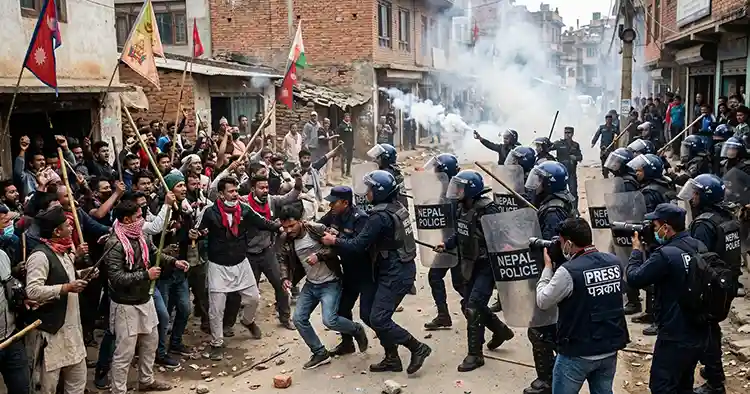
The chain of events that investigators pieced together began on the night of July 26, 2026, in Kaptanganj, Ward 3 of Dewanganj Rural Municipality, Sunsari. A group of Hindu devotees was returning from the Koshi Barrage carrying holy water for the annual Bolbam procession during the month of Saun, accompanied by loud devotional music.
Members of the local Muslim community objected to the volume of the loudspeakers, and — according to several independent accounts — tensions had already been simmering after a religious flag on a nearby electricity pole had earlier been swapped for a different community’s flag.
What began as a verbal argument between a handful of young men escalated within minutes into stone-pelting, then into a wider clash involving sticks, bamboo poles and other homemade weapons. A local Nepal Police team from the Kaptanganj Police Post initially tried to defuse the situation, but as reinforcements from nearby police posts and the Armed Police Force (APF) arrived, the confrontation intensified rather than settled.
Nepal Police first fired warning shots in an attempt to disperse the crowd. When that failed to restore order, the Armed Police Force resorted to live rounds. Investigators found that a combined total of around 20 rounds were fired by Nepal Police and the APF at the scene.
Three Lives Lost in Sunsari
The gunfire proved fatal for three local residents:
- Om Prakash Mehta, around 24–30 years old, was killed on the spot after being shot in the upper body.
- Jai Prakash Mehta, in his early twenties, was critically injured and died of his wounds three days later.
- Rabindra Mehta, also in his early twenties, was shot in the thigh; the wound later turned septic, leading to an amputation and, ultimately, organ failure. He died in a Kathmandu hospital more than a week after the initial shooting.
The investigation committee’s findings confirm what many families and eyewitnesses had already alleged: that the fatal shots came not from any outside actor, but directly from the security personnel deployed to control the crowd.
The Second Tragedy: Ganesh Yadav’s Death in Siraha
As unrest from Sunsari rippled outward into neighboring Madhesh districts, a second, separate fatal shooting occurred days later in Golbazar Municipality, Siraha district. Eighteen-year-old Ganesh Yadav, a resident of Aurahi Rural Municipality-2, was killed during a protest that had gathered in solidarity with, and in anger over, the Sunsari deaths.
The Siraha investigation committee’s report states that a total of nine rounds were fired at the Golbazar protest site — seven of them dummy or blank rounds, and two live rounds fired from a pistol. One of those two live rounds struck and killed Ganesh Yadav; the other round injured a second individual.
Notably, the committee also examined — and rejected — a separate claim that had circulated in the aftermath: that a police officer at the scene had himself been shot during the clash. According to a committee member, medical examination could not confirm any bullet injury to the officer in question; at most, the officer may have been struck by pellet fragments or debris, not a direct gunshot. The Council of Ministers has since declared Ganesh Yadav a martyr in recognition of his death during the unrest.
Committees Recommend Action Against Officers Who Fired
Perhaps the most consequential element of the report is its explicit recommendation that security personnel who fired the fatal shots in both incidents face disciplinary or legal action. A committee member told local media that in both the Sunsari and Siraha cases, wherever an officer was found to have discharged a weapon, the panel has recommended that “necessary action” be taken against that individual.
The report does not specify exactly what form the punishment should take — whether departmental action, suspension, criminal prosecution, or another form of accountability — leaving that determination to the Ministry of Home Affairs. What the report does spell out more clearly, according to sources familiar with its contents, is the chain of command and decision-making on the ground: the roles played by the district police chief, the field commander at each incident site, and the Chief District Officer (CDO) responsible for maintaining law and order.
Ministry spokesperson Rama Acharya said that action would follow once the reports have been formally studied, signaling that the disciplinary process is likely to take additional time even as public pressure mounts for swift accountability.

No Evidence of “Outside Infiltration,” Panel Says
One of the most politically sensitive questions the investigation had to settle was whether the unrest — which began as a hyper-local dispute over noise and religious symbols — had been deliberately fanned by outside actors as it spread from Sunsari into Siraha, Dhanusha, Saptari and other parts of Madhesh Province.
Rumors to that effect spread quickly, some suggesting cross-border influence given the district’s proximity to India, others alleging that shots had come from unidentified armed civilians rather than uniformed police.
Both committees rejected these theories outright. Their reconstructions of the gunfire — down to the type and number of rounds fired, and by which unit — point squarely to Nepal Police and Armed Police Force personnel as the sole source of the lethal shots. No evidence of an external or unidentified armed group was found at either site.
Political Fallout and Government Response
A Seven-Point Agreement With Victims’ Families
Even before the investigation reports were finalized, the scale of public anger forced the government into direct negotiation with the affected families. Home Minister Sudan Gurung and Health Minister Nisha Mehta traveled to Biratnagar and Dewanganj to meet the injured in hospitals and to hear grievances directly from victims’ relatives.
Those talks produced a seven-point agreement, under which the government committed to formally recognizing Om Prakash Mehta and Jai Prakash Mehta as martyrs, providing financial relief of roughly NPR 1 million to each bereaved family, offering employment to one eligible family member per household, and — critically — conducting an impartial investigation into the shootings, the very process that has now concluded.
Prime Minister Balendra Shah Breaks His Silence
The unrest also became a significant political flashpoint for Prime Minister Balendra Shah, who had rarely appeared in public since taking office earlier in the year. Four days after violence first erupted in Sunsari, and only after his Home Minister had personally traveled to the affected districts, Shah delivered a televised national address. He offered condolences to the families of Om Prakash Mehta, Jai Prakash Mehta and Ganesh Yadav, appealed for calm, and pledged an impartial probe — the same investigation whose findings have now been submitted.
Critics, including opposition commentators, argued that the Prime Minister’s delayed response allowed the unrest to spread further into Madhesh before any de-escalation effort began, with curfews eventually imposed across parts of Sunsari, Siraha, Dhanusha and Saptari districts.
A Pattern? Nepal’s History of Lethal Crowd Control in the Tarai-Madhesh
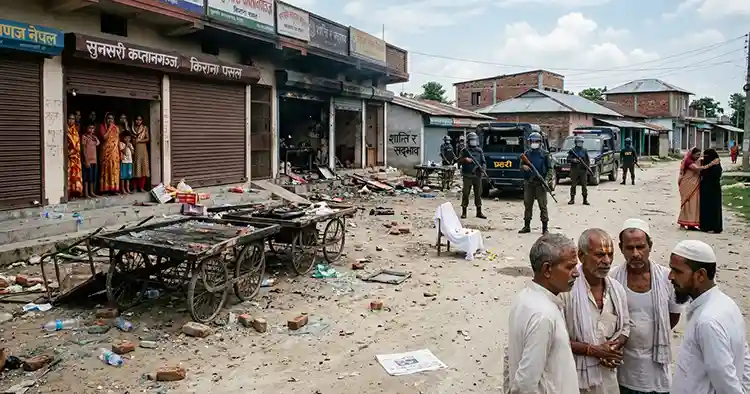
The Sunsari and Siraha shootings have reignited a long-running debate in Nepal about how security forces respond to unrest in the Tarai-Madhesh belt, a region that has repeatedly seen fatal police firings during protests and communal disputes. Commentary published after the incidents noted that lethal policing in Madhesh has a long history, and that the Sunsari case fits a broader pattern of security forces reaching for live ammunition faster than in other parts of the country.
This was not an isolated episode even within Sunsari district itself. Just months earlier, in January 2026, the Armed Police Force opened fire on a group near the India border in Koshi Rural Municipality, Sunsari, killing 45-year-old auto-rickshaw driver Bijay Sah during an operation targeting suspected smuggling — a shooting that also triggered local protests, a highway blockade and a separate internal investigation.
Rights advocates argue that these repeated incidents point to a systemic gap in how Nepal Police and the Armed Police Force are trained and equipped for crowd control, rather than a series of isolated, unconnected failures.
Nepal’s history of security forces using lethal force during periods of civil unrest stretches back further still. Decades-old cases, such as the killing of a teenager during crowd-control operations in western Nepal in 2018, and the far larger death toll recorded during nationwide unrest in September, when a single day of protests claimed close to 19 lives nationwide.
Including two in Sunsari district itself, are frequently cited by analysts as evidence that Nepal’s crowd-control doctrine leans too heavily on firearms rather than de-escalation. Each of these episodes prompted its own promise of an “impartial investigation,” yet critics argue that meaningful reform of standard operating procedures has been slow to materialize, making the Sunsari-Siraha report’s specific, actionable recommendations — rather than another vague pledge — especially significant if the government follows through.
Why the “No Infiltration” Finding Matters
The confirmation that no outside groups were involved carries weight beyond simply settling a factual dispute. In the days after the Sunsari violence, unverified claims about cross-border involvement and unidentified armed civilians spread rapidly on social media, feeding into a narrative that the clashes were part of a larger, coordinated communal conspiracy rather than a localized dispute that spiraled out of control. Some commentators had drawn parallels to sectarian polarization seen elsewhere in South Asia, warning that similar dynamics were taking root in Nepal’s Tarai belt.
By tracing every round fired back to a specific security unit, and by ruling out any unidentified shooter, the investigation committees have effectively closed off that conspiracy narrative — at least from an official standpoint. That said, the finding does not erase the underlying communal tension that triggered the initial dispute over loudspeakers and religious flags, which local officials and community leaders in Sunsari and Siraha will still need to address through longer-term reconciliation efforts, independent of the ongoing accountability process for the security personnel involved.

Reactions From Victims’ Families and Local Communities
Families of the four deceased have consistently maintained, since the earliest days after the shootings, that the deaths were the direct result of security force gunfire rather than any third-party involvement — a position the official investigation has now vindicated. In Sunsari, relatives of Om Prakash Mehta had initially refused to accept his body from the mortuary at Biratnagar’s Neuro Hospital until their demands for accountability were addressed, a standoff that was only resolved after continuous dialogue between the family and local police officials.
Local community leaders in both districts have called for the investigation’s recommendations to be implemented in full and without further delay, warning that perceived inaction could reignite tensions that authorities have worked to calm through curfews, prohibitory orders and, eventually, the seven-point agreement reached with victims’ families in Sunsari.
Recommendations for Reform: Non-Lethal Weapons and Body Cameras
Beyond assigning responsibility for the July 2026 deaths, the investigation committees used their reports to propose concrete changes intended to prevent similar tragedies. Drawing on a broader social, religious and security analysis of the unrest, the panels recommended that:
- Security personnel deployed for crowd control should be equipped with non-lethal weapons, including rubber bullets, as a first line of response rather than live ammunition.
- Officers carrying firearms during crowd-control operations should be required to wear body-worn cameras, creating an objective record of when and why force is used.
- Video and photographic documentation should be mandatory during future crowd-control operations, to support faster and more transparent post-incident investigations.
- Nepal’s forensic science laboratory capacity should be strengthened, so that ballistic and forensic evidence — central to determining exactly who fired fatal shots — can be processed more quickly and reliably.
- Crowd-control training and resource allocation for security forces should be reviewed and upgraded, particularly in districts with a history of communal or political tension.
If adopted, these measures would mark one of the more concrete institutional responses to a pattern of fatal police shootings that has recurred across Nepal’s Tarai-Madhesh region in recent years.
What Happens Next
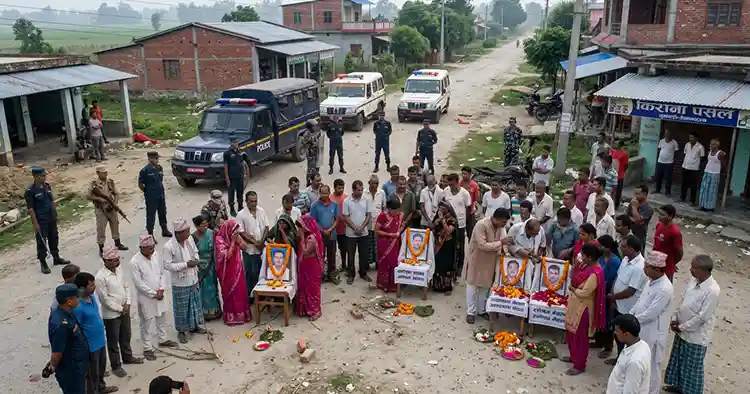
With both investigation reports now formally submitted, attention turns to the Ministry of Home Affairs, which must decide what disciplinary or legal action to take against the individual officers identified as having fired the fatal shots. Victims’ families, who have already secured commitments around martyr status and compensation as part of the earlier seven-point agreement, are likely to press for the accountability portion of that agreement to be honored without further delay.
For residents of Sunsari and Siraha, the confirmation that no outside forces were behind the violence may bring some closure to weeks of rumor and communal suspicion. But the deeper question raised by the report — why Nepali security forces resorted to live fire against civilians on two separate occasions within days of each other — is likely to keep the Sunsari-Siraha shootings at the center of Nepal’s national conversation about policing, accountability and communal tension for weeks to come.
Key Facts at a Glance
- Total deaths confirmed: 4 (Om Prakash Mehta, Jai Prakash Mehta, Rabindra Mehta in Sunsari; Ganesh Yadav in Siraha)
- Cause of death (all four): Gunfire from Nepal Police / Armed Police Force personnel
- Outside infiltration found: None, according to both committees
- Rounds fired in Sunsari: Approximately 20
- Rounds fired in Siraha: 9 total (7 dummy/blank, 2 live)
- Recommended action: Disciplinary/legal action against officers who fired live rounds
- Committees involved: Two, led by Home Ministry Joint Secretaries Bhupendra Thapa (Sunsari) and Pushparaj Shahi (Siraha)
This article is based on official investigation committee findings submitted to Nepal’s Ministry of Home Affairs, corroborated with independent reporting. For additional background on the initial unrest, see coverage from Al Jazeera and the Kathmandu Post.

Economic Affair
- Budhigandaki Flood: 47 Rescued as Bridges Washed Away
- Nepal Supreme Court Handcuff Order: Police Barred From Routine Use
- 250+ Officials Deploy to Assess Rasuwa-Bhotekoshi Flood Damage
- Electricity VAT: Energy and Finance Ministers Strike Landmark Deal After Just 2 Months
- Nepal Inflation Shockingly Triples to 5.96% — Food and Transport Hit Hardest


Comments